
45–90 Day Commercial Loan Closing Timeline for Sponsors

A financed commercial acquisition typically closes in 45 to 90 days from a signed letter of intent, with an all-cash or bridge deal moving in as little as 30 days and SBA or CMBS transactions often stretching to 60 to 120 days or beyond. The two variables that decide where you land on that range are the loan type you choose and how complete your lender package is on day one. Third-party reports and title issues cause most of the slippage. Order your appraisal and Phase I environmental assessment the moment you have a signed term sheet, and submit a full, internally consistent financial package to your lender, and you will compress the calendar more than any other single action.
TL;DR:
- Ordering appraisals, environmental assessments, and surveys immediately after signing the LOI can cut weeks from the closing timeline.
- Submitting a complete, internally consistent loan package upfront prevents delays caused by lender questions and document mismatches.
- Property type and loan size influence closing times; complex assets like multi-tenant or special-use properties often require longer review periods.
- Choosing faster loan products like bridge loans helps only if the borrower maintains organized, full documentation from the start.
- Effective project management, including owner-assigned tasks and early vendor scheduling, can prevent most delays in commercial closings.
Table of Contents
- Commercial Loan Closing Timeline by Loan Type and Stage
- What Happens at Each Stage of a Commercial Closing?
- The Delays That Actually Blow Up a Closing Schedule
- A Copyable Closing Checklist With Owners
- How Brookmont Capital Ventures Approaches a Tight Closing Window
- What Does a Commercial Closing Actually Cost?
- Why Document Readiness Determines Your Closing Date More Than Anything Else
- How Property Type and Loan Size Change the Timeline
- Why Timeline Discipline Beats Optimism in This Market
- Get to Closing Faster With an Advisor Who Runs the Timeline for You
- Sources
- FAQ
Commercial Loan Closing Timeline by Loan Type and Stage
The clock starts differently depending on whether you count from the letter of intent (LOI) or the purchase and sale agreement (PSA), but the industry convention treats PSA-to-close as the core financing window. Most conventional bank loans close in 30 to 60 days once the purchase agreement is signed, according to Axiant’s breakdown of commercial closing timelines. Government-backed and securitized products take longer because more parties review the file before anyone signs off.
Here’s how the major loan tracks typically compare, measured from a complete application to funding:
- Bridge loans: 2 to 4 weeks, sometimes faster when the sponsor and asset are already vetted
- Conventional bank or life-company loans: 30 to 60 days
- SBA 7(a) loans: 45 to 75 days, per Axiant
- SBA 504 loans: 60 to 90 days, slower because a Certified Development Company reviews the file alongside the primary lender
- CMBS loans: 60 to 90 days, driven by rating-agency review and standardized loan documents
Layered on top of every track are fixed-duration third-party items that do not compress no matter how organized your paperwork is. Commercial appraisals commonly take 3 to 6 weeks because appraisers work from a backlog and MAI-designated reports require more analysis than a residential comp check. Phase I environmental assessments run 1 to 2 weeks in most markets, and if that Phase I flags a concern, a Phase II can add several more weeks. Treat those windows as the baseline, not the buffer.
What Happens at Each Stage of a Commercial Closing?
A commercial closing moves through five distinct stages, and each one has its own rhythm, its own bottlenecks, and its own dependencies on the stage before it.
- Letter of intent (1 to 3 weeks). The LOI sets the deal’s basic economics and, critically, the diligence window and financing contingency period. Sponsors who negotiate specifics here, rather than leaving them vague, avoid a lot of the back-and-forth that stalls the next stage.
- Purchase and sale agreement (2 to 4 weeks). The PSA converts the LOI’s business terms into binding legal language. A clear LOI shortens this negotiation considerably; a vague one means the attorneys renegotiate deal points that should have already been settled.
- Due diligence (30 to 60 days, often running in parallel with financing). This is where title review, survey, environmental testing, and lease audits happen. Lenders typically require at minimum a Phase I environmental report, a current rent roll, tenant estoppels, and an appraisal, and sometimes a property condition assessment, according to Serif’s commercial closing checklist.
- Financing (45 to 75 days for bank and CMBS tracks, faster for bridge). Your loan application, the appraisal, full underwriting, and loan committee approval all happen here. This is also where debt service coverage ratio calculations, loan-to-value analysis, and pro forma review determine your final terms. Bridge lenders often compress this stage because they underwrite to the asset and the exit plan rather than running a file through a full committee process.
- Closing (1 to 3 weeks). The settlement statement gets finalized, the lender funds, and the deed records. This final window is tight by design. Fortra Law’s overview of the commercial loan closing process notes that wire instructions must be independently verified at this stage, since wire fraud targeting real estate closings has become a real and recurring risk.
These stages overlap more than a linear list suggests. Due diligence and financing are meant to run concurrently, not sequentially, and a sponsor who waits for due diligence to finish before starting the loan application is adding weeks to the deal for no good reason.
The Delays That Actually Blow Up a Closing Schedule
Most closing delays trace back to one of three sources: scheduling third-party reports too late, submitting an incomplete or inconsistent lender package, or discovering a title problem after underwriting is already underway. The scheduling issue is the most avoidable one. Appraisers and environmental consultants work off their own calendars, and a request submitted the week before you want to close simply will not get filled in time.
Here’s what reliably shortens the timeline:
- Order the appraisal, Phase I, and survey immediately after signing the LOI or term sheet, not after the PSA is fully negotiated.
- Submit a complete, internally consistent loan package upfront. Mismatched revenue figures across your P&L, tax returns, and bank statements are a common trigger for lender “stop the clock” requests that add days or weeks to underwriting.
- Review the title commitment early and flag any endorsements you will need before underwriting asks for them, since First American’s guidance on reducing closing delays identifies late title issues as one of the most common causes of last-minute holds.
- Build a shared closing checklist with named owners for every task, and hold a short weekly call to track open items rather than emailing around them.
- If the calendar genuinely cannot move, choose a loan product built for speed, like a bridge loan, rather than forcing a conventional or SBA track into an unrealistic window.
Pro Tip: Treat your loan application like a lender’s underwriting file, not a wish list. Every number should tie out across every document before you submit, because a single mismatched figure can cost you more calendar time than a missing exhibit ever would.
A Copyable Closing Checklist With Owners
Assigning ownership to each closing task, with a deadline attached, is one of the most reliable ways to prevent a deal from stalling in its final weeks. Use this as a starting template and adjust the day counts to your specific PSA.
- Loan application and financials (owner: borrower) — submit within days of signing the PSA.
- Appraisal order (owner: borrower or lender, per loan terms) — order on day 0, expect 3 to 6 weeks.
- Phase I environmental assessment (owner: borrower) — order on day 0, expect 1 to 2 weeks.
- Title commitment review (owner: title company and attorney) — review by day 15, flag endorsements needed.
- Estoppels and SNDAs (owner: tenant and attorney) — request by day 20, follow up weekly.
- Lender conditions clearance (owner: borrower and lender) — target major conditions cleared by day 30.
- Closing statement and wire coordination (owner: title or escrow) — finalize in the last 1 to 3 weeks, with wire instructions verified by phone, never by email alone.
How Brookmont Capital Ventures Approaches a Tight Closing Window
Advisors who move deals through underwriting quickly do it by front-loading the parts that create delay everywhere else. An experienced advisory firm builds an investment-grade loan package before a lender ever sees the file, prioritizing clean financials, a defensible pro forma, and entity documents that match across every exhibit. On active files, that work includes lender matchmaking suited to the asset and timeline, tracking each lender’s conditions precedent against a deadline, and coordinating appraisal and environmental vendors so reports land when underwriting actually needs them.
A borrower can manage a straightforward conventional refinance in-house without much difficulty. A complex capital stack, a compressed bridge-to-permanent timeline, or a deal with multiple lender relationships in play is where an advisor’s coordination work starts paying for itself in days saved, not just terms improved.
What Does a Commercial Closing Actually Cost?
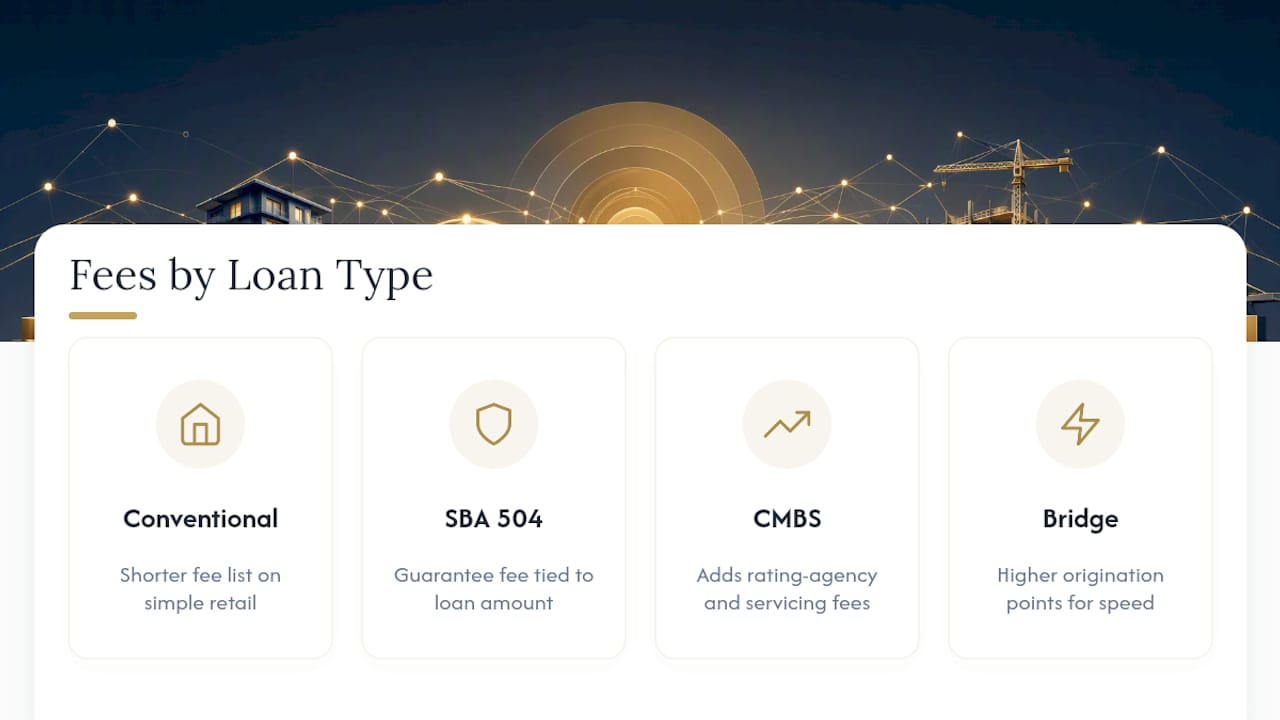
Closing costs on a commercial deal typically run higher than residential transactions, and they scale with loan size and complexity rather than sitting at a flat percentage. Expect to budget for the appraisal ($2,500 to $10,000 depending on property type and complexity), the Phase I environmental report (often $2,000 to $5,000), title insurance and endorsements (which vary by state and loan amount), survey costs, legal fees for both borrower and lender counsel, and the lender’s own origination or commitment fee.
SBA loans add a guarantee fee tied to the loan amount, and CMBS loans typically layer on rating agency and servicing fees that a bank loan would not carry. Bridge loans often carry higher origination points in exchange for speed and looser underwriting, which is the trade-off sponsors are usually making when they choose that track deliberately.
None of these costs are fixed across the industry, and quotes vary by lender, region, and asset class. What is consistent is the pattern: the more parties involved in reviewing your file, the more line items show up on the settlement statement. A conventional bank loan on a straightforward retail asset will have a shorter fee list than an SBA 504 loan on a mixed-use property with tenant improvements and multiple layers of review. Budgeting on the high end of these ranges and being pleasantly surprised beats being caught short two weeks before funding.
Why Document Readiness Determines Your Closing Date More Than Anything Else
The single biggest lever a borrower controls is the completeness of the loan package at submission. A sponsor who shows up with three years of clean financials, a matching rent roll, entity documents already assembled, and a coherent narrative around the deal’s business plan will move through underwriting noticeably faster than one who submits piecemeal and answers lender questions in installments.
The failure mode here is subtle. It’s rarely one catastrophic missing document that stalls a file. It’s usually a string of small inconsistencies, a P&L that doesn’t match the tax return, a rent roll that’s six weeks stale, an entity structure that doesn’t match the signature page, that each trigger a separate round of lender questions. Every round adds days, and rounds compound.
Preparedness also shows up in how a sponsor handles third-party report timing. Borrowers who order the appraisal and Phase I the day a term sheet is signed, rather than waiting for full PSA execution, routinely shave two to three weeks off their overall timeline simply because they got in the scheduling queue earlier, leveraging fast financing document workflows to speed the process. That single habit, treating vendor scheduling as the true hard constraint rather than lender review time, separates borrowers who close on schedule from those who don’t.
How Property Type and Loan Size Change the Timeline
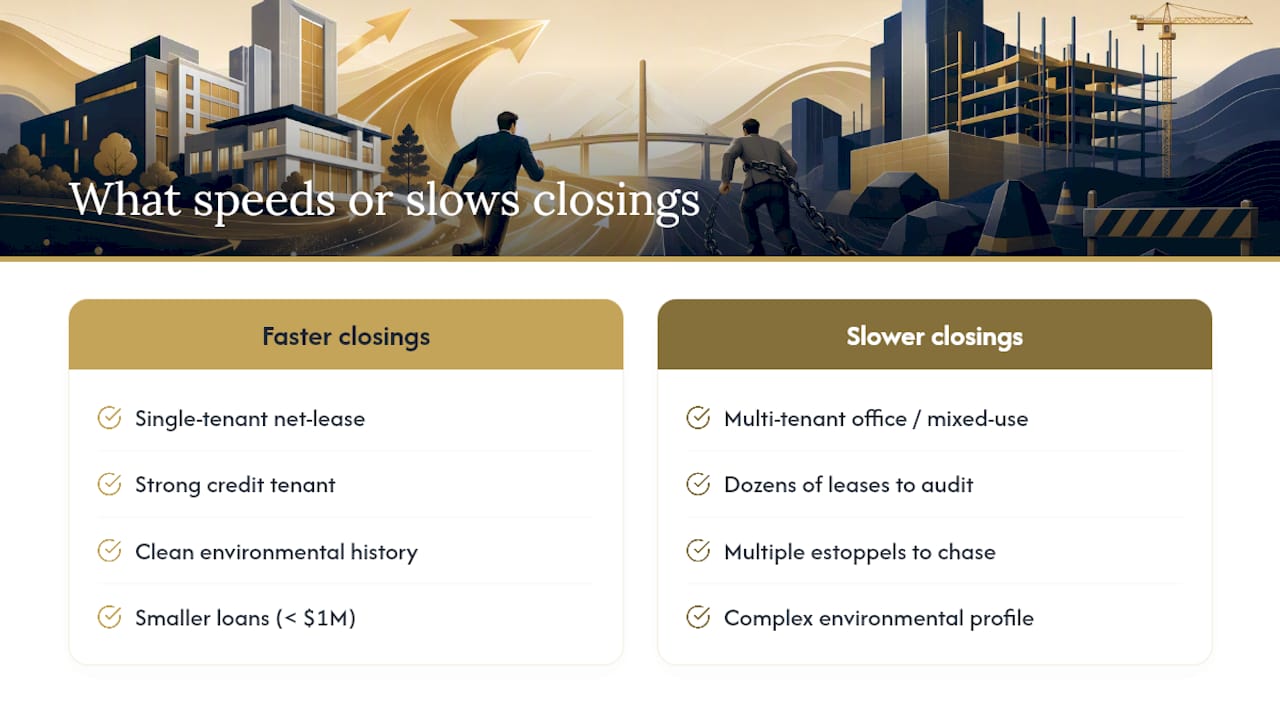
Property type and loan size both move the needle, sometimes more than the loan product itself. A single-tenant net-lease property with a strong credit tenant and a clean environmental history can close faster than the general ranges above suggest, because there’s less to underwrite. A multi-tenant office or mixed-use asset with a dozen leases to audit, several estoppels to chase down, and a more complex environmental profile will push toward the longer end of every range, and sometimes past it.
Loan size cuts both ways. Smaller loans, particularly those under $1 million, sometimes move faster because they qualify for streamlined underwriting programs at community banks or credit unions. Larger loans, especially anything requiring syndication among multiple lenders or a complex capital stack with preferred equity or mezzanine debt layered in, add negotiation time simply because more parties need to agree on structure before anyone can finalize terms.
Special-purpose properties, hotels, self-storage with unusual zoning, or industrial sites with a history of prior use, tend to draw more scrutiny on the environmental side and sometimes require a Phase II, which can add weeks that a standard retail or multifamily deal would never encounter. If you’re financing something outside the conventional asset classes, build extra time into your PSA financing contingency rather than assuming the standard range applies.
Why Timeline Discipline Beats Optimism in This Market
The conventional advice on closing timelines tends to treat every deal like the fastest one the author ever closed. That’s the wrong benchmark. The more useful frame is this: your timeline is set by the slowest necessary task, not the average one, and in most commercial deals that slow task is a third-party report sitting in a vendor’s queue, not a lender dragging its feet.
What gets underrated is how much control a sponsor actually has over the front end of the process. Ordering reports the day a term sheet is signed, rather than waiting for a fully negotiated PSA, is a free 10 to 20 days on most deals. What gets overrated is loan product selection as a fix for a bad process. Choosing a bridge loan for speed only helps if the sponsor also submits a clean package. A disorganized borrower will find a way to slow down even the fastest loan track available.
If you take one thing from this guide, prioritize document consistency before you prioritize lender selection. A perfectly matched, complete file moving through a slower loan process will often beat a messy file moving through a fast one.
— Jerry
Get to Closing Faster With an Advisor Who Runs the Timeline for You
Brookmont Capital Ventures exists for exactly the friction points this guide covers: incomplete packages, slow lender matching, and third-party reports that get ordered too late to matter. Instead of assembling your loan application, chasing appraisers, and negotiating conditions precedent on your own, Brookmont’s deal packaging and underwriting support builds an investment-grade file before it ever reaches a lender’s desk, and its national lender relationships mean faster matching to a track suited to your timeline, whether that’s a bridge loan for a fast acquisition or a structured capital stack advisory engagement for something more complex.
Before reaching out, have your last two to three years of financials, a current rent roll, entity formation documents, and a basic narrative on the deal’s business plan ready. That alone eliminates most of the back-and-forth that stalls a file in underwriting. From there, an advisory firm can help identify the right lender, structure the request, and manage the third-party coordination that otherwise eats weeks off your calendar. Explore the full range of financing solutions or reach out directly through Brookmont’s debt placement page to start the conversation on your specific deal.
Sources
- Commercial loan closing process — Fortra Law
- Commercial Real Estate Loan Close Time: 30–75 Days | Axiant
- How to reduce closing delays in complex commercial transactions — First American
- Commercial real estate closing checklist — Serif
FAQ
How Long Does a Commercial Loan Take to Close?
Most financed commercial loans close in 45 to 90 days from a signed purchase agreement, with conventional bank loans on the faster end at 30 to 60 days and SBA or CMBS loans often running 60 to 120 days. Bridge loans can close in as little as two to four weeks when the sponsor and asset are already vetted.
How Long Does It Take to Close a Commercial Real Estate Deal?
The full deal, from letter of intent through funding, typically spans several months once you add the LOI and PSA negotiation periods to the financing timeline. Due diligence alone, covering title, survey, environmental, and lease review, usually runs 30 to 60 days and often overlaps with the financing process rather than following it.
What Is the 2% Rule in Commercial Real Estate?
The 2% rule is a quick screening test some investors use to gauge whether a rental property’s monthly income looks strong relative to its purchase price, aiming for monthly rent equal to roughly 2% of the price. It’s a rough filter for initial deal screening, not an underwriting standard, and most lenders rely on debt service coverage ratio and loan-to-value analysis instead.
What Is the 3 Day Rule for Closing?
Definitions of a “3 day rule” vary by context and most commonly refer to residential mortgage disclosure requirements under TRID rather than commercial lending, so it does not apply the same way to a commercial closing. In commercial deals, the equivalent concept is the final closing window, typically 1 to 3 weeks, during which the settlement statement is finalized and funds are wired.
What’s the Single Biggest Factor in Closing on Time?
Document readiness at application beats every other variable, including loan product choice. Borrowers who submit a complete, internally consistent package and order third-party reports immediately after signing a term sheet routinely close weeks faster than those who submit piecemeal, according to First American’s analysis of closing delays.