How Lenders Evaluate Sponsor Guarantees Before Closing

Lenders judge a sponsor guarantee on three things: whether the guarantor can actually fund it, whether the guarantee is legally enforceable, and whether the trigger structure is objective enough to avoid a fight. A guarantee that scores well on funding capacity but sits in a fund entity with governance restrictions is worth less than the number on its cap page. The same is true in reverse: a fully authorized guarantor with no real liquidity behind it doesn’t move the needle at underwriting.
Before you draft anything, know what a credit committee is going to check:
- Liquidity and uncalled capital the guarantor can actually access within the loan term
- Legal authority of the signing entity, confirmed against fund or corporate governing documents
- Cap integrity, including whether “all amounts” language quietly swallows the cap
- Trigger clarity, objective financial or event-based tests rather than vague discretion
- Payment mechanics and timing, especially whether funds go direct to the lender
Lenders assess sponsor guarantees against three core criteria: guarantor liquidity, an enforceable funding pathway, and the entity’s legal authority to issue the guarantee. Sponsors who prepare audited financials and fund documents before the term sheet stage consistently move faster through diligence.
Key Takeaways
Lenders value a sponsor guarantee based on the guarantor’s funding capacity, the entity’s legal authority to sign, and how objectively the guarantee’s triggers and caps are structured.
| Point | Details |
|---|---|
| Capacity comes first | Lenders check liquidity, uncalled capital, and audited financials, not personal credit. |
| Authority determines enforceability | Confirm the signing entity has actual power under fund or corporate governing documents. |
| Cap language hides risk | “All amounts” clauses can make a capped guarantee effectively uncapped if not reconciled. |
| Objective triggers reduce disputes | Measurable tests like DSCR breaches beat subjective “material adverse change” language. |
| Preparation shortens diligence | Brookmont Capital Ventures packages guarantor diligence materials to speed lender acceptance. |
Table of Contents
- What A Sponsor Guarantee Is And Who Signs It
- Common Guarantee Types And What Each Protects
- The Three Criteria That Drive Lender Underwriting
- How Lenders Verify Guarantor Creditworthiness
- Drafting And Negotiation Points That Decide The Outcome
- Enforceability And The Defenses Guarantors Actually Raise
- Sponsor Guarantees, Equity Cures, And Capital Calls
- A Practical Checklist For Sponsors Preparing A Guarantee
- If The Guarantee Gets Called: What Enforcement Looks Like
- How Brookmont Capital Ventures Helps Sponsors Prepare Guarantees
- Sources
- FAQ
What A Sponsor Guarantee Is And Who Signs It
A sponsor guarantee is a contractual promise, separate from the loan itself, that a sponsor entity will backstop a specified obligation if the borrower fails to perform. Lenders use it for credit enhancement, to relieve a covenant breach, or to support a project through a workout without foreclosing.
The signing entity matters more than most first-time sponsors expect. It’s rarely the sponsor’s personal balance sheet. More often it’s the fund vehicle, an equity aggregator, or a holding entity that actually controls the capital. Sponsors avoid personal guarantees when they can, both for liability reasons and because fund constitutive documents frequently limit or prohibit guarantees issued directly from the fund. When governance restricts a direct guarantee, deal teams sometimes structure a back-to-back or secondary guaranty through a permitted entity instead, which adds a layer lenders will want fully documented.
Common Guarantee Types And What Each Protects
Not every guarantee protects the lender the same way, and the type dictates how much credit value underwriters assign it. A Practical Law toolkit that counsel routinely cites when drafting these instruments breaks the landscape into a handful of recurring forms:
- Full recourse guaranty: covers the entire loan balance, the strongest form from a lender’s perspective
- Nonrecourse carveout guaranty (“bad boy” guaranty): limited to specific triggering acts like fraud, waste, or unauthorized transfers
- Payment guaranty: guarantees a defined payment obligation, often used alongside a capital stack that already has other credit support
- Completion guaranty: common in construction financing, covering cost overruns and lien-free completion
- Environmental indemnity: shifts environmental liability exposure to the guarantor
- Capital call agreement: obligates a fund to call capital from limited partners to satisfy a shortfall
Lenders generally favor payment guaranties or full recourse structures over bare equity commitments because a payment guaranty creates a direct, immediate obligation rather than a promise contingent on fund mechanics working as intended. Completion guaranties matter enormously in construction financing, where cost overruns are the most common source of default before a project ever reaches stabilization.
The Three Criteria That Drive Lender Underwriting
Every credit committee runs a sponsor guarantee through the same lens, even when the deal terms vary widely. Capacity comes first. Underwriters want to see liquidity that isn’t already pledged elsewhere, uncalled capital commitments that can actually be drawn, and a fund structure that isn’t already leveraged past the point of meaningful support. Increasingly, lenders require corporate guarantors to submit annual audited financial statements rather than treating a guarantee as a one-time credit check, because a guarantor’s balance sheet can change materially over a five- or seven-year loan term.
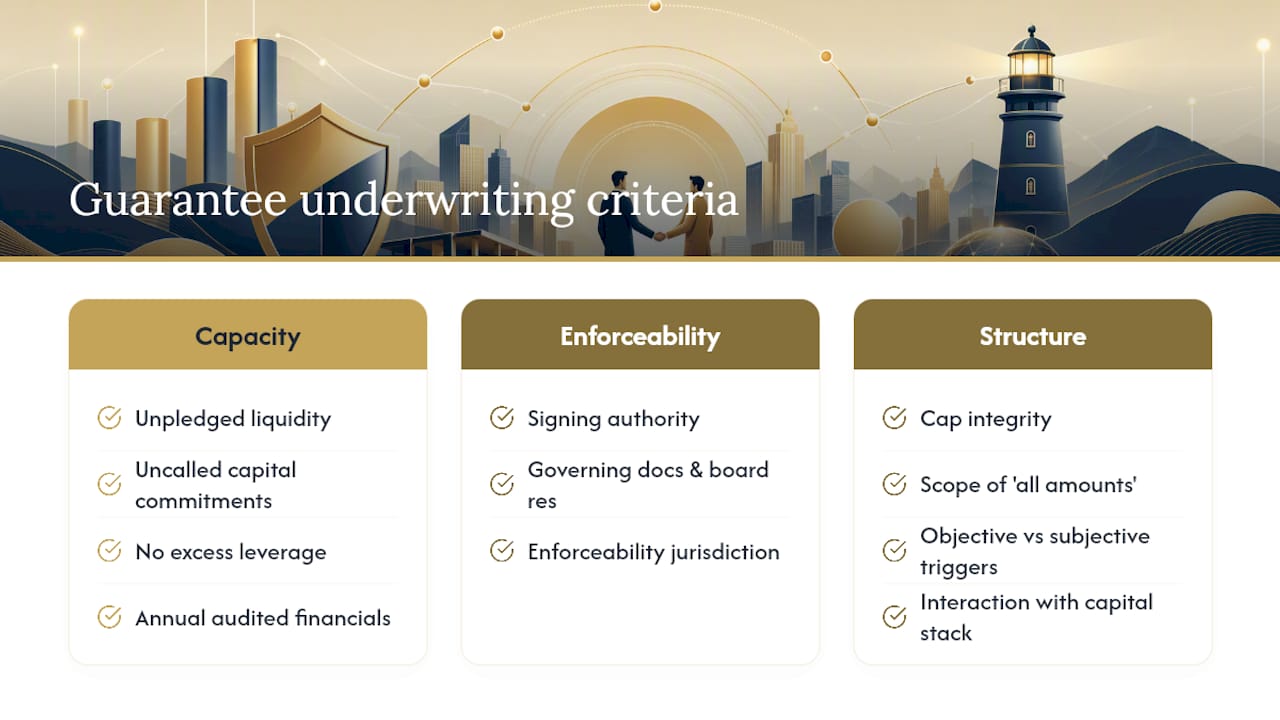
Enforceability and authority come second, and this is where deals stall more often than sponsors expect. A guarantee signed by someone without corporate power to bind the entity is close to worthless, no matter how strong the balance sheet looks. Lenders confirm this against governing documents, board resolutions, and, for cross-border sponsors, the jurisdiction where enforcement would actually happen.
Structure is the third leg, and it’s the one sponsors underestimate most. This covers cap integrity, the scope of “all amounts” language, whether triggers are objective (a missed DSCR test, a bankruptcy filing) or subjective (lender discretion), and how the guarantee interacts with other credit protections already in the capital stack.
Pro Tip: Ask your lender’s counsel for the exact defined term used for “Guaranteed Obligations” before you negotiate the cap number. A cap of $5 million means nothing if unpaid interest, default rate charges, and enforcement costs sit outside that defined term.
How Lenders Verify Guarantor Creditworthiness
Diligence on a sponsor guarantee looks a lot like a corporate credit review, not a personal credit pull. Expect the lender to request:
- Two to three years of audited financial statements for the guarantor entity
- Officer certificates confirming authority to execute the guaranty
- Evidence of uncalled limited partner commitments, including the mechanics for calling that capital
- Fund governing documents showing no prohibition on issuing guarantees
- Standard KYC/AML documentation for the guarantor entity and its principals
Beyond paper review, lenders run liquidity stress scenarios against the guarantor’s stated capacity, confirm capital call mechanics with the fund’s administrator or trustee, and often require quarterly or annual recertification that the guarantee remains in force and unimpaired. This is consistent with how lenders assess sponsors in multifamily syndications, where ongoing certification matters as much as the initial underwrite.
A few red flags routinely reduce how much credit value a lender assigns to a guarantee: concentration limits that cap how much a fund can commit to any single guarantee, preemptive rights held by other lenders or investors, and fund documents silent on guarantee authority altogether. Any one of these can turn a seemingly strong guarantee into a document a lender treats as, at best, a soft comfort letter.
Drafting And Negotiation Points That Decide The Outcome
Initial guaranty drafts almost always come from lender counsel, and they’re written to favor the lender. Guarantors who wait to bring in their own counsel typically accept broad waiver language and pro-lender terms that are difficult to scale back once a term sheet is signed. Getting counsel involved at term sheet stage, not at closing, is the single highest-leverage move a sponsor can make.
The real negotiation happens across a handful of specific levers:
- Cap level and definition. Push for a defined cap that explicitly states what it includes and excludes, particularly default interest, legal fees, and enforcement costs.
- Trigger objectivity. Replace subjective “material adverse change” language with measurable tests, a DSCR threshold, a specific covenant breach, a bankruptcy filing.
- Timing of payments. Negotiate reasonable notice periods and cure windows before a demand becomes payable.
- Carveouts and scope. Narrow “bad boy” carveouts to acts genuinely within the sponsor’s control, not general market or operational risk.
- Officer certificate cadence. Agree on a realistic recertification schedule (annual, not quarterly, in most stabilized deals) to avoid administrative drag.
Sponsors negotiating in a distressed or workout context should pay particular attention to reconciling the cap with “all amounts” language, since a capped guarantee can effectively become uncapped if ancillary obligations sit outside the defined term.
Pro Tip: Insert a reinstatement clause that ties reinstatement to a specific triggering event, not lender discretion. Otherwise a “cured” guarantee can be revived at the lender’s option long after you thought the exposure had closed.
Enforceability And The Defenses Guarantors Actually Raise
Courts scrutinize guaranties more closely than most commercial contracts, largely because guarantors are secondary parties who didn’t receive the loan proceeds directly. That scrutiny opens the door to a recurring set of defenses:
- Lack of authority or capacity to execute the guaranty on behalf of the entity
- Statute of frauds challenges when the guaranty wasn’t properly documented in writing
- Inadequate consideration, particularly in guarantees added after the original loan closed
- Material changes to loan terms made without the guarantor’s consent
- Bankruptcy-related challenges, including fraudulent transfer claims against the guaranty itself
Practice commentary consistently recommends explicit waiver language and precise drafting specifically because these defenses are common enough that vague contract language invites litigation rather than deterring it. Clear waivers of suretyship defenses, explicit consent to future modifications, and precise authority representations all reduce the odds a guarantee gets challenged successfully.
Pro Tip: If your guarantee has been amended more than once, get a fresh reaffirmation signed each time. Stale reaffirmations are one of the most common gaps lenders’ litigation counsel exploits during enforcement.
Sponsor Guarantees, Equity Cures, And Capital Calls
A sponsor guarantee doesn’t operate in isolation from the rest of the fund’s remedies. Many loan agreements allow a sponsor contribution to count as an equity cure for a covenant breach, but only if the guarantee document and the fund’s capital call mechanics are drafted to align with that treatment.
- Immediate cash paydowns satisfy lenders fastest and carry the least negotiation friction.
- Staggered, capital-call-backed guarantees are acceptable to most lenders, but only when notice periods, call mechanics, and cap reconciliation are spelled out in advance.
- Lenders generally prefer immediate infusions but will accept capital-call structures when the funding pathway survives scrutiny.
- Preemptive rights held by other fund investors can slow a capital call and should be flagged during negotiation, not discovered during enforcement.
Negotiating the form of consideration matters too: a lender that will accept a promissory note as an interim measure while a capital call processes is treating the guarantee very differently than one that insists on cash only.
A Practical Checklist For Sponsors Preparing A Guarantee
Sponsors who move fastest through lender diligence tend to do the same handful of things before the term sheet is even signed.
Pre-diligence essentials:
- Confirm the guarantor entity has actual authority under its governing documents
- Assemble audited financials and evidence of uncalled capital commitments
- Pre-clear the guarantee against any fund-level restrictions or side letters
Negotiation priorities:
- Fight for a defensible, clearly defined cap
- Insist on objective triggers over subjective “material adverse change” language
- Require direct payment mechanics to the lender where enforcement risk is real
- Cap enforcement expense exposure rather than leaving it open-ended
Pro Tip: Assign one person, not a committee, to own guaranty governance after closing. Quarterly drift on certifications and consent tracking is exactly how a clean guarantee turns into a dispute two years later.
Deal teams that treat a guarantee as a closing formality rather than a live obligation almost always regret it during a workout. The sponsors who fare best are the ones who assign an owner, calendar the certification dates, and revisit the cap language before it ever becomes a problem.
Sponsors preparing for this stage often benefit from dedicated support in structuring the underlying financial model and lender presentation well ahead of term sheet negotiations.
If The Guarantee Gets Called: What Enforcement Looks Like
Enforcement typically follows a sequence: notice of default, a formal demand letter, then payment, either direct to the lender or routed through the borrower depending on how the guaranty was drafted. In distressed situations, lenders increasingly require payment directly to themselves rather than through the borrower, which avoids the funds getting tangled in a borrower bankruptcy estate.
- Notice and cure periods can add weeks before a demand becomes payable
- Litigation or a borrower bankruptcy filing can extend timing well beyond the guaranty’s own terms
- Direct-payment language, if not enforceable in the guarantor’s jurisdiction, can undo the entire benefit of that structure
A guarantee is best understood as time-and-friction-adjusted credit support, not a guaranteed same-day recovery. Sponsors should have liquidity pre-approved and ready, not assume a demand letter triggers instant funding.
How advisors prepare sponsors for guaranty negotiations
Getting a guarantee through underwriting cleanly starts well before the term sheet stage. That means confirming early whether the fund’s governing documents actually permit the guarantee, involving counsel before lender-drafted language sets the tone, and having diligence materials, audited financials, capital call schedules, officer certificates, assembled before the lender asks. One recurring negotiation lever worth flagging: reconciling the cap definition against “all amounts” language so a $5 million cap doesn’t quietly become $6.5 million once fees and default interest are added back in. Post-closing, someone specific needs to own guaranty governance, tracking certifications, consents, and sunset dates, rather than leaving it to whoever remembers.
How Brookmont Capital Ventures Helps Sponsors Prepare Guarantees
Getting a sponsor guarantee through underwriting without unnecessary concessions takes preparation most sponsors don’t have bandwidth to build alone. Brookmont Capital Ventures packages the diligence materials lenders actually request, audited financials, capital call evidence, entity authority documentation, and matches sponsors with institutional lenders and debt funds whose guarantee standards fit the deal.

Sponsors who come to the table with clean documentation and a defensible cap structure typically move through lender diligence faster and negotiate from a stronger position, with fewer surprises if the guarantee is ever called. If you’re structuring a guarantee for an upcoming financing, explore Brookmont’s capital stack and advisory services to get your diligence package and negotiation position ready before you’re sitting across from lender counsel.
Sources
- Sponsor guarantees (Dechert OnPoint)
- Negotiating sponsor support on distressed deals (Vedder Price)
- Sponsor capital infusions in distressed portfolio companies (Sidley)
- Guaranties in commercial real estate loans toolkit (Practical Law/Westlaw)
These are the sources lenders and counsel most commonly rely on when drafting or challenging a guaranty.
This article is general information, not a substitute for advice from a qualified financial advisor. Consult a qualified financial professional about your own circumstances before acting on anything here.
FAQ
What are the three main things lenders look at in a guarantee?
Lenders focus on the guarantor’s funding capacity (liquidity and uncalled capital), the entity’s legal authority to sign, and the objectivity of the guarantee’s triggers and caps.
What factors do lenders evaluate when reviewing a sponsor’s financing application?
Beyond the guarantee itself, lenders review audited financials, uncalled capital commitments, fund governing documents, the sponsor’s track record, and the guarantor’s overall liquidity position relative to loan size.
Does signing a personal guarantee affect your credit score?
A personal guarantee itself doesn’t directly appear on a credit report, but if the guarantee is called and the debt goes to collections or judgment, that outcome can damage the guarantor’s personal credit significantly.
Is a sponsor the same as a guarantor?
Not always. A sponsor is the deal’s lead investor or developer, while the guarantor is often a separate fund or holding entity the sponsor controls, which is why lenders always confirm which entity actually signs the guaranty.
How do lenders judge a sponsor’s experience and track record?
Lenders review the sponsor’s history with similar asset types and deal sizes, prior loan performance, and often require feasibility studies that demonstrate management capability on the specific project type.
Recommended
- How Lenders Assess Multifamily Syndications in 2026 | Brookmont Capital Ventures
- Construction Lender Underwriting Criteria: 2026 Guide | Brookmont Capital Ventures
- How to Get Your CRE Deal Funded in 2026: What Lenders Actually Want to See | Brookmont Capital
- Why Lenders Require Feasibility Studies: A Developer’s Guide | Brookmont Capital Ventures