Why Lenders Require Feasibility Studies: A Developer’s Guide

Lenders require feasibility studies because they need independent, defensible proof that a project can generate sufficient cash flow to service debt under conservative scenarios. This is not procedural paperwork. It is the mechanism by which a credit committee, an examiner, or a program guarantor like the SBA or USDA can verify that a loan decision rests on documented market evidence rather than a sponsor’s projections. The debt service coverage ratio (DSCR) must hold not just in the best case, but also when revenue falls below forecast or costs exceed estimates. A credible feasibility study is what demonstrates that.
Three things drive the requirement:
- Risk mitigation: An independent third-party study shifts reliance from the borrower’s promises to documented market evidence, giving the lender a defensible basis for approval.
- Underwriting evidence: Credit committees and regulators expect documented support for every material assumption, particularly demand projections, absorption timelines, and cost completeness.
- Stress-tested repayment proof: Banks expect sensitivity analysis showing the impact of revenue shortfalls and cost overruns, with explicit DSCR calculations under each scenario.
Brookmontcapital works with developers and sponsors at the point where feasibility scope meets lender expectations, helping align study deliverables with what credit committees actually need before a submission goes in.
Table of Contents
- Why lenders see feasibility studies as a core underwriting obligation
- The five analytical pillars lenders expect in a bank-grade feasibility study
- When does a lender actually require a feasibility study?
- What underwriters actually look for when reviewing a feasibility study
- Who prepares lender-grade feasibility studies and what independence means
- What a lender-grade feasibility study typically costs and how long it takes
- How a feasibility study shapes loan approval, pricing, and deal structure
- A practical checklist to prepare your feasibility study submission
- How Brookmontcapital has seen feasibility work change committee outcomes
- Key Takeaways
- The feasibility study is not the obstacle — the gap between your study and the lender’s questions is
- Brookmontcapital helps you get feasibility-ready before the lender asks
- Authoritative sources and further reading
Why lenders see feasibility studies as a core underwriting obligation
Lenders are not asking for feasibility studies because they distrust you personally. They are operating under fiduciary obligations to credit committees, bank examiners, and, in guaranteed programs, federal agencies. Every loan approval requires a documented rationale, and that rationale must survive scrutiny from people who were not in the room when the deal was pitched.
An independent feasibility study creates an auditable paper trail that the lender can present to risk committees or examiners as evidence of due diligence. The loan officer who champions your deal needs to hand the credit committee something they can defend, not just a sponsor’s pro forma. A third-party study accomplishes that by separating the analysis from the borrower’s financial interest in the outcome.
The specific underwriting questions a feasibility study must answer include: Is there real demand for this product at the proposed price point? Is the absorption timeline realistic given current market conditions? Are the construction costs complete and contingency-adequate? And critically, does the projected DSCR hold when you stress revenue down and costs up simultaneously?
A well-structured feasibility study reduces time in underwriting because it pre-answers the questions a credit committee will ask. When those answers are absent, the committee sends the file back — and every round-trip costs the borrower weeks.
Studies that answer these questions clearly also influence loan conditions directly. A strong downside scenario with a DSCR that still clears the lender’s threshold may reduce required reserves or ease disbursement controls. A study that reveals material uncertainty tends to produce the opposite: tighter covenants, higher contingency holdbacks, and additional guaranty requirements.
Pro Tip: Frame the feasibility study around the lender’s credit memo, not your investment thesis. The first question a credit officer asks is “what happens to DSCR if lease-up takes six months longer than projected?” Build that answer into the study’s executive summary.
The five analytical pillars lenders expect in a bank-grade feasibility study
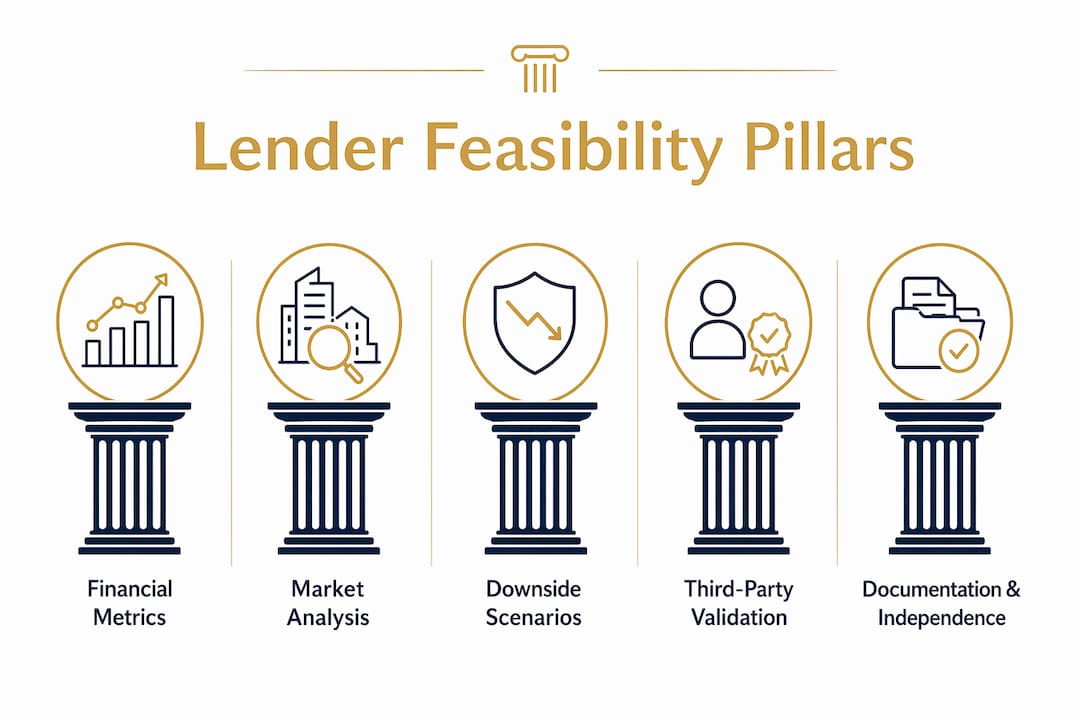
A bank-grade feasibility study confirms that a project meets its objectives while maintaining a viable DSCR under conservative assumptions. That confirmation requires five distinct analytical pillars, each of which drives specific underwriting metrics.
- Technical: Site conditions, buildability, infrastructure adequacy, and construction schedule. Lenders use this to assess timeline risk and cost completeness.
- Financial: DSCR calculations, cash flow projections, NPV/IRR analysis, and debt service schedules. This is the pillar credit committees scrutinize most closely.
- Market: Demand analysis, competitive supply, absorption rates, and pricing benchmarks tied to local comparables. Weak market analysis is the most common reason studies fail underwriting review.
- Operational: Management capacity, staffing plan, logistics, and ongoing maintenance obligations. Relevant for hotels, medical facilities, and other operationally intensive asset types.
- Legal/regulatory: Permits, zoning, environmental clearances, and program-specific compliance for SBA, USDA, or other guaranteed loans.
Multi-scenario modeling is not optional. Lenders expect at minimum an optimistic case, a base case, and a downside case. Every assumption in each scenario must be traceable to a named source, a local comparable, or a documented benchmark. The chain of evidence is what separates underwriting intelligence from advocacy.
| Analytical Pillar | Primary Underwriting Metric Driven |
|---|---|
| Financial + Market | DSCR under base and stress scenarios |
| Technical + Legal | Timeline risk, cost completeness, permit exposure |
| Operational | Stabilized NOI reliability, management risk |
| Legal/Regulatory | Program compliance, guaranty eligibility |

Consider two brief scenario examples. A ground-up multifamily project in a secondary market projects high occupancy at stabilization. The base-case DSCR clears the lender’s required threshold. Under the downside scenario, occupancy declines for the initial period due to slower absorption, and DSCR falls below the lender’s covenant threshold. That gap triggers a required operating reserve. In a second example, a hotel conversion project models ADR at market peak; the downside scenario applies a reduction in ADR and reveals negative DSCR during a portion of the loan term, which forces a restructure of the interest reserve before the loan can close.
When does a lender actually require a feasibility study?
Not every loan triggers the requirement. Lenders calibrate the ask based on uncertainty, capital intensity, program rules, and their own familiarity with the asset class.
Common triggers include:
- Ground-up construction, particularly in secondary or tertiary markets where absorption data is thin
- New business ventures or first-time sponsors with limited track records in the asset class
- High capital intensity relative to stabilized value (loan-to-cost above typical lender thresholds)
- Special-use or complex assets: hotels, medical facilities, senior housing, adaptive reuse projects
- SBA and USDA guaranteed loans, where historical performance is insufficient to underwrite risk independently
- CMBS or institutional debt where third-party due diligence is standard practice
- Loan sizes that exceed a lender’s internal approval threshold without committee sign-off
Program-driven requirements deserve particular attention. USDA Rural Development programs, including the Business and Industry Guaranteed Loan program, specify mandatory components and documentation thresholds that studies must address. The SBA similarly expects independent analysis for loans where the business lacks operating history. These are not discretionary asks; they are conditions of program participation.
Two use cases illustrate how the threshold works in practice:
- Ground-up multifamily in a secondary market: The lender has limited local comp data, the sponsor has one prior development, and the loan-to-cost is 72%. All three factors independently would prompt a feasibility request; together, they make it non-negotiable.
- Adaptive reuse with uncertain absorption: A former industrial building converting to creative office space in a mid-sized city. Demand for the product type is unproven locally, and the lender cannot benchmark absorption without a market study. The feasibility study becomes the primary source of underwriting data for the market pillar.
For multifamily syndications specifically, lender expectations around third-party market analysis have tightened as cap rate compression has unwound and debt service has become the binding constraint.
What underwriters actually look for when reviewing a feasibility study
Underwriters are not reading for optimism. They are reading for defensibility. The chain of evidence linking assumptions to local comparables is what turns a study from advocacy into underwriting intelligence. A study that reads like a pitch deck will be sent back regardless of how attractive the projections look.
Acceptance criteria underwriters apply:
- Author independence: no material financial interest in the project’s approval
- Traceable benchmarks: every revenue and cost assumption cites a source, a comparable, or a documented methodology
- Locally relevant comparables: market data drawn from the subject market, not a national average
- Month-by-month ramp for year one: lease-up or revenue build modeled at the unit level, not as a straight-line assumption
- Explicit DSCR schedules under base and downside scenarios
- Contingency allowances that reflect actual project complexity
- Conservative revenue assumptions, not market-peak projections
- Sensitivity tests covering at minimum revenue down 10–20% and costs up 10–20%
Most failed submissions fail because they are not defensible, not merely because they are pessimistic. An optimistic study with a traceable audit trail will survive more scrutiny than a conservative study built on unsourced assumptions.
Common red flags that cause rejection:
- Advocacy-style language that reads as marketing rather than analysis
- Missing downside scenarios or sensitivity tables
- Untraceable market data (national averages substituted for local comparables)
- Incomplete cost schedules with no soft-cost breakdown or contingency line
- Weak liquidity or working capital plan for the lease-up period
For program-specific loans, the bar is higher. USDA Appendix A under 7 CFR Part 5001 specifies the components a feasibility study must address for Rural Development guaranteed loans. SBA lenders have their own documentation expectations for loans where the borrower lacks operating history. Confirm the current program requirements directly with the relevant agency or an approved lender before commissioning a study.
Who prepares lender-grade feasibility studies and what independence means
The preparer’s independence is not a formality. It is a substantive underwriting criterion. A study authored by the developer, the developer’s in-house team, or any party with a financial interest in the loan approval will not satisfy most lenders’ independence requirements, regardless of its analytical quality.
Credible preparer types include:
- Third-party market and feasibility consultants with documented methodology and no project equity interest
- Independent engineering or technical firms for the site and buildability components
- Financial modelers with demonstrated lender-side experience, particularly for DSCR and cash flow schedules
- Specialized program-compliance firms for USDA, SBA, or EB-5 studies where regulatory documentation requirements are prescriptive
Lenders expect the preparer to document their methodology, disclose their data sources, and confirm in writing that they have no material financial interest in the project. For USDA Rural Development programs, program rules specify independence and documentation requirements explicitly. SBA-approved lenders apply similar standards for loans where independent analysis is required as a condition of the guarantee.
When evaluating a consultant, ask for examples of studies that have passed underwriting at a named lender type (bank, USDA, SBA), ask for their methodology documentation, and confirm they will provide a traceable data appendix. A consultant who cannot answer those questions clearly is unlikely to produce work that survives a credit committee review.
Pro Tip: Engage the feasibility consultant before you finalize your pro forma assumptions. Consultants who are brought in after the sponsor’s numbers are set often end up reverse-engineering justifications rather than conducting independent analysis, which is exactly what underwriters are trained to detect.
What a lender-grade feasibility study typically costs and how long it takes
Cost and timeline vary significantly by scope, complexity, required field work, and program compliance requirements. Basic screening studies generally represent lower-cost options, while complex investor-grade or program-compliant studies may require substantially higher budgets.
| Study Type | Typical Cost Range | Typical Delivery Timeline |
|---|---|---|
| Basic market screening | $5,000+ | few weeks |
| Standard lender-grade study | varies by scope | several weeks |
| Full program-compliant study (USDA/SBA) | can exceed $100,000–$150,000 | multiple weeks |
| Complex mixed-use or institutional-grade | up to $150,000+ | extended timelines |
What accelerates delivery:
- Organized sponsor documentation package (site plans, construction budget, operating history, comp data)
- Clear scope agreed with the lender before the consultant is engaged
- Prior comparable data available in the subject market
- No required field work beyond desktop research
What slows delivery:
- Missing or incomplete permits and entitlements
- Weak sponsor-provided data requiring the consultant to source independently
- Required site visits or primary market research in thin-data markets
- Program-specific documentation requirements that add review cycles
Commissioning a study after the lender asks for one adds weeks to your timeline. Sponsors who engage a consultant during pre-application, aligned to the lender’s specific requirements, consistently close faster than those who treat the study as a reactive deliverable.
How a feasibility study shapes loan approval, pricing, and deal structure
A credible feasibility study does more than satisfy a checklist. It directly influences the terms you receive. Credit committees use the study’s findings to calibrate loan size, pricing, reserve requirements, and disbursement controls, and the quality of the analysis determines how much negotiating room you have.
Ways a strong study improves outcomes:
- Faster credit committee decisions when the study pre-answers the committee’s standard questions
- Tighter covenant negotiation when the downside scenario shows limited DSCR variance
- Reduced operating or interest reserves when the study demonstrates conservative absorption assumptions
- Stronger case for a higher loan-to-cost when market demand is well-documented
Ways a weak or unfavorable study introduces harsher conditions:
- Additional personal or corporate guaranty requirements when the downside scenario shows DSCR breach risk
- Higher interest rate spread to compensate for unquantified risk
- Larger contingency holdbacks during construction when cost completeness is in question
- Phased disbursement controls tied to leasing or occupancy milestones
Studies also shape amortization structure and holdback mechanics. A lender who sees a credible 18-month lease-up model with a month-by-month DSCR ramp may structure a 24-month interest-only period with a conversion trigger tied to occupancy. Without that model, the lender defaults to more conservative structural protections. For construction financing, the feasibility study is often the primary document that determines whether disbursement is milestone-based or draw-based.
- Study reveals structural weakness: A hotel project’s downside scenario shows DSCR of 0.92x in year two. The lender requires a 12-month debt service reserve and a completion guaranty, adding $800,000 in required equity.
- Study strengthens the case: A multifamily project’s downside scenario holds DSCR at 1.22x even at 80% occupancy. The lender reduces the required operating reserve from six months to three, freeing $400,000 in sponsor capital.
A practical checklist to prepare your feasibility study submission
The quality of your source documents determines both the cost of the study and its defensibility under underwriting review. Consultants who receive complete, organized packages produce better work faster. Those who spend the first two weeks chasing basic data from the sponsor produce studies that reflect that friction.
- Site plans and specifications: Current survey, architectural drawings, and any geotechnical or environmental reports already completed.
- Detailed construction budget: Hard costs by trade, soft costs itemized (architecture, engineering, permits, financing costs), and a contingency line with basis stated.
- Historical operating data: If the property has any operating history, provide at minimum three years of actual income and expense statements.
- Market comparables: Rent comps, sale comps, and occupancy data for the subject market, organized by asset class and vintage.
- Purchase or ground lease documentation: Executed contract or term sheet, with any contingencies noted.
- Management resumes: Principals and proposed property management firm, with relevant track record documentation.
- Proposed rent or pricing schedule: Unit-by-unit or suite-by-suite with basis for each assumption stated.
- Pro forma assumptions: Your working model, including revenue ramp, expense load, and debt service assumptions, even if the consultant will rebuild it independently.
- Contingency and working capital sources: Documentation of how cost overruns and lease-up shortfalls will be funded.
- Entitlements and permit status: Current zoning, any variances required, and status of pending approvals.
Pro Tip: Organize your submission package by underwriting question, not by document type. A lender’s credit memo follows a predictable structure: market, demand, cost, cash flow, management, and risk. Package your documents in that order and label them accordingly. Consultants and underwriters will move faster, and you will look like a sponsor who understands the process.
Common construction financing mistakes often trace back to incomplete cost schedules and missing contingency documentation, both of which a well-organized submission package addresses before the study begins.
How Brookmontcapital has seen feasibility work change committee outcomes
Across the capital markets advisory work Brookmontcapital conducts for developers and sponsors, the most consistent pattern is this: the studies that move through credit committees quickly are the ones that were scoped to the lender’s credit memo from the start, not the ones that were most optimistic.
The most common weakness encountered in market practice is not pessimistic assumptions. It is the absence of a defensible audit trail. A study that projects $2.4 million in stabilized NOI but cannot trace that figure to specific lease comps, a documented absorption timeline, and a named expense benchmark will stall in underwriting regardless of how reasonable the number looks. Underwriters are trained to ask “where does this come from?” and a study that cannot answer that question at the line-item level is treated as advocacy.
The studies that close deals are not the most optimistic ones. They are the ones where every assumption has a source, every scenario has a DSCR output, and the downside case still shows a credible path to repayment.
A few patterns from advisory practice illustrate the range of outcomes. In one engagement, a sponsor submitted a feasibility study for a mixed-use ground-up project that had been prepared by the developer’s own financial team. The lender’s credit committee rejected it on independence grounds before reviewing the analysis. Engaging an independent consultant and resubmitting with a traceable methodology added three weeks but resulted in approval with no additional reserve requirement. In another case, a USDA Business and Industry loan application stalled because the feasibility study did not address the program-specific components required under the applicable regulatory framework. Aligning the study scope to those requirements before resubmission resolved the issue.
Practical alignment points Brookmontcapital recommends for every feasibility engagement:
- Confirm the lender’s specific DSCR threshold and covenant structure before the consultant begins modeling
- Request the lender’s credit memo template or underwriting checklist if available
- Build the downside scenario around the lender’s stated stress parameters, not the consultant’s default assumptions
- Treat the DSCR calculation as the study’s organizing metric, not a concluding output
Key Takeaways
Lenders require feasibility studies because independent, traceable evidence of DSCR under stress is the only basis on which a credit committee can defensibly approve a loan.
| Point | Details |
|---|---|
| Independence is non-negotiable | Studies authored by the sponsor or financially interested parties will not satisfy most lenders’ underwriting requirements. |
| DSCR under stress is the central metric | Every pillar of the study ultimately feeds into whether debt service holds under a downside scenario. |
| Cost ranges from $5,000 to $150,000+ | Basic screening studies start around $5,000, while complex investor-grade or program-compliant studies can exceed $100,000–$150,000, depending on scope and requirements. |
| Prepare documents before engaging a consultant | Organized sponsor packages reduce study cost, delivery time, and the risk of untraceable assumptions. |
| Brookmontcapital aligns study scope to lender needs | Engaging Brookmontcapital early helps sponsors structure feasibility work that matches credit committee expectations and reduces rework. |
The feasibility study is not the obstacle — the gap between your study and the lender’s questions is
The developers who treat feasibility studies as a box to check tend to produce work that stalls in underwriting. The ones who treat the study as a pre-answer to the credit committee’s questions tend to close faster and on better terms. That distinction is not subtle once you have seen both outcomes play out.
What most sponsors underestimate is how much the study’s structure matters relative to its conclusions. A study that concludes “the project is feasible” but buries the DSCR calculation on page 34 with no sensitivity table will not move a credit committee. A study that opens with a clear DSCR schedule, a downside scenario, and a traceable market comp section gives the loan officer exactly what they need to write the credit memo. The analysis is the same; the presentation determines whether the committee approves it in one meeting or three.
The other underappreciated dynamic is that a well-scoped feasibility study often improves the deal structure before the lender sees it. Sponsors who commission studies early frequently discover that their absorption assumptions are aggressive, their contingency is thin, or their management plan has gaps. Correcting those issues before submission is far less costly than having the lender impose structural protections in response to them.
Brookmontcapital helps you get feasibility-ready before the lender asks
Sponsors who engage Brookmontcapital before submitting a feasibility study to a lender arrive at the credit committee with work that is already aligned to underwriting expectations, not work that needs to be revised after the first review cycle.
Brookmontcapital’s capital markets advisory practice covers the full scope of what developers need at this stage: financial modeling built to lender-grade DSCR standards, construction financing placement across banks, debt funds, and institutional lenders, and capital stack advisory that connects feasibility findings to the right financing structure. For sponsors working through DSCR-sensitive deals, the firm’s DSCR loan solutions are structured around the same metrics your feasibility study must demonstrate. The practical advantage of engaging early is straightforward: when the study scope is set to match the lender’s credit memo, rework is rare and approval timelines compress. Contact Brookmontcapital to schedule a scoping conversation before your feasibility study begins.
Authoritative sources and further reading
- U.S. Small Business Administration — Loans: Primary source for SBA loan program eligibility, guarantee terms, and lender requirements.
- USDA Rural Development — Business and Industry Guaranteed Loan: Program rules and documentation requirements for USDA B&I guaranteed loans.
- 7 CFR Part 5001 — USDA OneRD Guarantee Loan: Regulatory text governing USDA guaranteed loan programs, including Appendix A feasibility study requirements.
- OGScapital — When Do Banks Require a Feasibility Study?: Practical overview of lender triggers and the independence rationale for third-party studies.
- Wert-Berater — Understanding Bank Underwriting Feasibility Studies: Detailed explanation of what underwriters look for and why traceability determines credibility.
- SimpleFeasibility — Why Banks Require Feasibility Studies: Covers DSCR expectations, sensitivity testing requirements, and common loan types that trigger the requirement.
- Bristola — How Much Does a Feasibility Study Cost?: U.S. cost range guidance from basic screening to full program-compliant studies.
- Investopedia — Feasibility Study: Accessible reference on study structure, benefits, and when sponsors should commission one.
- Institute of Project Management — What Is a Feasibility Study?: Governance context for feasibility work as a stage-gate decision tool in project development.
Recommended
- Predevelopment Costs and Lender Requirements: 2026 Guide | Brookmont Capital Ventures
- How Lenders Underwrite Mixed Use Projects: A Developer’s Guide | Brookmont Capital Ventures
- Construction Lender Underwriting Criteria: 2026 Guide | Brookmont Capital Ventures
- Development Financing Sources Checklist for Developers | Brookmont Capital Ventures