
Pre-Underwrite Debt Yield and Lease Risk for CMBS Sponsors
CMBS loans fund stabilized, income-producing properties that clear specific underwriting thresholds, primarily loan-to-value, debt service coverage ratio, and debt yield, and they demand special purpose entity ownership, funded reserves, and a thick stack of third-party diligence. Deals typically start around $2 million, though most conduit loans land between $5 million and $50 million. If your asset is still leasing up or your capital plan assumes future changes, a bridge or agency loan is the better fit. An experienced advisor can help you figure out which path actually applies before you waste weeks on an application that a CMBS underwriter will reject outright.
TL;DR:
- CMBS loans typically require properties with stable, predictable cash flow and assets in core classes like multifamily, office, retail, industrial, and hospitality.
- The main underwriting thresholds include a loan-to-value of roughly 65% to 75%, a debt service coverage ratio of at least 1.25x, and a debt yield near 8.5% to 10%.
- Property size generally starts at $2 million with most deals between $5 million and $50 million, while larger, complex assets often go through SASB channels.
- Borrowers must establish a strict SPE ownership structure, fund reserves, and pass extensive third-party due diligence, including appraisals, environmental, and property condition reports.
- An experienced advisor is essential to prepare your deal properly, stress-test your numbers, and ensure key issues like lease rollover and debt yield are addressed before submitting a formal application.
Table of Contents
- CMBS Loan Requirements Commercial Property Investors Need to Know First
- Underwriting Metrics: LTV, DSCR, and Debt Yield
- Which Property Types and Loan Sizes Qualify
- SPE Ownership, Non-Recourse Structure, and Reserve Requirements
- Documentation and Due Diligence Checklist
- Underwriting Timeline: From Term Sheet to Securitization
- Defeasance, Assumability, and the Cost of Rigidity
- What Brookmont Capital Ventures Recommends Before You Apply
- Why the CMBS Checklist Matters More Than the Pitch
- Get Your Deal CMBS-Ready Before You Apply
- Sources
- FAQ
CMBS Loan Requirements Commercial Property Investors Need to Know First
Before you touch an application, understand that CMBS underwriting is property-first, not sponsor-first. Lenders care less about your track record than about whether the asset itself throws off enough cash to service the debt under stress. That single fact drives every requirement that follows: the loan-to-value ceiling, the debt service coverage floor, and the debt yield backstop all exist to protect the bond investors who eventually buy pieces of your loan once it’s pooled into a securitization.
That structure is also why CMBS underwriting feels rigid compared to a bank relationship loan. Once your deal is packaged and sold, nobody at the special servicer knew you before closing, and nobody is inclined to make exceptions after. The requirements below aren’t negotiating positions. They’re the floor.
Underwriting Metrics: LTV, DSCR, and Debt Yield
Three numbers determine how much a conduit lender will actually put on your property, and they rarely agree with each other cleanly.
Loan-to-value typically tops out in the mid-60s to mid-70s percent range for conduit loans, though JPMorgan notes that actual advance rates often land lower once DSCR and debt yield constraints kick in. Debt service coverage ratio usually needs to clear roughly 1.25x on a stressed basis, meaning the underwriter recalculates your net operating income using in-place rents, market vacancy assumptions, and full reserve funding rather than the seller’s pro forma. Recent conduit vintages have run well above that floor, with weighted-average DSCR figures from JPMorgan’s market data sitting comfortably higher than the 1.25x minimum, a sign that lenders are pricing in more cushion than the stated thresholds suggest.
Debt yield, calculated as net operating income divided by loan amount, commonly needs to meet a threshold near 8.5% to 10% depending on property type [JPMorgan]. Debt yield exists because LTV can be gamed by an aggressive appraisal and DSCR can be gamed by a low interest rate. Debt yield ignores both. It’s a raw cash-on-loan-dollar test, and underwriters increasingly use it to cap proceeds independent of what the other two ratios suggest.
- LTV: typically 65% to 75% for conduit, sometimes higher for SASB
- DSCR: floor near 1.25x on stressed cash flow
- Debt yield: roughly 8.5% to 10%, varying by property type and market
Statistic to know: Through July 2026, private-label CMBS issuance reached $76.2 billion, with single-asset single-borrower (SASB) deals representing roughly 76% of that volume by loan balance, a shift that concentrates risk in fewer, larger transactions and changes how lenders price conduit deals competing for smaller allocations.
Run the math on a $2 million net operating income property. At a 9% debt yield floor, your maximum loan caps near $22.2 million regardless of appraised value. Sponsors who only model LTV walk into underwriting with the wrong number.
Which Property Types and Loan Sizes Qualify
Conduit CMBS pools loans from multiple property types into a single securitization, which means eligibility skews toward asset classes with predictable, comparable cash flow.
- Multifamily, office, industrial, retail, and hospitality are the core conduit food groups, alongside self-storage and mixed-use assets with a clear dominant use.
- Single-asset single-borrower (SASB) deals handle larger, more complex, or trophy-quality properties, often office towers, data centers, or major hotel portfolios that don’t fit neatly into a pooled conduit deal.
- Minimum loan size typically starts near $2 million, with the bulk of conduit activity in the $5 million to $50 million range; SASB deals run substantially larger.
- Construction and heavy value-add deals are out of scope. Lease-up risk, unfinished capital plans, and unstabilized cash flow don’t fit a securitization structure that can’t underwrite a future business plan.
- Owner-occupied and special-purpose properties (think churches, schools, or single-tenant industrial built for one operator) rarely qualify because there’s no independent income stream if that tenant leaves.
If your property is still stabilizing, a bridge loan makes more sense as an interim step before refinancing into CMBS once occupancy and rents settle.
SPE Ownership, Non-Recourse Structure, and Reserve Requirements
Every CMBS loan is made to a special purpose entity, a bankruptcy-remote borrower structure designed to isolate the property from your other assets and liabilities. This isn’t boilerplate. Lenders and rating agencies scrutinize your organizational documents for “separateness covenants,” provisions requiring the SPE to maintain its own books, avoid commingling funds, and often include an independent director whose consent is needed for a bankruptcy filing.
Violating these covenants can flip an otherwise non-recourse loan into full recourse against you personally. Legal analysis of CMBS underwriting confirms that standard non-recourse carve-outs, covering fraud, waste, environmental liability, and unauthorized transfers, remain the sponsor’s real exposure even in a “non-recourse” loan.
Expect these standing requirements at closing:
- Tax and insurance escrows, funded monthly
- Capital expenditure and replacement reserves
- Tenant improvement and leasing commission reserves for properties with near-term rollover
- Hard or springing cash management, where rents flow through a lender-controlled account
Pro Tip: Have your attorney review your SPE formation documents against current rating agency criteria before you submit, not after the underwriter flags a defect. A single missing independent-director provision can delay closing by weeks.
Two servicing roles matter after closing: the master servicer handles routine payment processing, and the special servicer takes over only if the loan defaults or needs a modification. That handoff, and the limited flexibility borrowers face once a loan is securitized, is worth understanding before you sign, not after you’re in distress.
Documentation and Due Diligence Checklist
CMBS due diligence is extensive because the loan will eventually be disclosed to bond investors under SEC Regulation AB II, which requires standardized loan-level reporting, and Dodd-Frank’s credit risk retention rules, which require the loan sponsor to retain a stake in the securitization. That regulatory backdrop is why nothing gets waived.
- Appraisal, ordered by the lender, establishing “as-is” value under conservative cap rate assumptions
- Phase I environmental site assessment, with a Phase II triggered if the Phase I flags contamination risk
- Property condition or engineering report, cataloging deferred maintenance and remaining useful life of major systems
- ALTA survey and title commitment, confirming boundaries, easements, and lien priority
- Rent roll and lease abstracts for every material tenant, cross-checked against actual collections
Beyond the third-party reports, underwriters want tenant financials for anchor occupants, historical operating statements going back three years, your organizational chart showing the SPE structure, and proof of sponsor net worth and liquidity, generally requiring both to exceed the loan amount.
- Undercollateralized appraisals that come in below the purchase price
- Environmental qualifiers requiring costly remediation escrows
- Heavy lease rollover in the next 24 months with no renewal history
Any one of these can shave millions off your final loan proceeds. A commercial property systems inspection checklist is a useful reference for the kind of building-systems detail engineers will flag in a property condition report, particularly on older assets where plumbing and mechanical age drive reserve requirements.
Underwriting Timeline: From Term Sheet to Securitization
Most CMBS loans close in 60 to 90 days from application to funding, though the timeline stretches when third-party reports surface issues or when rate volatility disrupts the securitization calendar.
- Pre-submission screening. The lender reviews a summary package and issues an indicative term sheet with preliminary pricing and proceeds.
- Acceptance and deposit. You sign the term sheet and post a good-faith deposit, typically covering third-party report costs.
- Report ordering. Appraisal, environmental, engineering, and survey firms get engaged simultaneously to compress the timeline.
- Underwriting and commitment. The lender finalizes NOI adjustments, stress tests, and issues a formal commitment letter with final terms.
- Closing and pooling. The loan closes, then gets aggregated with others into a securitization pool.
Because your loan won’t sit on the lender’s balance sheet indefinitely, timing against the securitization window matters. If interest rates move materially between your closing and the pool’s actual securitization, the lender may require supplemental pricing conditions. An experienced adviser who tracks the securitization calendar can time your submission to reduce that repricing risk, which is exactly the kind of coordination that separates a smooth close from a scramble.
Defeasance, Assumability, and the Cost of Rigidity
CMBS loans are built for buy-and-hold investors, not sponsors planning a quick flip. Early payoff typically requires defeasance, where you post a bond portfolio replicating the loan’s remaining payment stream, or yield maintenance, a prepayment penalty calculated against the interest rate differential.
- Both mechanisms are generally more expensive than a bank loan’s step-down prepayment penalty
- Assumability lets a buyer take over your loan rather than you paying it off, useful when rates have risen since closing and the existing debt is now below market
- Assumption requires lender and rating agency approval, plus fees, but can preserve value in a rate environment where refinancing would cost more
Statistic to know: SASB transactions now represent roughly 76% of 2026 issuance by loan balance, a concentration that means fewer, larger deals are absorbing more market risk, and pricing on smaller conduit loans can swing with investor appetite for that handful of jumbo transactions. If your hold period is uncertain, understand exactly how CMBS assumption works before you sign, because it’s often your only realistic exit before maturity.
What Brookmont Capital Ventures Recommends Before You Apply
Most CMBS applications that stall do so for the same reasons: an appraisal that doesn’t support the requested proceeds, a lease with rollover risk nobody flagged, or a sponsor liquidity position that looked fine until the underwriter asked for bank statements.
- Stress-test your own NOI before the lender does, using the same vacancy and reserve assumptions an underwriter would apply
- Resolve lease abstract discrepancies and rent concessions before submission, not during due diligence
- Confirm sponsor net worth and liquidity actually meet or exceed the loan amount on paper
- Order your Phase I environmental and property condition reports early so defects surface while there’s still time to address them
Pro Tip: Ask for the debt yield calculation in writing before you accept a term sheet. Some lenders quote LTV-driven proceeds up front and only reveal the lower debt-yield-capped number after you’ve paid for reports.
These deliverables should match what rating agencies expect to see, which is often a different standard than what a typical purchase-and-sale due diligence file contains.
Why the CMBS Checklist Matters More Than the Pitch
Most CMBS content online reads like a product brochure: attractive rates, non-recourse debt, long fixed terms. All true, and all beside the point if your deal doesn’t clear the numeric floors. The conventional advice tells you CMBS is “good for stabilized assets.” That’s not wrong, it’s just not useful, because it doesn’t tell you what stabilized actually means to an underwriter running a stressed DSCR calculation.
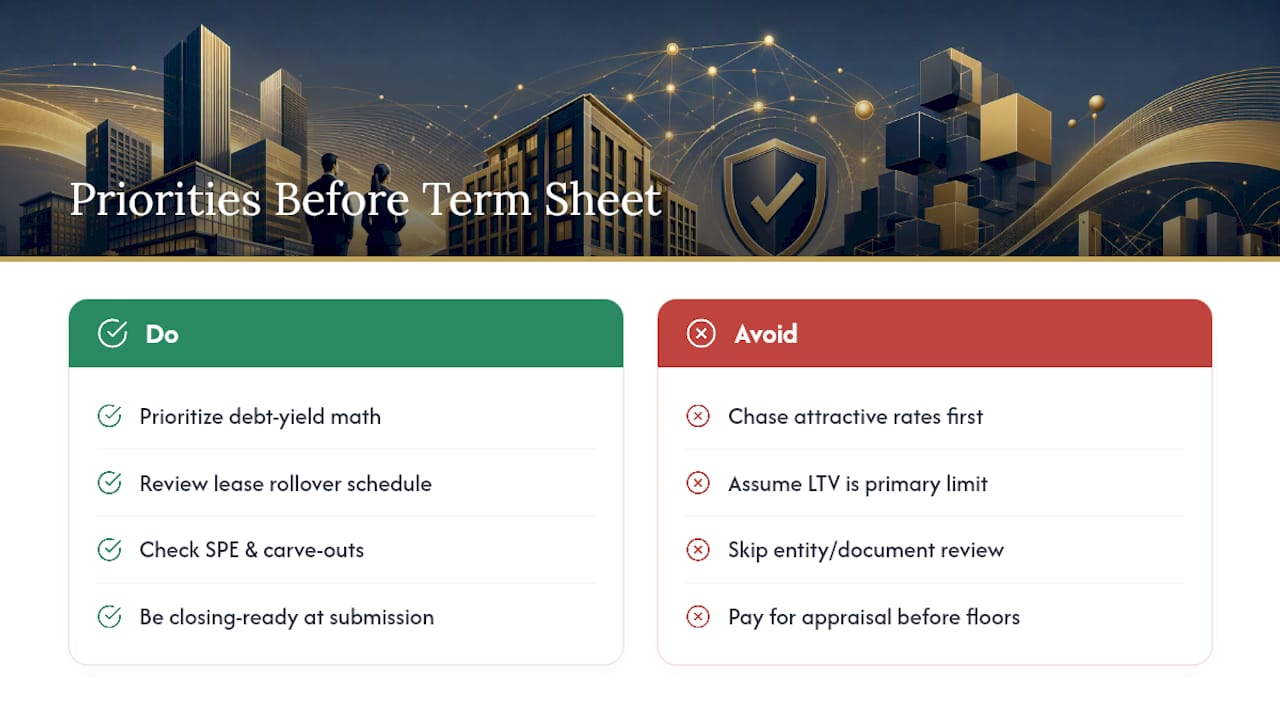
What the research here supports is blunter: debt yield, not LTV, is usually the real constraint on your proceeds, and most sponsors don’t find that out until they’ve already paid for an appraisal. The SPE and non-recourse carve-out language isn’t fine print either. It’s the mechanism that turns a clean non-recourse loan into a personal liability if your entity documents have a gap.
If you take one thing from this, prioritize the debt yield math and the lease rollover schedule before you touch a term sheet. Those two items kill more deals late in underwriting than pricing ever does. CMBS rewards sponsors who show up closing-ready. It punishes everyone else with delays, retrades, or a declined application.
— Jerry
Get Your Deal CMBS-Ready Before You Apply
Specialized advisors structure and source CMBS financing for sponsors who need proceeds sized correctly the first time, not after a lender’s underwriter finds the debt yield problem three weeks in.
Our team runs deals through the same stress tests conduit and SASB underwriters apply, checks lease files for rollover and concession issues before they become proceeds-killers, and packages sponsor financials the way rating agencies actually expect to see them. Direct work with institutional lenders and debt funds can help place CMBS loans for commercial real estate, and if your asset doesn’t fit conduit parameters, advisors can recommend bridge financing or another structure instead of wasting your time. If you’re weighing CMBS against other paths for a retail or NNN asset, our retail financing team can walk through what fits. Request a pre-underwriting review before ordering any third-party report, to find out whether your numbers actually clear the floor.
Sources
- Commercial mortgage-backed securities (CMBS) loans — JPMorgan
- How CMBS underwriting works: metrics, parties, and rules — LegalClarity
FAQ
What are the requirements for a CMBS loan?
A CMBS loan requires a stabilized income-producing property meeting LTV, DSCR, and debt yield thresholds, along with SPE ownership, non-recourse carve-outs, funded reserves, and extensive third-party due diligence.
What are the requirements for a commercial real estate loan generally?
Most commercial real estate loans, CMBS included, evaluate property cash flow, sponsor financial strength, loan-to-value, and debt service coverage, though bank loans allow more underwriting flexibility than securitized CMBS debt.
What are the five C’s of commercial lending?
The five C’s, character, capacity, capital, collateral, and conditions, are a traditional bank underwriting framework; CMBS underwriting overlaps mainly on capacity (cash flow) and collateral (the property itself), with less weight on borrower character than a relationship bank loan.
What are the requirements for a commercial loan?
Commercial loan requirements typically include a minimum DSCR, a maximum LTV, proof of sponsor liquidity and net worth, and property-level financial documentation, with CMBS adding SPE structuring and rating-agency-driven diligence on top.
How long does the CMBS loan application process take?
Most CMBS loans close in 60 to 90 days from application to funding, depending on how quickly third-party reports come back and whether the securitization calendar requires repricing.