
Can You Assume a CMBS Loan? Rules, Costs, and Timing

Yes, most CMBS loans can be assumed with servicer consent. It’s the right move when the in-place rate sits materially below current market and enough term remains to justify the costs. The commonly cited threshold is a spread of 250 basis points or more against current market rates, with at least three years remaining on the term. Below that, the assumption fees, legal costs, and reserve requirements often eat the benefit.
Three things to do immediately if you’re eyeing an assumable CMBS loan:
- Pull the loan documents and confirm assumption is permitted under the note and mortgage.
- Contact the master servicer to start the pre-application conversation before you sign a purchase contract.
- Build a net-value model comparing interest savings against total assumption costs.
Quick math: a $10 million loan with a 250 bps rate advantage and four years remaining can generate meaningful present-value savings, but only after you net out the assumption fee, legal costs, and any reserve top-ups the servicer demands.
Key Takeaways
CMBS loan assumption works best when the in-place rate sits 250 or more basis points below market with at least three years of term remaining, and closing it requires managing four separate approval parties on a 90 to 120 day timeline.
| Point | Details |
|---|---|
| Check the economic threshold first | Assumption creates value when the rate spread is 250+ bps below market with 3+ years remaining on the term. |
| Map the full approval chain | Master servicer, special servicer, rating agencies, and the CCR each review the deal, and any one can add conditions. |
| Budget realistic time and cost | Plan for 90 to 120 days and an assumption fee near 1% of the balance plus legal costs. |
| Watch for late-stage deal killers | Reserve top-ups, guarantor pushback, and late CCR conditions sink more deals than the initial underwriting. |
| Get advisory support early | Brookmont Capital Ventures models net value and manages servicer negotiation through CMBS advisory services from application to closing. |
Table of Contents
- What CMBS Loan Assumption Actually Allows You to Change
- Who Approves a CMBS Loan Transfer, and in What Order?
- How Long Does a CMBS Loan Assumption Take, and What Does It Cost?
- What Documents Do Servicers Require to Approve an Assumption?
- Why Do Some CMBS Assumptions Fall Apart Late?
- Building Your Assumption Checklist From LOI to Closing
- Turning Assumption Savings Into a Better Purchase Price
- How an Assumption Affects the Buyer and the Original Borrower
- Due Diligence: What to Inspect Before You Assume the Debt
- Does the Interest Rate Change When You Assume a CMBS Loan?
- Defeasance, Prepayment Locks, and Why Assumption Exists at All
- What Assumptions Mean for Bondholders and the CMBS Trust
- Practitioner Perspective From Brookmont: What We See in the Field
- How Brookmont Helps You Close a CMBS Loan Assumption
- Sources
- FAQ
What CMBS Loan Assumption Actually Allows You to Change
A CMBS loan assumption transfers the existing debt obligation to a new borrower under terms that stay largely fixed. You’re not renegotiating the loan. You’re stepping into it.
The Pooling and Servicing Agreement (PSA) governs the entire process. Every CMBS loan is pooled with hundreds of others and sold to bondholders as part of a securitized trust, and the PSA sets out exactly what the servicer can and can’t approve. That document is why CMBS assumptions feel more rigid than a bank loan transfer: the servicer isn’t negotiating on behalf of a single lender, but protecting a fixed pool of bondholders who bought a specific risk profile.
Non-recourse carve-outs typically survive the transfer intact. The new borrower and guarantor step into the same “bad-boy” carve-out exposure the original sponsor carried, covering fraud, waste, unauthorized transfers, and bankruptcy filings. Expect the servicer to require a fresh guarantor with net worth and liquidity comparable to the outgoing one.
What you generally cannot do:
- Change the interest rate, amortization schedule, or maturity date.
- Increase or decrease the loan balance.
- Modify prepayment or defeasance provisions built into the original note.
REMIC status, the tax structure that lets the trust pass income through to bondholders without entity-level tax, constrains servicers from approving anything that resembles a new loan. An assumption that changes economic terms too much risks triggering REMIC violations, so servicers default to preserving the deal exactly as structured.
Who Approves a CMBS Loan Transfer, and in What Order?
The approval chain is longer than a conventional loan assumption, and understanding the sequence keeps you from missing steps that add weeks to your timeline.
- Master servicer application. You submit a formal assumption application, along with the underwriting package covering the buyer, the property, and the proposed structure. The master servicer underwrites the request against PSA requirements.
- Special servicer involvement. If the loan is in default, on a watchlist, or the PSA requires it for certain transfer types, the special servicer takes over review. Special servicers typically respond within 10 to 15 business days of receiving a complete package, though incomplete submissions restart that clock.
- Rating agency confirmation. For larger loans or trusts where the PSA requires it, the servicer requests a no-downgrade confirmation from the rating agencies tied to the trust.
- Controlling Class Representative review. The CCR, representing the most subordinate bondholder class with a material economic stake, can weigh in and sometimes adds conditions late in the process.
The rating agency step deserves special attention because of 17g-5, an SEC rule that requires servicers to post assumption materials to a designated information provider rather than communicate with rating agencies directly. That procedural wall exists to prevent conflicts of interest, but it also means the servicer can’t just call the rating agency and get a quick answer. Everything runs through the posting process, which adds time you can’t shortcut.
Pro Tip: Ask the master servicer’s assumption desk, early, whether your loan falls under a watchlist or specially serviced status. If it does, budget extra weeks for special servicer review and expect more conservative reserve demands.
How Long Does a CMBS Loan Assumption Take, and What Does It Cost?
Most CMBS assumptions run 60 to 150 days from application to closing, with a standard scenario landing closer to 10 to 12 weeks. Build your acquisition timeline around 90 to 120 days rather than the optimistic low end, since rating agency posting and CCR review routinely extend a clean file.
Budget for these cost categories:
- Assumption fee: commonly around 1% of the outstanding loan balance, paid to the servicer for processing the transfer.
- Legal and opinion-letter costs: often $15,000 to $50,000 or more, driven higher when a new non-consolidation opinion is required.
- Application and processing fees: separate from the assumption fee, covering the servicer’s underwriting and third-party review costs.
- Reserve deposits: replenished or increased reserves for taxes, insurance, capital expenditures, and sometimes debt service, based on the servicer’s updated risk assessment.
A general range across loan types puts total assumption-related costs at 0.5% to 2.0% of the loan balance, though CMBS transactions tend to sit at the higher end because of the added legal and rating agency layers. Your net-value model has to offset the present value of interest savings against every one of these line items, plus the clearing bank setup costs that come with most CMBS cash management structures.
What Documents Do Servicers Require to Approve an Assumption?
CMBS servicers work from a standardized checklist, and submitting an incomplete package is the single most common reason applications stall.
At the sponsor level, expect to provide:
- Financial statements and tax returns for the buyer entity and all guarantors.
- An organizational chart showing full ownership structure down to the individuals.
- Certificates of good standing for every entity in the ownership chain.
- Guarantor net worth and liquidity schedules, often benchmarked against the outgoing guarantor’s figures.
- Background and credit checks on principals.
At the property level, the servicer wants:
- Current rent rolls and copies of all material leases.
- Updated debt service coverage ratio (DSCR) and loan-to-value (LTV) calculations based on current net operating income and a fresh appraisal.
- A current survey, title commitment, and evidence of insurance meeting the PSA’s coverage requirements.
- Environmental reports if the existing ones have aged out of the servicer’s acceptable window.
On the operational side, you’ll need to name a clearing bank for cash management, confirm the lockbox or cash management structure required under the loan documents, and submit a property management plan if the buyer is bringing in a new manager. Every one of these items feeds directly into the underwriting file that the master servicer, and potentially the special servicer, uses to decide whether your DSCR and LTV profile still fits the trust’s risk parameters.
Why Do Some CMBS Assumptions Fall Apart Late?
The deals that die usually don’t die on the big issues. They die on the details that surface after everyone assumed the file was clean.
Other recurring failure points include:
- Warm-body guarantor pushback, where the servicer rejects a proposed guarantor’s net worth or liquidity as insufficient relative to the original sponsor.
- Late CCR conditions, where the controlling class representative introduces new terms after the master servicer has already signed off.
- Foreign buyer and crowdfunded structure limits, since certain ownership structures raise flags that require extra documentation or outright rejection.
- Insurance, title, or tenant issues that surface during final diligence and force a scramble in the final weeks before closing.
Building Your Assumption Checklist From LOI to Closing
Sequencing matters more in a CMBS assumption than almost any other part of a commercial real estate deal.
- Start servicer outreach before you sign the purchase contract, if the seller allows it. This single step prevents more delays than anything else on this list, especially if you’re structuring a 1031 exchange, where the IRS’s 180 day replacement window can conflict directly with a 90 to 120 day assumption timeline.
- Assemble your team early: transaction counsel familiar with CMBS assumptions, an accountant to prepare guarantor financials, and a debt-advisory partner who has worked the servicer relationship before.
- Submit a complete package the first time. Partial submissions restart servicer review clocks and are the fastest way to blow past your target closing date.
- Negotiate contract language that protects you, including extension rights tied to servicer response times and clear allocation of who pays the assumption fee, legal costs, and reserve shortfalls.
- Stay proactive with the servicer throughout the review period, and keep your team ready to respond fast to rating agency information requests, since delays on your end compound delays on theirs.
Pro Tip: If your acquisition depends on a tight closing date, get the extension language into the contract before you need it. Servicers don’t move faster because your deadline is approaching.
Turning Assumption Savings Into a Better Purchase Price
The interest-rate spread that makes an assumption worthwhile is also your best negotiating lever. If the seller’s in-place loan carries a rate well below market, calculate what that spread is worth in present value and use it to justify a price adjustment, particularly when the alternative for the seller is defeasance or yield maintenance costs they’d rather avoid.
Push for the seller to cover the assumption fee, legal costs, or a portion of any reserve shortfall the servicer requires, especially when those costs stem from the seller’s original loan terms rather than anything you’re introducing. And set a minimum spread threshold before you start: if the rate advantage is thin and the operational constraints (fixed cash management, no prepayment flexibility) outweigh the savings, walk toward conventional acquisition financing instead.
How an Assumption Affects the Buyer and the Original Borrower
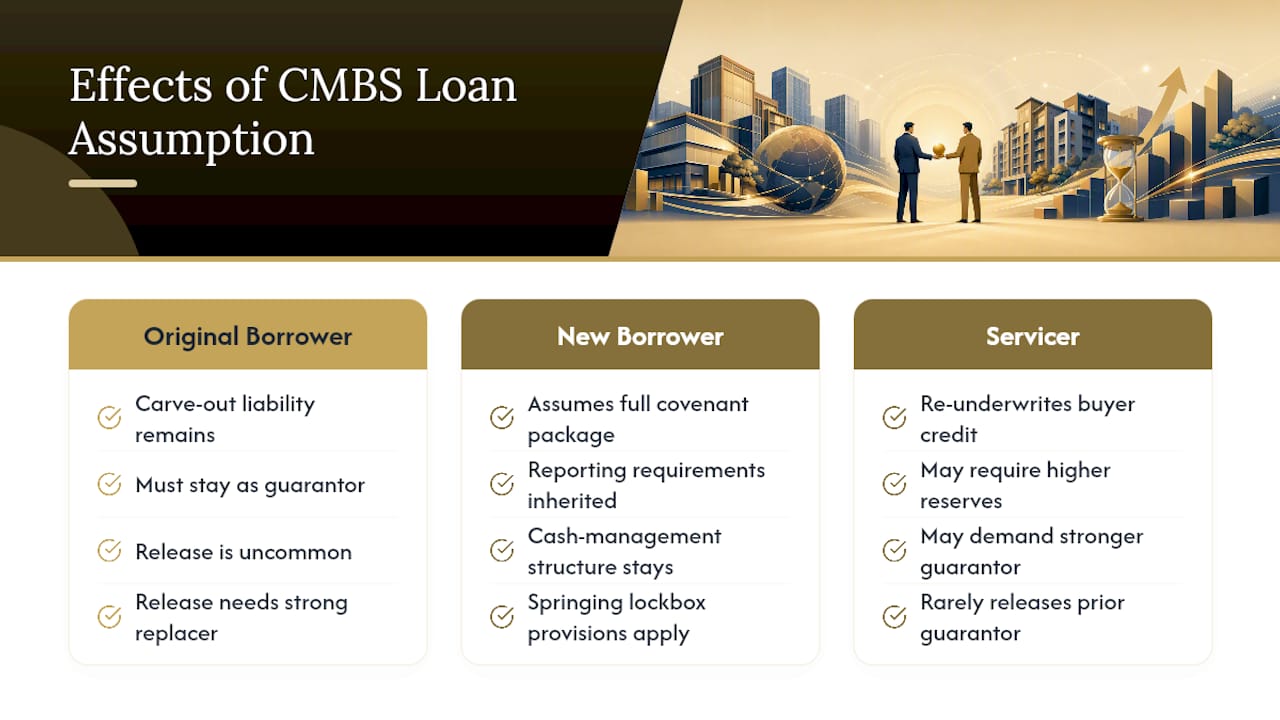
The original borrower’s exposure doesn’t end the moment the closing documents are signed. Most CMBS loan documents require the outgoing guarantor to remain on the hook for carve-out liability arising from acts committed before the transfer, even after a new guarantor steps in. Sellers frequently underestimate this and assume assumption equals a clean exit. It doesn’t, unless the servicer explicitly releases the prior guarantor, which is uncommon absent a strong replacement guarantor and a clean operating history.
For the new borrower, assumption means inheriting the loan’s full covenant package exactly as written, including the reporting requirements, the cash management structure, and any springing lockbox provisions tied to DSCR triggers. If the property’s performance has drifted since origination, whether improved or declined, the new borrower steps into whatever covenant thresholds the original loan set, not thresholds recalibrated to current performance.
This creates an asymmetry worth understanding before you sign a purchase contract. A buyer assuming a loan on a property that has significantly outperformed its underwritten projections benefits from covenant cushion the original borrower built through operational improvement. A buyer assuming a loan on a property that has underperformed inherits tighter covenant risk, sometimes close to trigger levels, without the benefit of a renegotiated cash flow test. Request trailing 12 month operating statements and covenant compliance history, not just the current rent roll, so you know which side of that line your target deal falls on.
The servicer, for its part, treats the new borrower’s creditworthiness as a fresh underwriting question, not a formality. A buyer with a thinner balance sheet than the outgoing sponsor should expect the servicer to compensate with higher reserves or a stronger guarantor requirement rather than simply approving the transfer as-is.
Due Diligence: What to Inspect Before You Assume the Debt
Property-level due diligence for a CMBS assumption goes further than a typical acquisition, because you’re not just buying real estate, you’re stepping into a securitized debt obligation with its own documentation trail.
Start with a full property condition assessment from a licensed engineer, comparing current conditions against whatever capital expenditure reserves the loan currently holds. If deferred maintenance has accumulated beyond what the reserve accounts for, that gap becomes your negotiating point with the seller, and potentially a red flag for the servicer’s updated LTV calculation.
Lease review deserves equal weight. Pull every material lease and check for:
- Upcoming lease expirations that could affect the DSCR calculation the servicer uses in underwriting.
- Co-tenancy or exclusivity clauses that might restrict future leasing flexibility.
- Estoppel certificates confirming tenant obligations match what’s represented in the rent roll.
- Any tenant default history or pending disputes not reflected in current financials.
Title and survey review matters more here than in a conventional purchase, since the servicer requires updated versions as part of the application, and any title exceptions that weren’t present at origination can trigger additional legal review. Confirm insurance coverage meets the PSA’s specific requirements, which are often stricter than standard commercial policy minimums, particularly around named windstorm or flood coverage depending on the property’s location.
Environmental reports round out the package. If the existing Phase I has aged beyond the servicer’s acceptable window, typically several years, budget for a new report, since an outdated environmental assessment is a common reason servicers request updated diligence mid-process.
Does the Interest Rate Change When You Assume a CMBS Loan?
No. The interest rate, amortization schedule, and maturity date stay exactly as written in the original note. This is the single biggest structural difference between a CMBS assumption and refinancing into new debt, and it’s also the entire reason assumptions create value when rates have risen since origination.
That said, a few terms can shift at the margin. Some CMBS loans include step-up provisions built into the original structure, typically tied to a specific date or a refinancing test rather than triggered by the assumption itself. If the loan you’re assuming has a scheduled rate step-up coming, that’s a fixed feature of the note, not something the servicer introduces because ownership changed. Review the note carefully for these provisions before finalizing your value model, since a step-up a year or two into your hold period can erode the savings that made the assumption attractive in the first place.
Servicers occasionally use the assumption process to tighten operational terms even when the rate itself can’t move. That can include increased reserve requirements, added cash management triggers, or updated DSCR covenant tests tied to the new borrower’s underwriting. None of these constitute a rate reset in the traditional sense, but they function as an economic adjustment layered on top of an otherwise unchanged interest rate. Treat any new servicer-imposed condition as part of your total cost of capital, not a minor administrative add-on.
Defeasance, Prepayment Locks, and Why Assumption Exists at All
Defeasance is the reason CMBS assumption exists as a practical option in the first place. Most CMBS loans prohibit standard prepayment for a lockout period, then require defeasance rather than a simple payoff for the remainder of the term. Defeasance means the borrower purchases a portfolio of government securities that replicates the loan’s remaining payment stream, substituting that collateral for the property in the trust. It’s effective, but it’s expensive, often costing more than the interest savings a seller would realize from paying off an above-market loan early.
That cost structure is exactly why assumption became standard practice in CMBS deals. Rather than forcing a seller into defeasance to close a sale, the loan documents allow the debt to transfer to the buyer instead, preserving the trust’s cash flow stream without triggering the securities-purchase mechanics of defeasance. Some loans permit assumption only after an initial lockout period expires, similar to defeasance windows, so check your specific note for when assumption becomes available relative to origination date.
Prepayment restrictions and defeasance provisions transfer with the loan on assumption. If you assume a loan with five years of defeasance-only prepayment remaining, you inherit that same restriction. This matters enormously for exit planning: if there’s a real chance you’ll want to sell or refinance before the defeasance window opens, assuming a loan with a long defeasance tail can trap you in the same way it constrained the seller, unless your hold period comfortably exceeds it.
What Assumptions Mean for Bondholders and the CMBS Trust
Every assumption decision runs through the lens of protecting the bondholders who own certificates backed by the loan pool, not the convenience of the buyer or seller. That’s the structural reality behind every seemingly bureaucratic step in the process.
The master servicer and special servicer owe contractual duties to the trust, and their incentives don’t always align cleanly with either transacting party. A servicer facing ambiguity in the PSA will generally interpret requirements conservatively, since erring toward stricter reserve requirements or a more demanding guarantor standard protects them from bondholder claims down the line. That conservative bias is precisely why buyers who assume a passive posture in negotiations tend to get the least favorable terms the servicer can justify.
The rating agencies get involved because a materially weaker borrower or a property with declining performance could justify a downgrade of the securities backed by that loan, which affects every bondholder in the trust, not just the tranche tied to your specific loan. That’s the entire logic behind the no-downgrade confirmation requirement.
The Controlling Class Representative’s involvement reflects a similar dynamic. As the party closest to absorbing losses if the loan underperforms, the CCR has genuine economic skin in the game and the contractual standing to weigh in, sometimes at a point in the process that feels late to everyone else at the table.
Practitioner Perspective From Brookmont: What We See in the Field
The friction point that trips up more buyers than anything else isn’t the paperwork. It’s timing arrogance. Sponsors routinely assume a CMBS assumption will move at the pace of a conventional loan transfer, then find themselves negotiating a 1031 exchange extension or a purchase contract amendment because the special servicer hasn’t finished review at day 60.

Brookmont Capital Ventures advises real estate developers, investors, and sponsors nationwide on CMBS structuring and placement, and the pattern we see most often is buyers who treat servicer communication as a formality rather than an active negotiation. The servicers that move fastest are responding to complete files and consistent follow-up, not to urgency alone.
We typically get involved at the underwriting stage, modeling net value against realistic reserve scenarios, then stay engaged through servicer negotiation, opinion letter coordination, and closing. That continuity matters because the conditions that kill deals tend to surface between application and closing, not at the outset.
— Jerry
How Brookmont Helps You Close a CMBS Loan Assumption
Getting a CMBS assumption across the finish line usually comes down to who’s managing the servicer relationship day to day, not just who filled out the application correctly. Brookmont Capital Ventures works directly with sponsors on the full arc of an assumption: building the net-value model before you commit to a purchase contract, preparing the underwriting package the master servicer expects on the first submission, and negotiating reserve requirements when a servicer’s LTV test comes back stricter than anticipated.
Our team coordinates the pieces that typically stall independent buyers, including opinion letter timing with transaction counsel, clearing bank setup, and guarantor qualification when the original sponsor’s balance sheet doesn’t transfer to the new buyer. We also help sponsors weigh assumption against alternative acquisition financing when the spread doesn’t justify the operational trade-offs.
If you’re evaluating a property with an assumable CMBS loan, or you’re already deep in a servicer application that’s stalled, visit our CMBS loan advisory page to request an assumption assessment and talk with a capital markets advisor about your specific timeline and structure.
Sources
FAQ
Can CMBS Loans Be Assumed?
Yes, most CMBS loans are assumable with master servicer approval, and often special servicer or rating agency involvement, though the specific loan documents and PSA govern the exact requirements.
Who Qualifies for a CMBS Loan Assumption?
Buyers need credit and financial strength comparable to the outgoing sponsor, a qualified guarantor, and a completed underwriting package covering the property’s current DSCR and LTV profile; servicers evaluate each application individually against the trust’s requirements.
What Are the Disadvantages of a CMBS Loan?
CMBS loans carry rigid non-recourse carve-outs, restrictive prepayment terms that typically require defeasance rather than a simple payoff, and a servicing structure that can slow down assumptions, modifications, or other borrower requests compared to a portfolio lender.
Are Any Mortgages Assumable Anymore?
Yes, beyond CMBS loans, certain government-backed mortgages like FHA and VA loans remain assumable under specific conditions, though most conventional commercial and residential loans today are not, making CMBS one of the more reliably assumable commercial debt structures on the market.
How Is a CMBS Assumption Different From a Traditional Commercial Mortgage Assumption?
A traditional bank loan assumption typically involves one lender making a discretionary credit decision, while a CMBS assumption runs through a servicer bound by the PSA, often adding rating agency review and CCR oversight that a bank loan simply doesn’t require.
Recommended
- CMBS Loans for Commercial Real Estate | Brookmont Capital
- Construction Lender Underwriting Criteria: 2026 Guide | Brookmont Capital Ventures
- Common Construction Financing Mistakes to Avoid in 2026 | Brookmont Capital Ventures
- How Construction Loan Sizing Works: 2026 Guide | Brookmont Capital Ventures