
How Construction Loan Sizing Works: 2026 Guide

How construction loan sizing works: LTC, LTV, and the binding constraint
Construction loan sizing is the process by which lenders determine the maximum loan amount a project can support, governed by two core metrics: loan-to-cost (LTC) and loan-to-value (LTV). The final loan amount is always the more conservative of the two. Lenders use both ratios because they protect against distinct risks: LTC limits cost overrun exposure, while LTV caps the lender’s downside if the completed property appraises below projections.
The key components feeding into loan sizing include total project cost (land, hard costs, soft costs, and contingency), the projected stabilized value of the completed asset, and the lender’s applicable ratio caps. Construction loans are also sized to stabilized debt yield, not in-place net operating income, because no income exists during the construction phase.
- LTC = Loan Amount ÷ Total Project Cost
- LTV = Loan Amount ÷ As-Completed Appraised Value
- The binding loan limit is whichever ratio produces the lower dollar amount
Table of Contents
- How LTC and LTV differ and why both constrain your loan
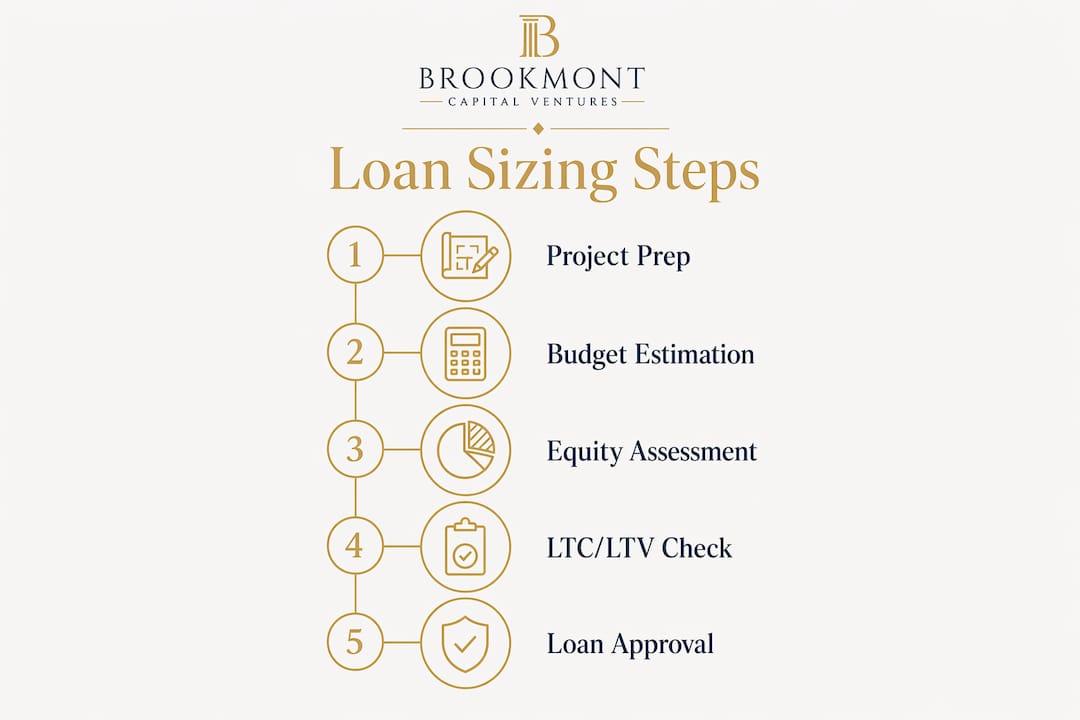
- The step-by-step construction loan sizing process in 2026
- Common pitfalls that derail construction loan sizing and management
- How Brookmontcapital helps developers size and structure construction loans
- Recent construction financing trends affecting loan sizing
- How your creditworthiness and financial strength affect loan sizing
- How contingency reserves affect your total loan amount
- Regulatory and underwriting limits in the US construction loan market
- How project type and location shape your maximum loan amount
- Typical LTC ratios across construction project phases
- Key Takeaways
- Brookmontcapital structures construction financing that lenders actually approve
How LTC and LTV differ and why both constrain your loan
LTC and LTV are complementary, not redundant. Each one guards against a different failure mode, and understanding which one will bind your deal is half the battle in structuring a viable capital stack.
LTC protects the lender against cost overruns by requiring the developer to maintain meaningful equity in the project. Private lenders cap LTC at a typical maximum range, ensuring the sponsor has real skin in the game. If a project’s total cost rises, LTC tightens automatically.
LTV protects against market valuation risk. The as-completed appraisal is conducted before the loan closes, using comparable sales and market data to estimate what the finished property will be worth. If that projected value is close to total project cost, the LTV constraint becomes the binding cap, since the developer’s value-add margin is thin.
| Metric | Formula | Risk It Mitigates | Typical Cap (2026) |
|---|---|---|---|
| LTC | Loan ÷ Total Project Cost | Cost overruns, budget creep | 65%–80% |
| LTV | Loan ÷ As-Completed Value | Market valuation decline | 70% or less of as-completed value |
- LTC binds when construction budgets are high relative to projected value
- LTV binds when value-add is thin or market comparables are weak
- The smaller dollar output of the two ratios sets the actual loan amount
The step-by-step construction loan sizing process in 2026
Modern lenders have shifted toward asset-based underwriting, prioritizing project metrics and sponsor track record over W-2 income or personal tax returns. For experienced developers, this is a meaningful structural advantage.
- Submit project scope and budget. Provide lot location, scope of work, and a detailed cost breakdown covering land, hard costs, soft costs, and contingency. Most lenders can complete initial review within 24–48 hours.
- Lender calculates LTC and LTV. The underwriter applies ratio caps to total project cost and the as-completed appraisal. Commercial construction loans vary widely in size, with LTC commonly capped between typical percentage ranges and interest rates that fluctuate with the market.
- Debt yield test. The lender verifies that stabilized NOI divided by the loan amount meets the minimum debt yield threshold, typically 8%+, to confirm the project can support a permanent takeout loan.
- Equity and contingency confirmation. Lenders require a meaningful contingency of hard costs built into the budget, plus substantial equity contribution from the borrower, which can include land value held free and clear.
- Draw schedule and interest reserve sizing. The lender structures a phased draw schedule tied to construction milestones, with an interest reserve funded into the loan itself. Retainage of a moderate percentage of each draw is held until the certificate of occupancy is issued.
- Loan commitment and closing. The commitment letter sets the loan amount, rate, term (usually a short-term duration typical for construction loans), and conditions for draw funding, including appraisal, title insurance, and contractor approval.
Pro Tip: Build at least a two-month schedule buffer into your construction timeline. Loan extensions are not guaranteed and come with fees, additional inspections, and sometimes a rate increase.
Common pitfalls that derail construction loan sizing and management
The most expensive mistakes in construction financing are rarely about the initial loan amount. They surface mid-project, when the budget is stressed and the lender has no obligation to increase the commitment.
- Understating the interest reserve. True average outstanding balance over the construction period is often higher than common simplified estimates used by some developers. That gap understates the required interest reserve by 5%–15%, a material error on large loans.
- Ignoring the S-curve of draws. Draws accelerate during vertical construction and taper through finishes. Sizing the reserve on a flat linear assumption produces a number that looks right on paper but fails in practice.
- Insufficient contingency. Lenders will not increase the loan amount mid-project in most cases. Developers who exhaust their contingency must inject personal capital or secure expensive mezzanine financing to complete the build.
- Draw inspection misalignment. Inspection turnaround runs 3–10 business days, and draw requests submitted without accounting for that window create cash flow bottlenecks that slow contractor payments and project momentum.
- Underestimating soft costs. Architectural fees, permits, surveys, legal fees, and financing costs commonly run 15%–20% of total project budget. Leaving them out of the LTC calculation produces a loan that is undersized from day one.
For a detailed breakdown of where developers go wrong at the underwriting stage, Brookmontcapital’s guide on construction financing mistakes covers the most costly errors in the 2026 market.
How Brookmontcapital helps developers size and structure construction loans
Brookmontcapital works with real estate developers and sponsors nationwide to structure construction financing that holds up under lender scrutiny. The advisory process covers LTC/LTV analysis, interest reserve modeling, contingency planning, and capital stack structuring before a loan package ever reaches a lender’s desk.
- Access to institutional lenders, debt funds, banks, and equity partners across the US market
- Guidance on underwriting criteria specific to project type, location, and sponsor profile
- Capital stack advisory covering bridge loans, construction financing, CMBS, preferred equity, and DSCR structures
- Project structuring support that accounts for draw schedules, retainage, and interest reserve accuracy
Pro Tip: Engage a capital advisor before finalizing your project budget. The LTC and LTV constraints are fixed once the loan closes; adjusting the capital stack before closing is far less costly than restructuring mid-construction.
Recent construction financing trends affecting loan sizing
Financing trends in 2026 show asset-based lending gaining ground, with lenders prioritizing project metrics and sponsor experience over personal income documentation. For developers with a track record, this shift compresses qualification timelines and reduces documentation friction.
Floating rates tied to SOFR remain the standard structure for construction debt, with spreads of 275–400 basis points above SOFR as of mid-2026. Understanding how construction loan interest rates move within that range directly affects how much of your loan budget the interest reserve will consume. Debt yield requirements of 8%+ have also become a standard third sizing test alongside LTC and LTV, particularly for commercial projects where the takeout lender needs confidence in stabilized cash flow.
How your creditworthiness and financial strength affect loan sizing
Sponsor quality influences not just approval odds but the actual loan amount a lender will commit. Lenders weigh credit score and financial strength significantly, generally preferring higher credit ratings and net worth relative to the loan amount, along with adequate liquidity post-close.

A first-time developer can still qualify with a strong team, conservative underwriting assumptions, and sufficient liquidity. The AGC Guide to Construction Financing confirms that lenders assess both the borrower and the project, with contractor qualifications and project management transparency carrying real weight in the underwriting decision.
How contingency reserves affect your total loan amount
Contingency reserves are not just a budget cushion. They are a direct input into LTC sizing. A 10%–15% contingency built into total project cost increases the denominator of the LTC calculation, which can tighten the ratio and require additional equity. Developers who undersize contingency to improve their LTC ratio on paper create a structural problem: when costs run over, the loan is already at its ceiling.
The right approach is to model contingency as a hard line item in the sources-and-uses budget, then calculate LTC against the fully loaded project cost. This produces a loan amount that reflects real-world risk rather than an optimistic scenario that unravels at the first change order.
Regulatory and underwriting limits in the US construction loan market
US commercial construction lenders operate within regulatory frameworks that cap concentration risk and require minimum equity contributions. Most banks cap LTC at a range around two-thirds to three-quarters for standard asset classes, with lower limits for hospitality, cannabis, and speculative concepts. The AGC financing guide notes that loan-to-value ratios are frequently 70% or less, varying by lender, project type, and market conditions.
Debt service coverage ratio requirements apply to the permanent takeout loan, not the construction loan itself. Most banks require stabilized DSCR above one, with hospitality and unproven concepts subject to higher DSCR requirements. Missing the DSCR test at origination means the construction loan will not receive a term sheet, regardless of how strong the LTC and LTV look.
How project type and location shape your maximum loan amount
Asset class and geography are two of the most direct variables lenders apply when setting ratio caps. Ground-up multifamily in a primary market with strong absorption data supports higher LTC than a speculative retail build in a secondary market with weak comparable sales. Lenders apply asset-class-specific LTC and LTV caps, and those caps tighten meaningfully for hospitality, cannabis, and unproven concepts.
Location also affects the as-completed appraisal, which drives the LTV constraint. In markets where comparable sales are thin or values are declining, the LTV cap becomes the binding limit earlier in the sizing process. Developers building in supply-constrained urban markets often find LTC binding first, since strong valuations give the LTV test room to breathe.
Typical LTC ratios across construction project phases
LTC ratios are not static across a project’s life. They reflect the lender’s risk appetite at each phase, with higher leverage available as project risk decreases.
| Project Phase | Typical LTC Range | Notes |
|---|---|---|
| Pre-construction / land | 50%–65% | Highest risk; limited collateral |
| Vertical construction | 65%–70% | Standard range for most commercial projects |
| Stabilized / lease-up | 65%–80% | Lower risk as income materializes |
| Spec / high-risk builds | 65% | Lender applies tighter caps |
Ground-up construction for stabilized cash-flowing assets typically falls in the 65%–80% LTC band. Spec builds, hospitality, and projects with no pre-leasing commitments attract lower leverage. The draw schedule phases, from pre-construction through retainage release, mirror this risk curve: early draws are smaller, peak draws occur during vertical construction, and the final retainage release comes only after the certificate of occupancy.
Key Takeaways
Construction loan sizing is governed by the lower of LTC and LTV, with the binding constraint determined by total project cost, as-completed value, and the lender’s asset-class-specific ratio caps.
| Point | Details |
|---|---|
| LTC vs. LTV binding constraint | The loan amount equals the lower of LTC (65%–80%) and LTV (70% or less) outputs. |
| Interest reserve accuracy | True average outstanding balance runs 65%, not 50%; undersizing the reserve by that margin creates a real funding gap. |
| Contingency is non-optional | A 10%–15% contingency of hard costs is required; lenders will not increase loan amounts mid-project. |
| Sponsor quality affects sizing | Net worth greater than the loan amount and post-close liquidity of 10%–15% of the loan are standard lender benchmarks. |
| Brookmontcapital advisory | Brookmontcapital structures construction loan packages covering LTC/LTV analysis, capital stack design, and lender placement for US developers. |
Brookmontcapital structures construction financing that lenders actually approve
Developers who arrive at a lender with a fully modeled capital stack, accurate interest reserve, and a defensible LTC/LTV analysis close faster and on better terms. That preparation is exactly what Brookmontcapital delivers.
Brookmontcapital’s capital stack advisory covers the full construction financing process: sizing the loan against LTC and LTV, modeling the interest reserve on a draw-by-draw basis, structuring contingency, and matching the deal to the right institutional lender, debt fund, or equity partner. For projects requiring a bridge to permanent financing, the team also structures bridge loan solutions that keep capital moving between construction completion and stabilized takeout. The firm works with developers and sponsors across the US market on transactions from $500K through $50M+. Contact Brookmontcapital to get your construction loan sized and placed with the right capital source.
Recommended
- Construction Lender Underwriting Criteria: 2026 Guide | Brookmont Capital Ventures
- Common Construction Financing Mistakes to Avoid in 2026 | Brookmont Capital Ventures
- Construction Loan Requirements for Developers | Brookmont Capital Ventures
- Vertical Construction Financing: A Developer’s 2026 Guide | Brookmont Capital Ventures