
U.S. SNDA Playbook: Protect Leases, Preserve Loan Underwriting

An SNDA (Subordination, Non-Disturbance and Attornment) agreement lets a lender keep first-priority lien position while promising a compliant tenant it won’t be evicted if the landlord defaults and the property goes into foreclosure. Landlords, tenants, and lenders all sign it, but the tenant is the one whose occupancy actually hangs on the terms in a commercial loan application. Get it wrong, and a business with years left on its lease can lose its space the day the foreclosure sale closes.
TL;DR:
- SNDAs are crucial for preventing tenants from losing their occupancy rights during foreclosure by establishing enforceable protections for non-disturbance and attornment.
- Proper negotiation of SNDA terms, including broad non-disturbance clauses and short cure periods, must occur during lease signing rather than at closing to retain leverage.
- Recording the SNDA alongside the mortgage ensures enforceability and public notice, but tenants should verify all details match loan documents before closing.
- Lenders use SNDAs to protect rental income flow, which directly impacts loan approval, pricing, and the debt service coverage ratio.
- Boilerplate SNDA templates often hide risky clauses, so careful review and customized negotiations are essential to avoid unintended liabilities.
Table of Contents
- Why an SNDA Agreement in Real Estate Exists in the First Place
- Subordination, Non-Disturbance, and Attornment: What Each Piece Actually Does
- Reading the Fine Print: Clauses That Decide Who Bears the Risk
- How SNDAs Shape a Lender’s Underwriting Decision
- Negotiating an SNDA: A Checklist for Every Party at the Table
- Execution, Recordation, and What to Check Before Closing
- Brookmont Capital Ventures on SNDAs and Deal Financing
- Why the “Boilerplate” Label on SNDAs Is Costing Tenants Money
- Sources
- FAQ
Why an SNDA Agreement in Real Estate Exists in the First Place
Commercial mortgages and commercial leases collide in a predictable way: whichever instrument was recorded first generally wins if things fall apart. Under the standard “first-in-time, first-in-right” rule, a lease signed after a mortgage was recorded is subordinate to that mortgage by default. If the lender forecloses, a junior lease can be wiped out entirely, along with every dollar the tenant sank into buildout, signage, and fixtures.
An SNDA agreement fixes that exposure by creating a direct contractual relationship between tenant and lender that didn’t exist before. The lease itself is typically between landlord and tenant only; the lender is a stranger to it. The SNDA changes that dynamic, giving the lender enforceable rights over the tenant while giving the tenant a promise it can hold the lender to.
Lenders usually request SNDAs at a few predictable moments:
- Loan origination on a property with existing leases, especially anchor tenants
- Refinancing, where new debt replaces an old loan and priority has to be reestablished
- Leasehold mortgage transactions, where the lender’s collateral is the leasehold estate itself
- New leasing on an already-encumbered property, before the landlord signs a major tenant
Tenants who have invested heavily in tenant improvements have the most at stake here. A retailer that spent $400,000 building out a space has no Bankruptcy Code Section 365 protection against foreclosure. Those bankruptcy provisions govern a different scenario entirely. Without an SNDA, that tenant is negotiating from nothing if the landlord defaults.
Subordination, Non-Disturbance, and Attornment: What Each Piece Actually Does
The name is a checklist. Each of the three terms performs a distinct job, and understanding what each one protects (and doesn’t) is the difference between a routine signature and a costly oversight.
- Subordination puts the lease behind the mortgage in priority order. The tenant agrees its leasehold interest won’t take precedence over the lender’s lien, even though the lease might have been signed later. Lenders ask for this because it clears any argument that a tenant’s rights could interfere with a foreclosure sale or cloud the lender’s title position.
- Non-disturbance is the tenant’s payoff for agreeing to subordinate. The lender promises that if it forecloses, it won’t terminate the lease or evict the tenant, as long as the tenant isn’t in default and keeps paying rent. This is the clause tenants should scrutinize hardest, because lenders routinely try to attach conditions (rent thresholds, use restrictions, specific tenants only) that narrow the promise.
- Attornment obligates the tenant to recognize the lender (or whoever buys the property at foreclosure) as the new landlord and to keep performing under the lease. It’s the mirror image of non-disturbance: the tenant gets protection, and in exchange, the successor owner gets a tenant who won’t treat the ownership change as an excuse to walk.
Here’s how the three work together in practice. A regional lender forecloses on a shopping center after the landlord stops making debt service payments. Without an SNDA, the anchor tenant’s lease could be extinguished along with the landlord’s interest, and the tenant would have no standing to stay. With an SNDA in place, subordination let the foreclosure proceed cleanly, non-disturbance kept the tenant’s occupancy intact, and attornment made the tenant’s rent obligation flow automatically to the new owner. No renegotiation, no vacancy, no lawsuit.
Reading the Fine Print: Clauses That Decide Who Bears the Risk
Every SNDA agreement in real estate financing built on a boilerplate template tends to include the same handful of clauses, and each one shifts real risk between the parties. Reading past the headings matters more than most tenants realize.
- Notice and cure provisions. If the landlord defaults on the mortgage, the tenant typically gets a reasonable window to receive notice and let the lender step in and cure before the tenant can claim any lease remedy against the lender.
- Rent collection and direct-pay clauses. Many SNDAs let the lender redirect rent payments straight to itself after a landlord default, sometimes with limits on how much prepaid rent the lender has to honor.
- Liability carve-outs. Lender templates almost always try to exclude the successor owner from liability for the prior landlord’s defaults, security deposit obligations, or unfunded improvement allowances. That leaves the tenant holding the bag for promises the original landlord never kept.
- Consent rights over lease modifications. Lenders frequently require their approval before any future lease amendment, rent reduction, or early termination becomes binding on them.
- Recordation language. How the SNDA references the recorded mortgage and lease affects title insurance underwriting and how cleanly the priority chain reads to a future buyer or lender.
Practitioners warn that lender-drafted templates often refuse to recognize prior landlord concessions or negotiated amendments at all, which can quietly erase deal terms a tenant thought were locked in.
Pro Tip: Ask for a “deemed approval” clause on any lender consent right. If the lender doesn’t respond within a set window, say 15 business days, treat the request as approved. Otherwise a slow lender can freeze routine lease administration indefinitely.
How SNDAs Shape a Lender’s Underwriting Decision
Rental income is the engine behind most commercial loan approvals, and the debt service coverage ratio (DSCR) is the number that decides whether a deal clears the lender’s desk. An SNDA is one of the tools lenders use to protect the assumption that rental income keeps flowing no matter what happens to ownership.
- Lenders want SNDAs from anchor tenants and from enough of the rent roll to keep the underwritten DSCR intact after a hypothetical foreclosure, since partial SNDA coverage leaves a real underwriting gap if the tenants without one walk.
- A properly executed SNDA limits the successor owner’s exposure to legacy landlord liabilities, which makes the loan more attractive to secondary buyers if the lender ever sells the note.
- Estoppel certificates sometimes get used instead of SNDAs on smaller tenants, but an estoppel is a snapshot of lease status at one point in time. It creates no ongoing obligation between tenant and lender, so it can’t substitute for an SNDA when the lender needs enforceable, forward-looking protections.
Negotiating an SNDA: A Checklist for Every Party at the Table
Waiting until loan closing to raise SNDA terms is the single most common mistake tenants make. Holland & Knight’s guidance on tenant negotiation is blunt on this point: it is far easier to negotiate favorable SNDA language during lease drafting, when the tenant still has leverage, than after the landlord has already agreed to a lender’s deadline.
- Tenants should push for broad non-disturbance language that isn’t conditioned on landlord performance the tenant can’t control, insist on carve-outs protecting tenant improvement allowances and negotiated concessions, cap any cure period the lender gets before the tenant can claim a remedy, and confirm the right to record the SNDA.
- Landlords need to coordinate directly with the lender early, since the lender usually controls the form of the agreement, and should expect to cover the lender’s drafting costs as part of standard closing logistics.
- Lenders should identify which tenants are material to the underwritten cash flow, set firm response and cure windows into the template itself, and make sure the SNDA doesn’t unintentionally waive underwriting assumptions baked into the loan approval.
Pro Tip: If the loan will be securitized into a CMBS pool, ask the lender’s counsel early whether servicer restrictions limit what the SNDA can promise after a transfer. Trustee and servicer constraints on securitized loans can quietly narrow the protections a lender is willing to put in writing.
Sponsors managing this timeline alongside a broader capital raise often find it easier to fold SNDA terms into a larger term sheet review rather than treating it as a separate, last-minute item.
Execution, Recordation, and What to Check Before Closing
The mechanics of getting an SNDA signed matter almost as much as its language. Confirm the execution sequence: the lender typically signs last, after landlord and tenant, and every signature block should match the parties named in the loan documents exactly.
- Recording the SNDA alongside a recorded lease or memorandum of lease puts future buyers and lenders on public notice of the tenant’s protected status.
- Recording costs are usually the landlord’s or lender’s responsibility to arrange, but tenants should negotiate the right to record even if they don’t pay for it, since an unrecorded SNDA is harder to enforce against a later purchaser who claims no knowledge of it.
- On closing day, tenants should verify the lender’s name, loan number, and property description match the actual closing loan, not an earlier draft.
- Lenders should confirm the SNDA references the correct recorded mortgage and that the tenant’s authorized signer actually has authority to bind the tenant entity.
Coordination like this is exactly why lender protections in leasehold financing get built into closing checklists rather than left to the week before funding.
Brookmont Capital Ventures on SNDAs and Deal Financing
SNDA terms show up directly in how Brookmont Capital Ventures packages a deal for lenders. A rent roll backed by signed SNDAs on the anchor tenants reads as durable cash flow; a rent roll without them reads as underwriting risk, and that risk shows up in pricing or leverage. Sponsors should bring an advisor in as soon as the lease-up plan and loan structure start moving in parallel, not after the lender has already issued a term sheet with SNDA conditions attached.
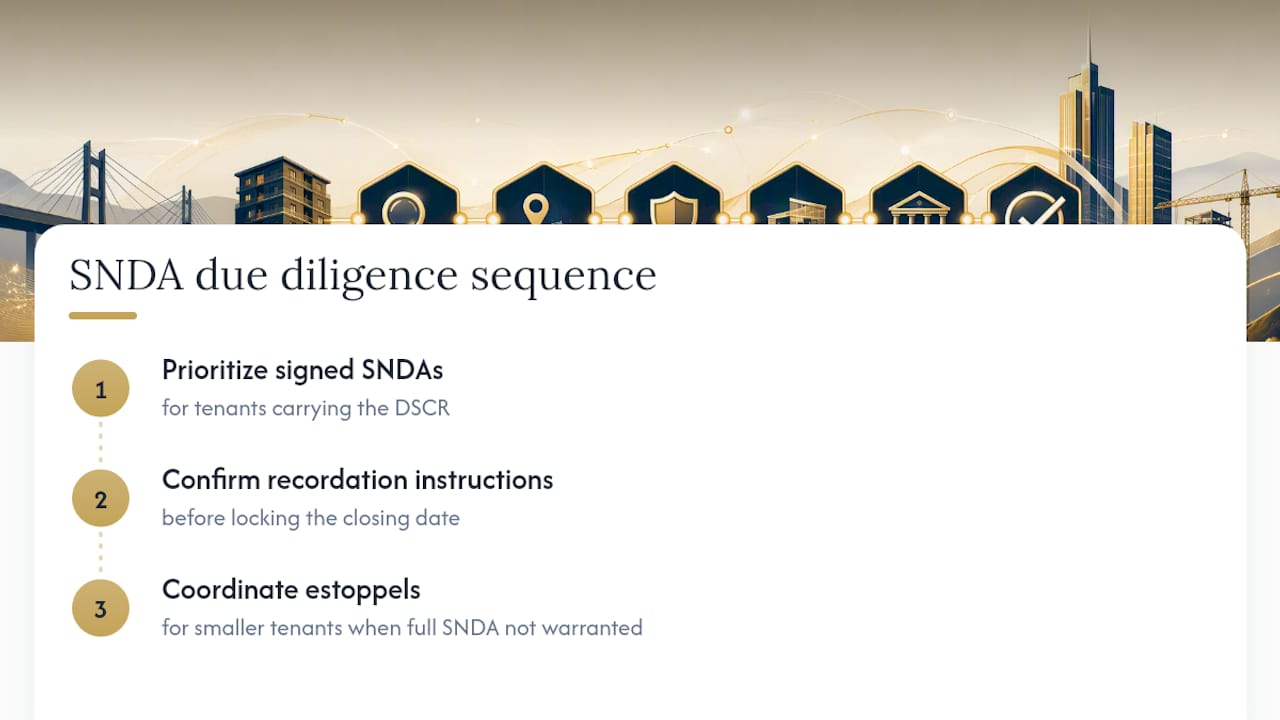
Our practical sequence: prioritize signed SNDAs for the tenants that carry the DSCR, confirm the lender’s recordation instructions before the closing date is locked, and coordinate estoppels for smaller tenants where a full SNDA isn’t warranted.
Why the “Boilerplate” Label on SNDAs Is Costing Tenants Money
Most of the SNDA advice circulating treats the document as a formality, something the tenant’s attorney glances at and signs because the lender’s counsel insisted. That framing is backwards. An SNDA is a capital-stack document. It sits at the exact point where a lender’s loan security and a tenant’s occupancy rights either align or collide, and the language decides who absorbs the cost when a landlord defaults.
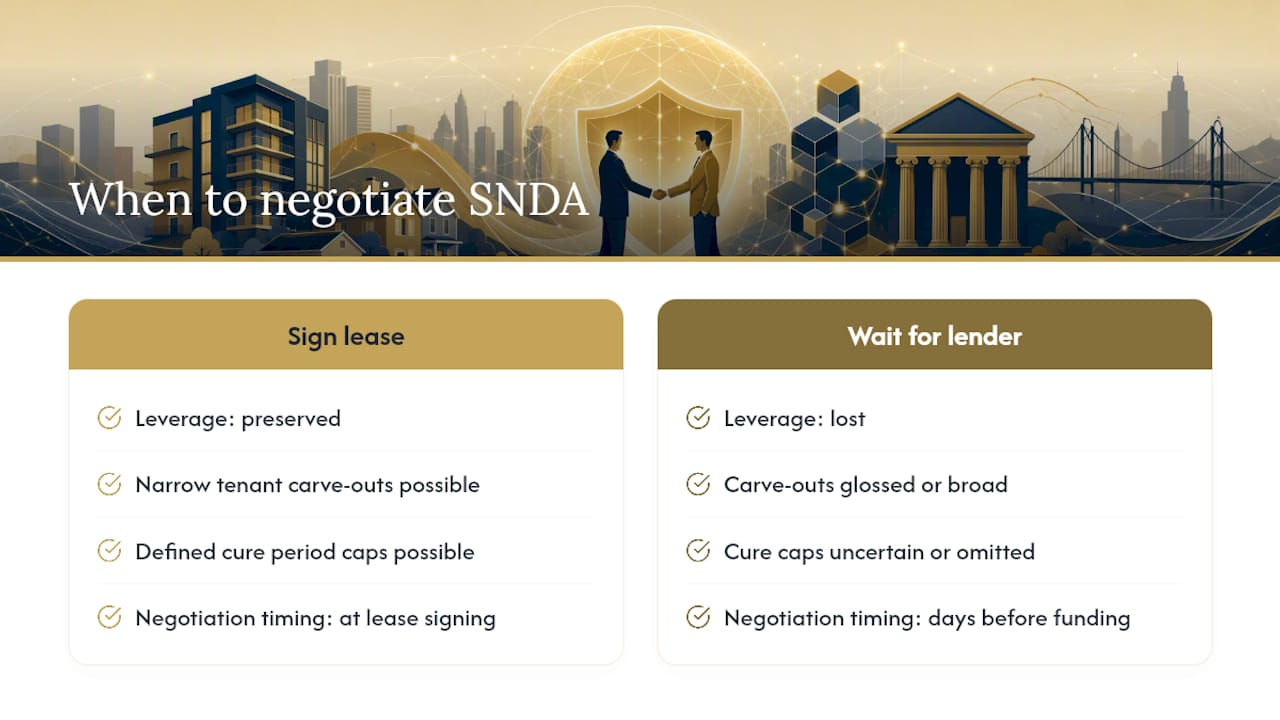
Where conventional advice falls short is the assumption that non-disturbance is binary, either you have it or you don’t. In practice, the conditions attached to that promise (rent thresholds, tenant-specific carve-outs, cure period lengths) do most of the real work, and they’re exactly what gets glossed over under closing deadline pressure.
If you take one thing from this: negotiate the SNDA when you sign the lease, not when the lender hands you a draft three days before funding. Tenants who wait lose the leverage that makes narrow carve-outs and defined cure caps possible in the first place. That timing decision matters more than any single clause in the document.
— Jerry
Sources
FAQ
Who Benefits From an SNDA Agreement?
All three parties benefit, but in different ways: the lender preserves lien priority and protects the rental income underwriting its loan, the tenant keeps occupancy rights after a foreclosure, and the landlord gets a smoother, more marketable financing deal by making the property’s leases lender-friendly.
Why Does a Lender Want an SNDA?
A lender wants an SNDA to make sure a foreclosure doesn’t wipe out the leases generating the rental income the loan depends on. Without it, foreclosure can terminate leases junior to the mortgage, which threatens the debt service coverage the loan was underwritten around.
Can an SNDA Be Negotiated?
Yes, and tenants generally have more leverage negotiating SNDA terms during lease drafting than after the landlord has already committed to a lender’s closing deadline. Common negotiation points include non-disturbance breadth, cure period length, and carve-outs for tenant improvement allowances.
What Is the Difference Between an Estoppel Certificate and an SNDA?
An estoppel certificate is a point-in-time statement confirming lease facts, like rent amount and default status, with no ongoing obligations attached. An SNDA creates a continuing contractual relationship between tenant and lender, including the lender’s promise not to disturb the tenant’s occupancy after foreclosure.