9 Term Sheet Lines Sponsors Must Nail for Joint Venture Equity

A real estate joint venture equity structure pairs an operating sponsor (GP) contributing expertise and a modest equity stake, with a capital partner (LP) supplying the bulk of the money. GP skin in the game typically runs 5% to 20%, with the LP funding the rest. The economics that decide who gets paid, and when, come down almost entirely to how the waterfall and major-decision rights are drafted.
TL;DR:
- LP contributions usually make up 80% to 95% of equity, while the GP invests between 5% and 20% of the required equity; larger institutional deals may have lower GP stakes.
- Key terms such as capital call triggers, major decision thresholds, and promote timing should be precisely defined with enforceable dollar amounts to prevent disputes.
- The distribution waterfall prioritizes return of capital, then preferred returns, followed by catch-up and promote, with IRR or equity multiple hurdles influencing profit splits.
- Most real estate JVs are formed as single-purpose Delaware LLCs with limited liability, where the operating agreement must clearly specify governance, fiduciary duties, and tax allocations.
- Negotiating leverage is affected by the GP’s co-investment level, with sponsors at 15-20% potentially securing better promote terms, while smaller stakes should expect stricter governance demands.
Table of Contents
- What Is a Joint Venture Equity Structure in Commercial Real Estate?
- What Terms Define a JV Equity Structure?
- How Does the Distribution Waterfall Actually Work?
- Which Entity and Governance Structure Should You Use?
- A Negotiation Guide From Brookmont Capital Ventures
- What Should Be on Your JV Term Sheet Checklist?
- Where Negotiating Leverage Sits Right Now
- How Brookmont Capital Ventures Structures JV Equity for Sponsors
- Sources
- FAQ
What Is a Joint Venture Equity Structure in Commercial Real Estate?
Joint venture equity sits above the debt in the capital stack and, in many deals, above a layer of preferred equity as well. Debt gets serviced first, preferred equity next, and JV equity absorbs the most risk while capturing the most upside if the deal performs. Understanding where it fits in relation to preferred equity and mezzanine debt and the broader capital stack matters before you negotiate a single term.
The GP sources the deal, underwrites it, and runs day-to-day operations, whether that is construction management, leasing, or a full repositioning. The LP writes the bigger check and, in exchange, usually retains approval rights over anything material.
- GP co-investment commonly ranges from 5% to 20% of required equity, sometimes as low as 1% to 15% in larger institutional deals.
- LP capital typically covers 80% to 95% of the equity requirement.
- Common LP sources include institutional investors, private equity real estate funds, family offices, and high-net-worth co-investors syndicated alongside the sponsor.
Each source brings different priorities. A family office may accept a longer hold in exchange for a lower preferred return, while an institutional fund often insists on tighter reporting covenants and harder governance thresholds.
What Terms Define a JV Equity Structure?
Every JV term sheet reduces to four buckets: contributions, fees, control, and exit. Get these wrong and the waterfall math becomes irrelevant, because you will be fighting over definitions instead of collecting distributions.
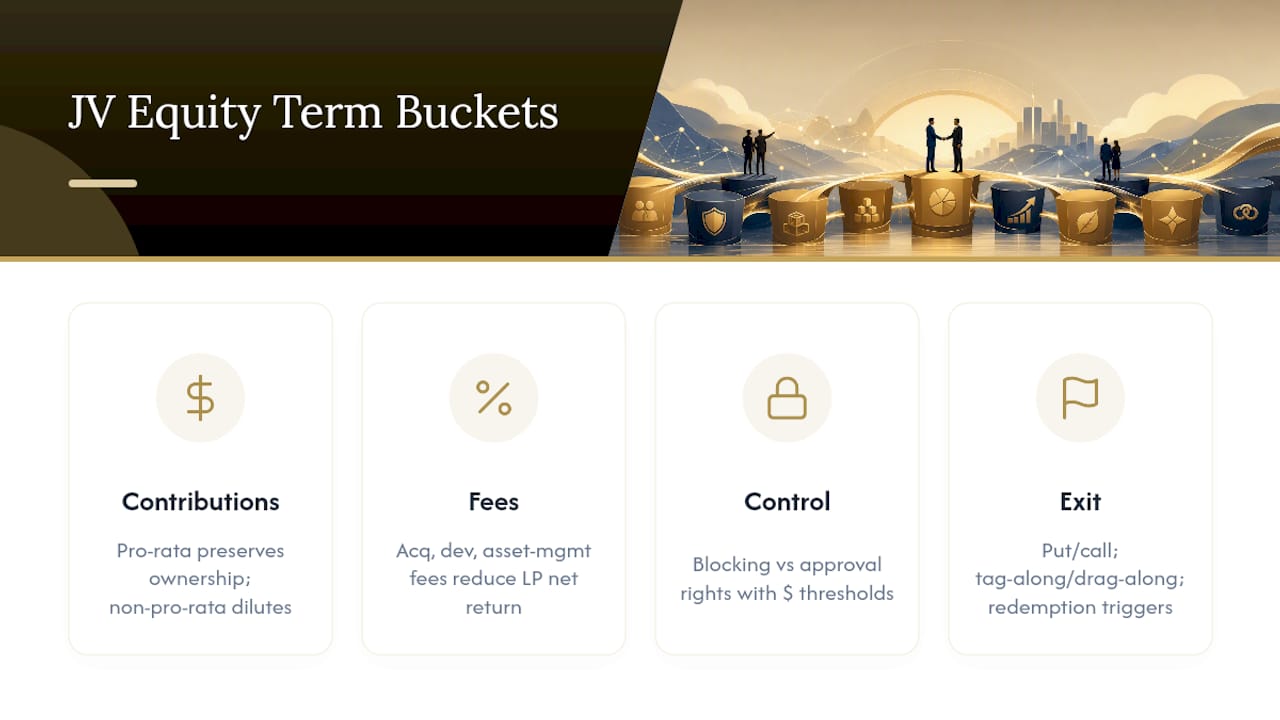
Contributions and dilution. The initial capital split sets ownership percentages, but the real fight is over how future capital calls work. Pro-rata calls preserve ownership ratios; non-pro-rata calls, common when a partner defaults or declines to fund often trigger dilution penalties that can run well above the shortfall amount.
Sponsor fees. Acquisition fees, development fees, and asset management fees compensate the GP separately from the promote. Stack too many fees on top of a rich promote and the LP’s net return suffers even in a winning deal.
Major decisions. These typically cover refinancing, sale, budget overruns beyond a set threshold, and material leasing. Defining blocking rights versus approval rights with specific dollar thresholds prevents the vague “material decision” language that fuels disputes later.
Exit mechanics. Put/call options, tag-along and drag-along rights, forced redemption, and dissolution triggers all need to be spelled out before closing, not negotiated under duress mid-hold.
Pro Tip: Push for a defined dollar threshold on every major-decision category rather than a vague standard like “material.” A $250,000 budget-overrun trigger is enforceable; “significant” is a lawsuit waiting to happen.
How Does the Distribution Waterfall Actually Work?
The waterfall is the mechanism that decides, tier by tier, who gets paid and in what order once cash is available for distribution. It is, without exaggeration, the single most negotiated document in the entire JV package.
- Return of capital. Both partners get their invested capital back before anyone earns a profit.
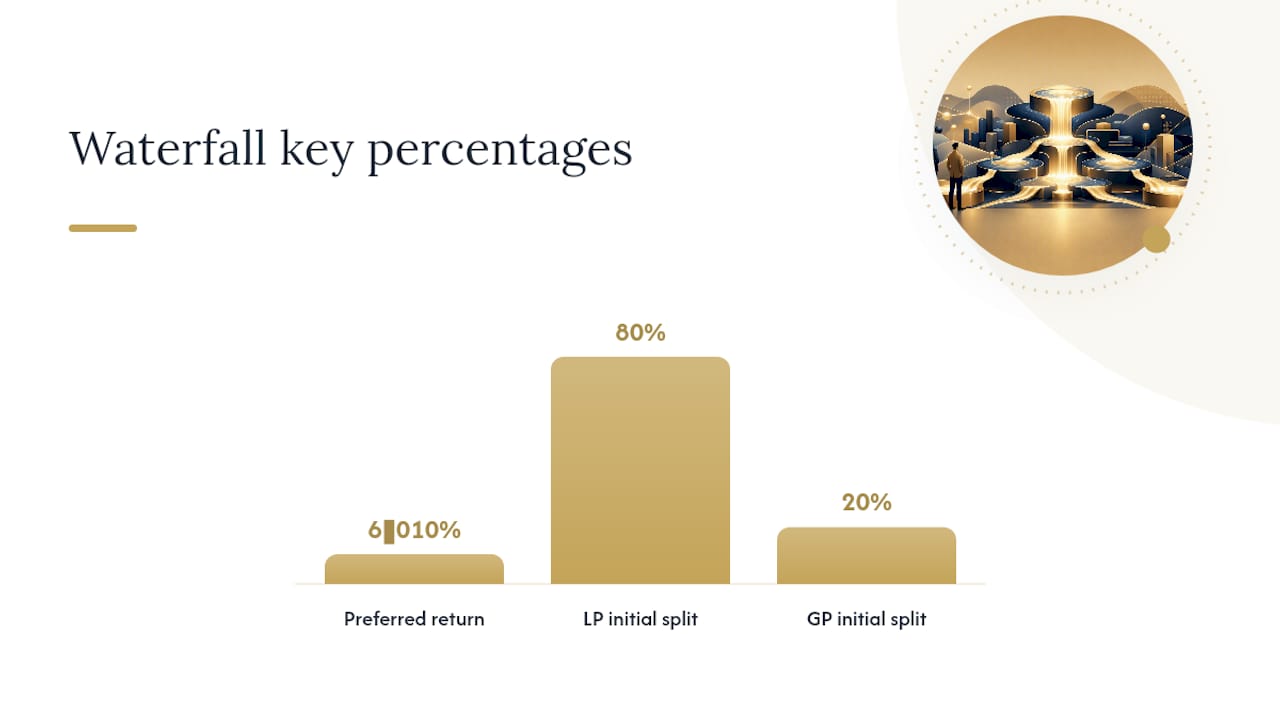
- Preferred return. The LP earns a set annualized return, often in the 6% to 10% range, before the GP participates in profit.
- Catch-up. The GP receives a larger share of distributions until its total take matches the negotiated promote percentage. A full catch-up accelerates sponsor upside fast; a split catch-up spreads it more slowly and protects LP net IRR.
- Promote (carried interest). Remaining profit splits according to a tiered schedule, often starting near an 80/20 split in the LP’s favor and escalating toward the sponsor as IRR hurdles climb.
Hurdles get tested against IRR, equity multiple, or a combined test, and the choice matters more than most sponsors realize. IRR rewards speed; equity multiple rewards magnitude. A combined test prevents a sponsor from gaming an early sale purely to hit an IRR trigger without delivering real dollar return. Whether the promote calculates deal-by-deal or across a fund-wide pool also changes sponsor behavior significantly, since a fund-wide calculation can let strong deals subsidize weak ones.
Crystallization adds another layer: some structures let the sponsor lock in and realize promote at a milestone, like stabilization, rather than waiting for a sale. That timing shift can materially change when the GP recognizes income and how the LP’s net-IRR benchmark reads mid-hold.
Which Entity and Governance Structure Should You Use?
Most commercial real estate JVs form as single-purpose Delaware LLCs, one entity per transaction, which limits cross-deal liability and simplifies lender underwriting. Limited partnerships and, less often, tenants-in-common structures appear too, usually when a specific tax or lender requirement demands it.
- Single-purpose LLCs isolate risk to one asset and one deal.
- Manager-managed structures give the GP day-to-day authority, with the LP holding a defined list of consent rights rather than general oversight.
- Subscription facilities and staged capital-call schedules reduce the friction of large one-time draws and give LPs predictable funding timing.
- Operating agreements need to define fiduciary duties, capital-call procedures, and remedies for funding failures explicitly, not by reference to generic partnership law.
One distinction trips up even experienced sponsors: the cash waterfall and the tax allocation schedule are not the same document. Cash distributions follow the operating agreement’s waterfall rules, but taxable income, gain, and loss get allocated under separate partnership tax provisions, sometimes using entirely different percentages. Skip that section and you risk a K-1 that does not match what anyone actually received in cash. Partners should also understand how joint ownership affects tax exposure before finalizing allocation language.
A Negotiation Guide From Brookmont Capital Ventures
GP co-investment level drives negotiating leverage more than any other single number. A sponsor putting in 15% to 20% can usually push for a richer promote and looser major-decision thresholds; a sponsor at 5% should expect the LP to demand tighter governance in return.
Economic and control terms trade against each other constantly. Raising the preferred return a point or two often buys the sponsor a lighter major-decision list. Conceding a lower promote tier can buy faster capital-call turnaround.
- Model sensitivity to both IRR (timing) and equity multiple (magnitude), not just one.
- Run the promote calculation under both crystallization and no-crystallization scenarios before accepting either.
- Decide catch-up design (full versus split) based on how much it moves the LP’s net-IRR benchmark.
- Draft explicit definitions for “available cash” and capital-call triggers, since vague definitions are a leading cause of post-closing disputes.
Pro Tip: Never accept a promote provision that lets the GP unilaterally define “available cash.” Tie the definition to a specific reserve formula and require LP sign-off on any reserve increase above a stated percentage.
What Should Be on Your JV Term Sheet Checklist?
Before signing anything, run the term sheet against this list:
- Entity type and jurisdiction
- Capital contribution schedule and call mechanics
- Preferred return rate and definition
- Catch-up structure (full or split)
- Promote tiers and hurdle tests (IRR, equity multiple, or combined)
- Fee schedule (acquisition, development, asset management)
- Major-decision list with dollar thresholds
- Exit mechanics: put/call, tag/drag, redemption, dissolution
- Clawback provisions
Ask directly: How is available cash defined? When does the promote crystallize? Is carry calculated deal-by-deal or across the fund? Red flags include vague cash definitions, unchecked sponsor discretion over distributions, and no stated remedy when a capital call goes unfunded.
Where Negotiating Leverage Sits Right Now
Capital remains selective heading into 2026, which tilts leverage toward LPs on single-asset deals but toward sponsors with a track record on programmatic relationships, where an institutional partner commits across multiple deals. Programmatic structures suit sponsors building a pipeline; single-asset co-investment suits opportunistic, one-off situations. Either way, bring in an advisor once the waterfall math or governance terms start feeling more complicated than the deal itself.
— Jerry
How Brookmont Capital Ventures Structures JV Equity for Sponsors
Getting the waterfall math right on paper is one thing. Getting a capital partner to actually sign at those terms is another, and that gap is where most sponsors lose leverage they didn’t need to lose.
Brookmont Capital Ventures works directly with sponsors on capital markets advisory, structuring JV equity terms, modeling waterfall scenarios against IRR and equity-multiple hurdles, and introducing vetted institutional lenders and equity partners. Engagements typically produce a clean term sheet, a properly modeled promote structure, and a capital placement that matches the deal’s actual risk profile rather than a generic template. If you’re preparing to raise JV equity or need help translating a term sheet into numbers that hold up under negotiation, Brookmont’s advisory services can walk through your capital stack and next steps.
Sources
For legal drafting detail, see Bradley’s analysis of JV agreement terms. For waterfall modeling, consult FTI Consulting’s dealmaker’s guide and J.P. Morgan’s equity waterfall primer.
- Joint Venture Equity | Lender Tribune
- Dealmaker’s guide to JV waterfall structuring | FTI Consulting
- Distribution waterfalls in real estate | Crowdfund Lawyer (Jason Powell)
- Equity waterfall in commercial real estate explained | J.P. Morgan
FAQ
What Are the Typical Structures of a Joint Venture?
Most commercial real estate JVs use a single-purpose Delaware LLC with a GP holding a minority equity stake and management control, and an LP holding the majority of capital alongside major-decision approval rights.
What Is Joint Venture Equity?
Joint venture equity is the ownership capital contributed by a sponsor and one or more capital partners to fund a real estate deal, with returns governed by a negotiated distribution waterfall rather than a fixed interest rate.
What Are the Four Types of Joint Ventures?
Real estate JVs are commonly grouped by structure: single-asset co-investments, programmatic multi-deal partnerships, preferred equity/co-GP arrangements, and recapitalization joint ventures, each carrying different governance and promote dynamics.
Who Owns the Assets in a Joint Venture?
The JV entity itself, typically the LLC, holds title to the asset; the GP and LP own membership interests in that entity rather than the property directly, with ownership percentages set by their capital contributions.
How Is the Promote Typically Split Between GP and LP?
Promote splits often start around an 80/20 division favoring the LP at lower return hurdles and escalate toward the sponsor as IRR thresholds increase, with exact tiers set during negotiation based on GP co-investment and track record.