
Real Estate Fund Structure Types for Sponsors

The capital stack for a commercial real estate deal typically runs five layers: senior debt (bridge, construction, permanent, or DSCR), mezzanine debt, preferred equity, common/JV equity, and CMBS for stabilized assets. According to Lev’s capital stacking primer, a simple stack is 65–75% senior debt plus common equity, while aggressive structures with subordinate capital can push loan-to-cost toward 80% or higher.
- Senior debt covers the largest share of capitalization at the lowest cost; sponsors use it to establish the foundation before any other layer.
- Mezzanine debt or preferred equity fills the gap between senior debt and sponsor equity when the project needs higher leverage or when sponsor equity is constrained by return targets.
- CMBS replaces or refinances senior debt on stabilized, cash-flowing assets when sponsors want non-recourse, fixed-rate certainty.
Brookmontcapital structures and sources all five layers for sponsors nationwide, from initial underwriting through closing.
Key Takeaways
| Point | Details |
|---|---|
| Five core layers | Senior debt, mezzanine, preferred equity, common equity, and CMBS each serve a distinct leverage and risk role. |
| DSCR stress-test threshold | Projects should sustain 1.10x–1.25x DSCR under a 10–20% revenue haircut and 50–100 bps rate shock before adding subordinate capital. |
| Mezz vs. preferred equity | Mezz carries deductible interest and intercreditor requirements; preferred equity avoids liens but has different enforcement and tax mechanics. |
| Term-sheet red flags | Cash-trap triggers, prepayment penalties, intercreditor standstill periods, and change-of-control provisions most affect sponsor control. |
| Brookmontcapital advisory | Brookmontcapital structures and sources all five capital-stack layers for sponsors nationwide, starting with conservative underwriting and a defined exit strategy. |
Sponsor checklist for initial lender meetings:
- Confirmed asset status and hold period.
- Stabilized NOI projection with sensitivity table (10–20% revenue haircut).
- Target LTC/LTV and required leverage by layer.
- Defined exit strategy (refinance, agency takeout, or sale).
- Sponsor track record summary and liquidity documentation.
Table of Contents
- What does the capital stack actually mean for your deal?
- Layer-by-layer reference: what each financing type costs and requires
- How subordinate layers change your returns and your risk
- How do you pick the right structure for your specific deal?
- What term-sheet clauses most affect your control and flexibility?
- Three capital-stack scenarios sponsors can map to their deals
- How Brookmontcapital structures capital stacks for sponsors
- Brookmontcapital sources the right capital stack for your deal
- Sources
What does the capital stack actually mean for your deal?
The stack determines three things simultaneously: your blended cost of capital, your control rights, and your break-even cash flow. Get one wrong and the others follow.
Hold period and asset type drive the first cut. A two-year value-add with a bridge-to-agency exit needs a different structure than a ten-year core hold. Short-hold deals tolerate higher-cost transitional debt because the business plan generates the return before the coupon compounds. Long-hold deals need permanent, fixed-rate debt with predictable amortization. Lender appetite also shapes feasibility: construction lenders underwrite to loan-to-cost and sponsor track record, while CMBS conduits underwrite to stabilized debt service coverage ratio and in-place cash flow.
Subordinate layers add leverage but raise the minimum cash flow the project must generate to stay current. That trade-off is the central decision in real estate investment structures at the deal level.
Pro Tip: Engage your senior lender before finalizing the capital structure. Senior lenders often restrict subordinate liens or require intercreditor approval, and discovering that constraint late can delay closing by weeks.
Layer-by-layer reference: what each financing type costs and requires
Commercial real estate loan types serve distinct deal stages: construction and bridge loans are transitional, while permanent, CMBS, and agency loans fit stabilized assets. Here is how each layer behaves in practice.
Senior debt (bridge, construction, permanent, DSCR)
Banks, life companies, CMBS conduits, and agency lenders (Fannie Mae, Freddie Mac) are the primary providers. Bridge loans run 12–36 months, are interest-only, and price materially above permanent debt; construction loans are draw-based over a similar 12–36 month window. Permanent and DSCR loans amortize over 25–30 years and are sized to stabilized net operating income. Common covenants include debt service coverage ratio minimums, loan-to-value maintenance, and cash management triggers.
Mezzanine debt
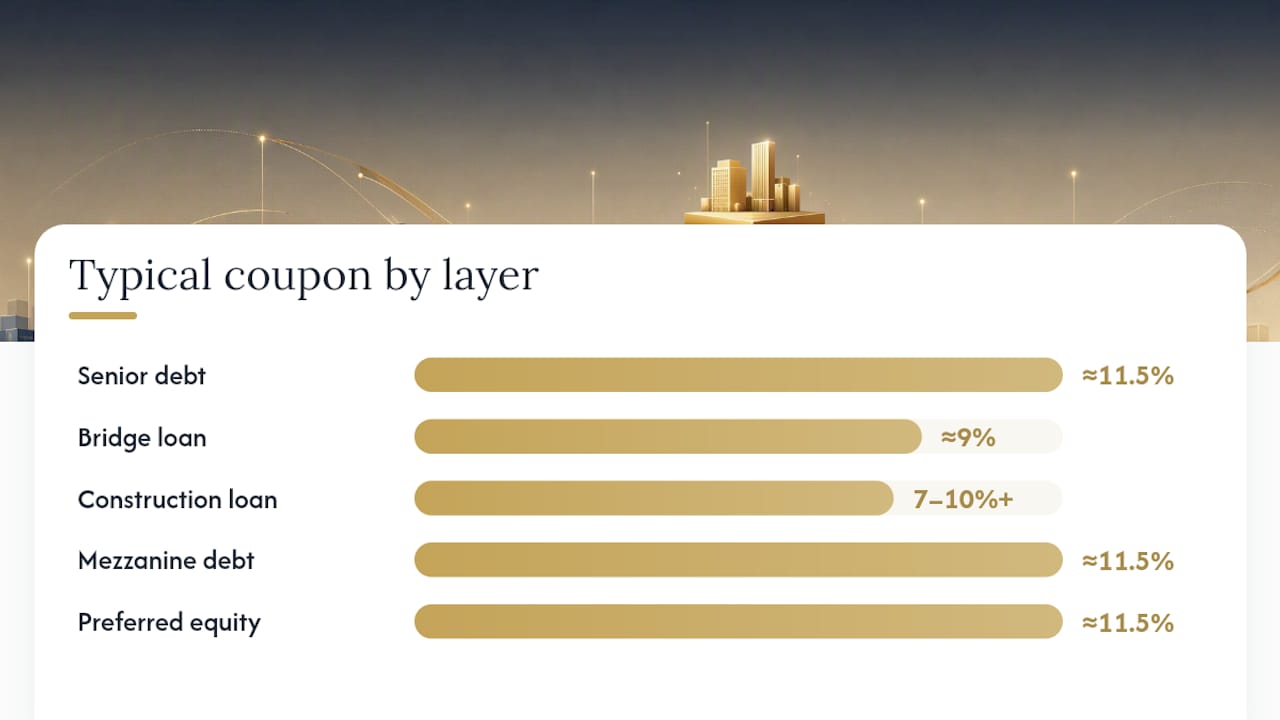
Mezz sits below senior debt and above equity, secured by a pledge of the borrower’s ownership interests rather than a first lien on the property. Coupons typically range in the high single digits to mid-teens, depending on leverage and market conditions. Terms generally mirror the senior loan. Because mezz is debt-like, interest is typically deductible to the borrower, which improves after-tax returns relative to preferred equity. Intercreditor agreements with the senior lender are standard and govern standstill periods and cure rights.
Preferred equity
Preferred equity is an equity instrument with a fixed preferred return, not a lien, which means it avoids the intercreditor friction that mezz triggers. Sponsors often choose preferred equity when the senior lender prohibits subordinate debt. Returns target a range similar to mezzanine, but enforcement mechanics differ: a preferred equity investor typically exercises remedies through the operating agreement rather than foreclosure. Tax treatment varies by structure and should be confirmed with counsel.
Common/JV equity
Common equity is the residual claim, last in priority and first to absorb losses. JV equity partners (family offices, institutional equity funds, high-net-worth co-investors) typically require preferred returns or promoted interest structures.
CMBS
CMBS loans offer fixed-rate, non-recourse financing for stabilized assets, typically with 5- or 10-year terms, 30-year amortization or interest-only periods, and strict prepayment protections such as defeasance or yield maintenance. They suit sponsors who want rate certainty and non-recourse protection and can accept limited post-close flexibility.
| Layer | Typical cost/coupon | Seniority | Typical term | LTV/LTC contribution | Typical provider |
|---|---|---|---|---|---|
| Senior debt (permanent) | high single digits to mid-teens | First lien | 5–10 years | 65–75% | Bank, life co., agency |
| Bridge loan | Generally in the mid to high single digits to low double digits | First lien | Roughly one to three years | Majority portion | Debt fund, bank |
| Construction loan | 7%–10%+ | First lien | 12–36 months | 65–75% LTC | Bank, debt fund |
| Mezzanine debt | Typically ranges from high single digits to mid-teens | Second position | Term similar to senior debt | Up to high leverage levels | Mezz fund, debt fund |
| Preferred equity | Targets returns similar to mezzanine | Below debt, above common equity | Term often aligned with senior debt | Can support high leverage | Pref equity fund |
| CMBS | 6%–8% (fixed) | First lien | 5–10 years | 65–75% | CMBS conduit |
| Common/JV equity | Residual return targets | Last priority | Varies with deal term | Remaining portion | Sponsor, equity fund |
Pro Tip: Tax treatment differs meaningfully between mezz and preferred equity. Mezz interest is generally deductible; preferred equity distributions may not be. Run both structures through your tax advisor before committing to a term sheet.
How subordinate layers change your returns and your risk
Adding subordinate capital raises leverage and can improve sponsor return on equity, but it also raises the minimum cash flow the project must generate to stay current on all layers. That is the core trade-off.
Consider a simplified illustration. A project financed primarily with senior debt and sponsor equity produces a blended cost of capital near the senior debt rate (ignoring equity return). Adding a mezzanine tranche with a higher coupon reduces the sponsor equity amount and raises the blended cost. If the project generates the same net operating income, the return on that smaller equity check is higher, provided debt service on both layers is covered.
The risk is the break-even point. Institutional guidance recommends stress-testing subordinate capital to ensure projects can sustain a debt service coverage ratio above certain thresholds under adverse scenarios before adding mezzanine or preferred equity.
Stress-test rule: Before adding any subordinate layer, run a sensitivity showing 10–20% adverse revenue and a 50–100 basis point interest rate shock. If the project cannot hold 1.10x DSCR under both shocks simultaneously, the stack is too aggressive for the risk profile.
Use Brookmontcapital’s DSCR calculator to run these scenarios before approaching lenders.
- Calculate stabilized NOI at underwriting assumptions.
- Apply a 10–20% revenue haircut (vacancy increase or rent reduction).
- Apply a 50–100 basis point rate shock to any floating-rate debt.
- Recalculate DSCR across all debt layers combined.
- If the result falls below 1.10x, reduce subordinate leverage or improve the business plan before proceeding.
How do you pick the right structure for your specific deal?
Add layers only when the project’s cash flow supports them.
Sponsor checklist before approaching lenders:
- Asset status: stabilized, value-add, or ground-up? (Determines eligible loan types.)
- Hold period: short-term flip, value-add reposition, or long-term hold? (Drives term and exit strategy.)
- Exit plan: refinance to permanent, agency takeout, or sale? (Senior lenders require a defined path.)
- Projected stabilized NOI and required debt service coverage at target leverage.
- Required LTC or LTV to make the equity return work.
- Sponsor track record: construction experience, asset class history, and liquidity.
- Timeline: how quickly must the deal close? (Bridge and debt funds close faster than CMBS or agency.)
Questions to ask each capital provider:
- Senior lender: What DSCR floor triggers a cash trap? Do you permit subordinate debt or preferred equity?
- Mezz lender: What are the intercreditor standstill terms? What events trigger acceleration?
- Preferred equity investor: What approval rights do you retain over major decisions? How is the preferred return calculated — current pay, accrual, or a blend?
For value-add multifamily financing, the bridge-to-agency path is one of the most common structures, and lender selection at the bridge stage shapes whether the agency takeout is achievable.
What term-sheet clauses most affect your control and flexibility?
Pay close attention to five mechanics: remedies, change-of-control provisions, prepayment language, cash-trap triggers, and intercreditor standstill terms. These clauses determine how much flexibility you retain and how quickly a lender can act against you.
- Prepayment protections: CMBS loans use defeasance or yield maintenance, which can cost several points of the loan balance. Bridge and mezz loans often carry step-down prepayment penalties or exit fees. Know the cost of your exit before you sign.
- Cash-trap triggers: Many senior loans include a cash management provision that sweeps excess cash into a lender-controlled account when DSCR falls below a threshold (often 1.10x–1.15x). Once triggered, the sponsor loses discretionary cash flow until the project recovers.
- Interest reserves: Construction and bridge loans typically require a funded interest reserve at closing, sized to cover projected interest during the lease-up or construction period. Underfunding the reserve is a common cause of distress.
- Intercreditor standstill: When mezz debt is present, the intercreditor agreement governs how long the mezz lender must wait before exercising remedies after a senior default. Standstill periods of 90–180 days are common; shorter periods favor the mezz lender.
- Change-of-control provisions: Both senior and mezz lenders typically require lender consent for ownership transfers above a threshold (often 49%). This can complicate recapitalizations or GP changes mid-hold.
Pro Tip: *Negotiate the cash-trap trigger level and cure period before signing the term sheet, not after.
Three capital-stack scenarios sponsors can map to their deals
Scenario 1: Stabilized multifamily hold
No subordinate capital needed because the asset cash flows support the return at this leverage. The caution: agency loans carry prepayment penalties; a forced sale before year five is expensive.
Scenario 2: Ground-up construction
Construction financing is typically interest-only with draws and requires a clear permanent takeout plan. The caution: construction cost overruns reduce the LTC cushion and can trigger a capital call from the preferred equity investor.
For a real-world example of preferred equity used as gap financing, see Brookmontcapital’s preferred equity case study.
Scenario 3: Value-add acquisition
A 60-unit workforce housing property acquired for $8M at 75% occupancy, financed with a bridge loan at 70% LTC for 24 months, interest-only, with a planned agency takeout at stabilization. No mezz or preferred equity; the sponsor uses the bridge period to execute the renovation and lease-up business plan. The caution: slower-than-projected lease-up extends the bridge term and increases carry cost, compressing sponsor IRR.
Pro Tip: For value-add multifamily deals, confirm the agency takeout parameters before closing the bridge loan. Fannie Mae and Freddie Mac have minimum occupancy and seasoning requirements that can delay the takeout if lease-up stalls.
How Brookmontcapital structures capital stacks for sponsors
Brookmontcapital uses a lender-first, stress-tested approach that prioritizes a defined exit strategy and conservative DSCR thresholds before sourcing any capital layer. The process:
- Underwriting and feasibility: Build a conservative pro forma with sensitivity tables covering rent, vacancy, and interest rate scenarios.
- Stack design: Identify the optimal layer mix based on asset type, hold period, leverage target, and sponsor return requirements.
- Lender canvass: Match the deal to the right capital providers across senior debt, bridge, mezz, preferred equity, and CMBS.
- Term negotiation: Negotiate covenant flexibility, prepayment terms, cash-trap triggers, and intercreditor mechanics.
- Closing support: Coordinate intercreditor agreements, interest reserve sizing, and closing logistics.
Brookmontcapital’s advisory process is built around one principle: the right capital stack is the one that survives a stress scenario, not just the one that maximizes leverage at underwriting.
Sponsors who engage Brookmontcapital gain access to institutional lenders, debt funds, and equity partners across all five capital-stack layers, with advisory support from initial underwriting through closing.
When Brookmontcapital recommends staying conservative on leverage
Stay conservative when cash-flow sensitivity or market uncertainty is high. Three scenarios where mezz or preferred equity materially raise break-even risk:
- Lease-up risk: A ground-up or heavy value-add deal with no in-place cash flow cannot service subordinate debt during the lease-up period without drawing on reserves. If the interest reserve runs dry before stabilization, the sponsor faces a capital call or default.
- Construction cost inflation: A cost overrun of 10–15% on a ground-up project reduces the LTC cushion and may require additional equity, not more debt.
- Weak tenant credit: A retail or office deal anchored by a single tenant with below-investment-grade credit should not carry subordinate debt; the cash-flow concentration risk is too high.
Brookmontcapital sources the right capital stack for your deal
Sponsors who need to close faster, reach higher leverage, or navigate complex intercreditor mechanics benefit from working with an adviser who has active relationships across all five capital-stack layers. Brookmontcapital sources senior debt, bridge financing, CMBS, preferred equity, and mezzanine debt for commercial real estate sponsors nationwide, with a process built around conservative underwriting and defined exit strategy.
Services include capital-stack structuring, lender canvassing, term negotiation, intercreditor coordination, and placement support. A typical engagement begins with a deal review and pro forma stress test, followed by a lender canvass and term sheet comparison. For sponsors ready to structure or source their next deal, Brookmontcapital’s capital stack advisory services are the starting point. Contact the team to discuss your project and get a term sheet comparison within days, not weeks.
Sources
- What is a capital stack in real estate | JPMorgan insights
- Capital Stacking in CRE: Senior, Mezz, Equity | Lev
This article is general information, not a substitute for advice from a qualified financial advisor. Consult a qualified financial professional about your own circumstances before acting on anything here.
Recommended
- Capital Stack Types in Commercial Real Estate: A Sponsor’s Guide | Brookmont Capital Ventures
- Sponsor Support Services | Financial Modeling, Presentations, Deal Team | Brookmont Capital
- How to Get Your CRE Deal Funded in 2026: What Lenders Actually Want to See | Brookmont Capital
- Institutional Real Estate Investment 2026: Why Capital Is Returning to CRE