

A construction interest reserve is a portion of the loan, or occasionally a separate borrower-funded escrow, set aside to pay the loan’s interest while the project is built and leased, so the sponsor does not fund monthly debt service from outside cash. It is sized from the projected draw schedule, the rate, and the time to completion and stabilization. The most common sizing mistake is covering interest only to the end of construction.
This guide covers the mechanics, a worked sizing example, the regulatory view that shapes how lenders treat the reserve, and what to do if it is running low.
TL;DR
- An interest reserve is a budget line in the construction loan, or sometimes a separate escrow, that pays interest through construction and lease-up, not only through the scheduled completion date.
- Size it with a monthly model of draws, rate changes, and lease-up cash flow. A flat percentage of the commitment misses front-loaded draws and slow absorption.
- No universal percentage exists. Lenders set their own limits, so two prudent lenders can size the same deal differently.
- A reserve that keeps a loan current does not prove the project can repay principal. Track reserve burn and repayment progress separately.
- If the reserve runs out, expect to contribute cash or a revised capital plan, not an automatic additional advance.
Table of Contents
- What a construction interest reserve does
- Why lenders and sponsors both want one
- How to size a construction interest reserve
- What drives the number
- How the reserve gets drawn during lease-up
- The risk: a reserve can hide a weak project
- What happens if the reserve runs out
- Connecting the reserve to the rest of the underwriting
- Tax treatment is a separate question
- Our perspective
- Getting the reserve right with Brookmont
- FAQ
- Sources
What a construction interest reserve does
Construction loans fund in stages. The sponsor draws against hard and soft cost budgets, and interest accrues only on the outstanding balance. During construction the property produces no income, so the interest has to come from somewhere. The reserve is that source.
The OCC’s commercial real estate lending handbook describes it as a reserve account established by the lender and used by the borrower to cover interest during construction and lease-up. It is typically funded through a budget line item in the loan, although some loans require the borrower to fund a separate escrow account.
The practical effect is that each month’s interest is paid by drawing the loan itself. That has two consequences sponsors should hold in mind:
- The interest reserve is part of total project cost, so it increases the loan balance and the interest that accrues on it. This is why it appears as capitalized interest in the sources and uses.
- The loan amount you need is larger than hard and soft costs plus land, which affects loan-to-cost and the equity the lender requires.
Why lenders and sponsors both want one
For the sponsor, the reserve protects liquidity. A stalled draw schedule or a slow lease-up does not force a monthly cash call, and the loan stays current without fresh equity every thirty days.
For the lender, the reserve ensures interest is serviced from a controlled source while the asset has no cash flow. The Federal Reserve’s policy statement on commercial real estate workouts notes that for many acquisition, development, and construction projects, the loan is structured with an interest reserve for the construction phase.
The same arrangement creates the main risk, which we cover below: a loan can look healthy only because the reserve is paying it.
How to size a construction interest reserve
The quick estimate
A common first-pass approach assumes the loan is, on average, half drawn over the construction period:
Interest reserve = (50% x loan amount x interest rate / 12) x months of construction
Use it for early feasibility, not for a term sheet. Raise the 50% assumption if costs are front-loaded, for example when land, site work, and foundations consume most of the budget early. And this estimate stops at completion, so it leaves out lease-up.
The monthly model lenders expect
A defensible reserve comes from a monthly schedule. The federal agencies’ interagency guidelines expect feasibility studies and sensitivity analysis for variables such as interest rates, vacancy, and operating expenses. Build the model in this order:
- Project monthly draws. Tie them to the construction schedule and the budget, including equity-first or pro rata funding requirements in the term sheet.
- Apply the rate by month. Use the actual index and spread. If the loan floats, run at least one rate-up scenario. Our piece on choosing SOFR or Prime covers how index choice changes payment exposure.
- Calculate interest on the projected outstanding balance for each period.
- Extend through lease-up or sale. Subtract project cash flow available for debt service once the property begins to produce income.
- Fund the largest cumulative shortfall, then add a cushion for delay.
A worked example
The numbers below are hypothetical and meant only to show the mechanics.
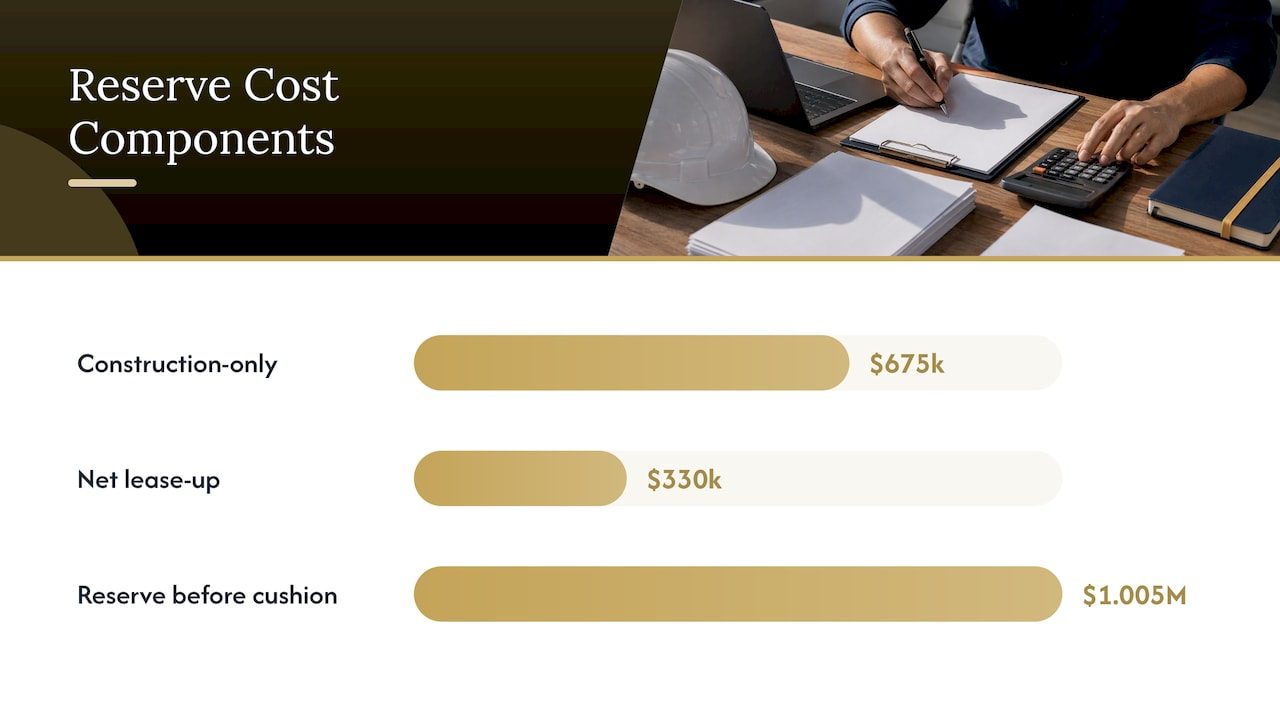
Assume a $10,000,000 construction loan at 9.0% over 18 months of construction, followed by a 6-month lease-up with the loan fully drawn.
| Phase | Assumption | Interest |
|---|---|---|
| Construction, 18 months | 50% average balance | $675,000 |
| Lease-up, 6 months | Full balance at $75,000 per month, gross | $450,000 |
| Less NOI applied during lease-up | Assumed | ($120,000) |
| Reserve before cushion | $1,005,000 |
The construction-only formula gives $675,000. The lease-up phase adds $330,000 net. Omitting it understates the reserve by roughly a third, and that gap would land on the sponsor as a cash call at the worst possible time.
Now stress it. A three-month delay in completion and a 100 basis point rate increase can add a few hundred thousand dollars. Whether that falls inside the contingency, or inside a reserve with room, is the question to settle at underwriting, not at month fourteen.
Why there is no standard percentage
Federal guidance does not prescribe a single reserve percentage. Bank policies are expected to set standards and limits for the reserve alongside loan-to-value limits, borrower equity, feasibility analysis, pre-leasing or pre-sale requirements, guarantor support, and takeout commitments. So the reserve varies with draw timing, project type, rate structure, and repayment source. A multifamily build with strong pre-sale or takeout support may be sized differently from a speculative office project.
What drives the number
- Draw curve. Front-loaded budgets accrue interest sooner. The FDIC’s construction lending guidance points to testing the reserve against the actual draw curve, rate changes, completion timing, and lease-up or sale timing.
- Rate structure. Floating-rate loans need a rate sensitivity. Fixed or capped structures narrow the range.
- Time. Months of delay are the most expensive variable. Every month of slippage costs a month of interest at a higher balance.
- Absorption. Lease-up pace determines how long the reserve runs after completion. Our article on absorption underwriting shows how to find the month a reserve is likely to run out.
- Underwritten NOI. The income you assume during lease-up offsets interest. See how lenders treat stabilized versus in-place NOI before you bake in an optimistic number.
How the reserve gets drawn during lease-up
In most structures, project income should ordinarily be applied to interest before the reserve is drawn. Once cash flow is sufficient to cover interest, further reserve draws should stop so operating income supports the property instead of being diverted elsewhere. This is a lender-control and underwriting principle rather than a universal formula, and the loan documents govern the actual waterfall. Read the cash management and draw provisions before you close, not after.
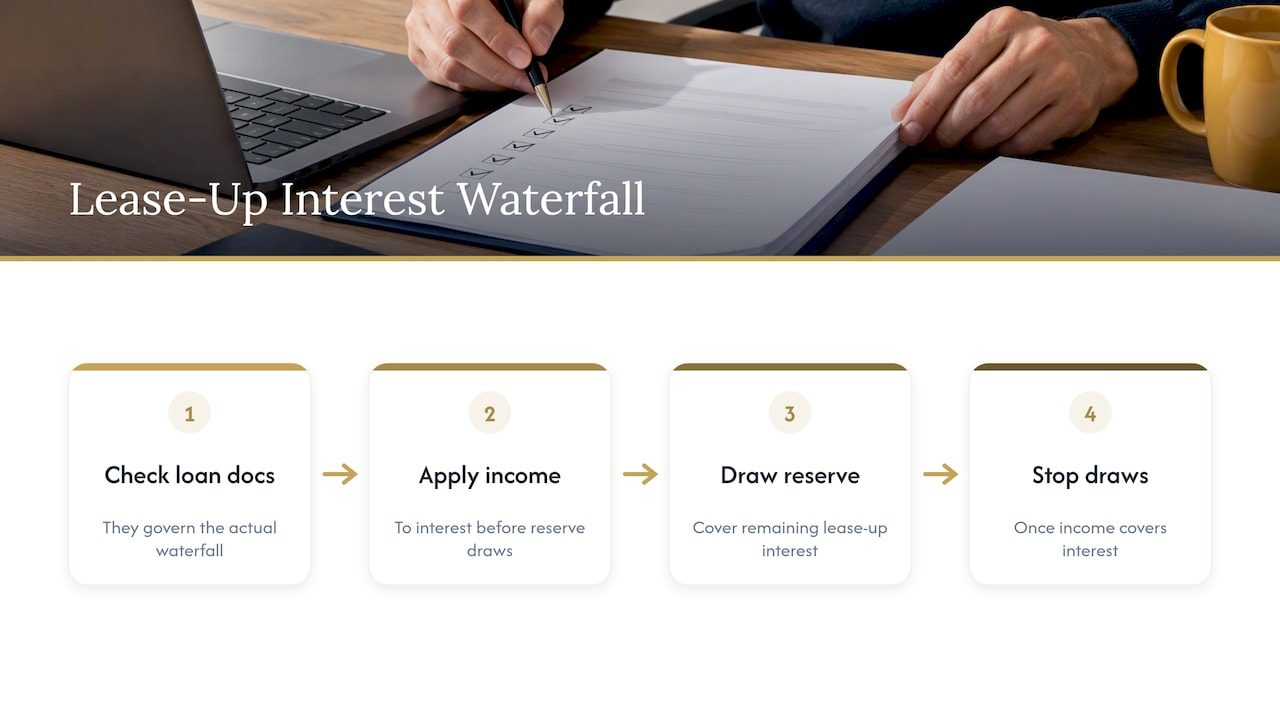
Continuing to draw the reserve while sending property income to distributions or other uses can create a lender-control problem and a misleading picture of performance. Keep the waterfall clean.
The risk: a reserve can hide a weak project
A loan can appear contractually current because interest is paid from the reserve while principal repayment becomes less certain. The federal agencies’ workout statement warns that reserve-funded payments can obscure stalled leasing, lower collateral values, and inadequate project cash flow. The credit question is expected repayment over the remaining term, not whether this month’s interest was paid.
This matters to sponsors for a practical reason. Your lender’s examiners read the file the same way. If you report only that the loan is current, you have told them nothing. Report these separately in every lender update:
- Reserve balance, monthly burn, and projected exhaustion date
- Construction percent complete against budget and schedule
- Leasing or pre-sale progress against the underwritten plan
- Takeout or refinance readiness, including the debt service coverage ratio you expect at stabilization (see our guide to calculating DSCR)
What happens if the reserve runs out
Exhaustion is an escalation event. If delays or market changes deplete the reserve before completion and lease-up or sale, regulators expect the lender to evaluate current feasibility, completion timing, and guarantor capacity. Additional borrower or guarantor cash is generally the first question. Raising the loan to refill the reserve can mask a deteriorating credit, so lenders treat it with caution.
There is no automatic obligation for the lender to advance more. Expect to deal with these options, roughly in order of how lenders prefer them:
- Sponsor or guarantor cash to replenish the reserve
- A reserve funded from a new equity source, such as preferred equity
- An extension, which will usually require updated feasibility, a revised budget, and fresh repayment analysis
- A debt-funded increase, which may be possible but signals stress and gets the closest review
The best time to line up option two is before the shortfall. Our article on equity partner term sheets lays out the lines sponsors should settle in advance.
Connecting the reserve to the rest of the underwriting
Lenders do not evaluate the reserve alone. They look at debt service capacity, collateral value, borrower strength, hard equity, secondary repayment sources, guarantees, and takeout commitments together. A sponsor who understands construction lender requirements can anticipate where the reserve will be questioned, because a thin reserve against an optimistic lease-up is a weakness in the whole package, not a single line item.
A useful discipline is to run the reserve through the same checklist as the rest of the deal. Our six-step underwriting checklist is a good place to start.
Tax treatment is a separate question
Capitalized interest in the budget is not the same as capitalized interest for tax. The IRS states that IRC Section 263A(f) requires capitalization of interest for designated property produced by a business when the rules are met, and all real property a taxpayer produces is treated as designated property for this purpose, subject to exceptions. The same guidance notes a small-business exception tied to gross receipts and tax-shelter conditions. Do not assume the reserve’s treatment in the loan matches its tax treatment. Ask your CPA or tax counsel how your entity and project are affected.
Our perspective
We see the reserve as a feasibility test dressed up as a budget line. When sponsors come to us with a reserve sized by the quick formula and a lease-up that starts the day construction ends, we rebuild the model month by month, add a delay and a rate scenario, and look for the cumulative shortfall. That number, not a percentage, drives how we structure the request.
Our view is that a reserve a lender has to question is a reserve that was not packaged well. Lenders respond to a draw schedule, an absorption assumption, and a takeout plan that all agree with one another. If any of the three is aspirational, the reserve is where it shows first.
We also advise sponsors to decide, before closing, what they will do if the reserve is exhausted: who funds, how fast, and from where. A fallback plan negotiated in advance costs far less than one assembled under a default notice.
— Jerry
Getting the reserve right with Brookmont
If you are a developer or syndicator structuring a construction request, we can build the underwriting, size the reserve against your draw curve and lease-up, and package it for lender review. See our construction financing and capital stack services, or our advisory services for underwriting, feasibility, and term sheet negotiation.
FAQ
What is a construction interest reserve?
It is a lender-established reserve, usually a line in the construction loan budget, used to pay interest during construction and lease-up. Some loans instead require the borrower to fund a separate escrow. It lets the project carry its debt service before it produces income.
How do I calculate the interest reserve on a construction loan?
For a quick estimate, multiply half the loan amount by the rate, divide by 12, and multiply by the months of construction. For a term sheet, build a monthly model of draws, rate changes, and lease-up cash flow, then fund the largest cumulative shortfall plus a cushion.
Does the reserve cover interest after construction ends?
It should if the loan is sized for it. Regulators describe reserves as covering interest through construction and lease-up, so a reserve that stops at completion may leave a gap while the property is still filling.
What if the interest reserve runs out early?
The lender is generally not obligated to advance more. Expect to contribute cash or find new equity, and expect updated feasibility, completion timing, and guarantor analysis before any extension or increase.
Sources
- OCC Comptroller’s Handbook: Commercial Real Estate Lending
- Interagency Guidelines for Real Estate Lending Policies
- FDIC Construction and Land Development Lending
- Federal Reserve Policy Statement on Prudent CRE Loan Accommodations and Workouts
- FDIC Policy Statement on Prudent CRE Loan Accommodations and Workouts (FIL-23-2023)
- IRS Practice Unit: Interest Capitalization for Self-Constructed Assets
- Construction Lender Requirements for CRE Brokers