

In-place NOI is the net operating income a property is actually producing today, built from the current rent roll and trailing expenses. Stabilized NOI is a pro forma figure: the income the same asset should produce once occupancy, rents and expenses settle at normalized, sustainable levels. The gap between the two is where most bridge loans, value-add business plans and preferred equity raises are won or lost, because lenders will lend against the first number and price the second one with skepticism.
This guide explains how each figure is built, which one drives which decision, and how to present the bridge between them so that it survives lender review.
TL;DR
- In-place NOI reflects current collected income less current operating expenses. It sets today’s debt service coverage and the going-in yield.
- Stabilized NOI is a projection at normalized occupancy, market rents and a full expense load with reserves. It drives exit value and permanent debt sizing.
- Lenders on transitional assets typically size against in-place or blended income and then test your path to stabilization, discounting loan proceeds when the plan relies on aggressive rent growth or heavy capital expenditures.
- Present both figures side by side, with a period-by-period roll-forward and a funded reserve, rather than a single optimistic number.
Table of Contents
- What in-place NOI means
- What stabilized NOI means
- Side-by-side comparison
- A worked example
- Which number drives which decision
- How the gap gets built: the roll-forward
- Common mistakes that cost sponsors proceeds
- How to present both numbers to a lender
- Our perspective
- Getting the gap financed
- FAQ
- Sources
What in-place NOI means
Net operating income is total revenue a property generates less the operating expenses required to run it, before debt service, depreciation and income taxes. The Comptroller’s Handbook on commercial real estate lending frames property cash flow as the primary source of repayment for income property loans, which is why the calculation receives such scrutiny.
In-place NOI applies that arithmetic to what is true now. It uses the current rent roll (signed leases at their actual rents), actual collections, and actual or trailing twelve-month expenses. If a tenant is in a free-rent period, in-place income reflects the concession. If a floor is vacant, it reflects the vacancy. If the owner deferred repairs, the expense line is flattering and an underwriter will notice.
Three variations appear in practice, and it pays to know which one a lender means:
- Trailing 12 (T-12) NOI: actual income and expenses for the last twelve months, which captures seasonality but lags any recent leasing.
- Annualized in-place NOI: the current month or quarter multiplied out, which captures recent leasing momentum but can overstate or understate seasonal items.
- Underwritten in-place NOI: the lender’s adjusted version, which normalizes expenses such as management fees, property taxes after reassessment and insurance, and applies its own vacancy and credit loss factor.
That third version is the one that matters when a term sheet arrives. Your T-12 and the lender’s underwritten in-place figure rarely match, and the difference is usually in expenses and vacancy, not revenue.
What stabilized NOI means
Stabilized NOI is a pro forma projection based on normalized operating conditions rather than a current snapshot. It strips out temporary distortions such as rent concessions, abnormally high vacancy and non-recurring repair costs, so that it describes the long-term earning power of the asset. Lenders use it to size permanent debt because it gives a smoothed, predictable view of performance that ignores short-term cyclical volatility, consistent with the framing in the OCC’s commercial real estate lending guidance.
A credible stabilized figure has four components:
- Stabilized occupancy. Practitioners commonly use roughly 90 to 95 percent for most property types, with a general vacancy and credit loss allowance around 5 percent applied to gross potential income. The right number is market and asset specific, and a submarket vacancy survey should support it.
- Market rents. Supported by comparable leases, not by asking rents or the highest deal in the building.
- Normalized expenses. A full expense load, including management fee, replacement reserves and reassessed taxes, whether or not the current owner incurs them.
- A defined timeline. Stabilized NOI without a date is a hope. The lender wants to know when, and how the cash flow carries the property until then.
One word of caution on terminology. “Stabilized” has no single regulatory definition, and lenders, appraisers and sponsors each apply their own thresholds. Ask which occupancy and rent assumptions a lender’s definition requires before you build your model around it.
Side-by-side comparison
| Feature | In-place NOI | Stabilized NOI |
|---|---|---|
| Basis | Actual leases and collections | Projected, normalized operations |
| Time frame | Today or trailing 12 months | Future, after lease-up or renovation |
| Vacancy | Actual vacancy | Market-normal vacancy and credit loss |
| Rents | Contract rents, including concessions | Market rents, net of concessions |
| Expenses | Actual, sometimes understated | Normalized, including reserves |
| Main use | Going-in DSCR, bridge sizing, current yield | Exit valuation, permanent loan sizing, yield on cost |
| Main risk | Understates potential | Overstates if assumptions are aggressive |
A worked example
The following figures are illustrative, not a market benchmark. Assume a 60-unit multifamily property being acquired with a value-add plan.
| Line | In-place | Stabilized |
|---|---|---|
| Gross potential rent | $864,000 | $1,008,000 |
| Vacancy and credit loss | ($173,000) at 20% | ($50,400) at 5% |
| Other income | $24,000 | $42,000 |
| Effective gross income | $715,000 | $999,600 |
| Operating expenses (incl. reserves) | ($420,000) | ($440,000) |
| NOI | $295,000 | $559,600 |
At a 6.0 percent exit cap rate, in-place NOI implies a value near $4.9 million, while stabilized NOI implies a value near $9.3 million. That spread is the business plan. It is also the problem, because a lender asked to fund the acquisition, the renovation and the carry is being asked to underwrite $4.4 million of value that does not yet exist.
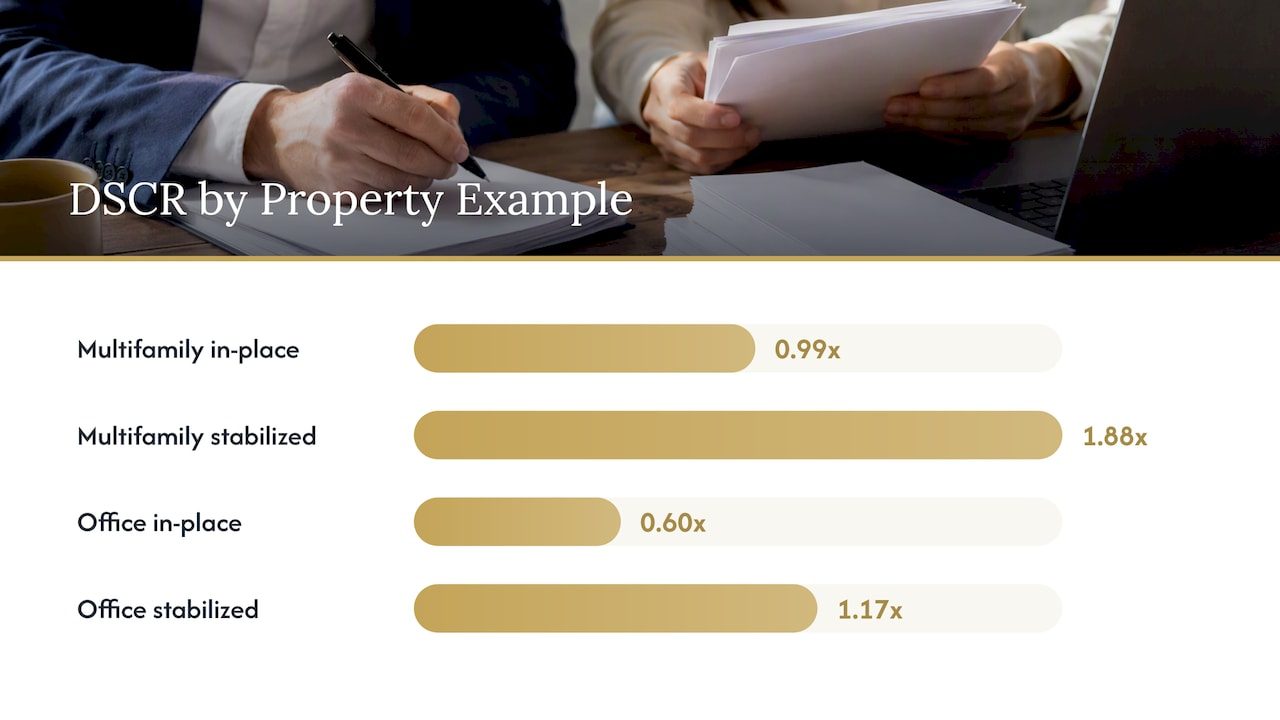
Now look at coverage. On a hypothetical $3.5 million bridge loan with interest-only debt service of $297,500 a year (8.5 percent), in-place DSCR is about 0.99x. The property cannot service its own debt on today’s income, so the loan needs an interest reserve, and that reserve is part of the capital stack you must raise. At stabilization, the same debt service produces roughly 1.88x, which is why the take-out refinance is plausible. The lender’s whole analysis hinges on whether the sponsor can cross from 0.99x to something healthy before the reserve runs dry.
The same logic appears in a published worked example for an office building, where in-place NOI of $600,000 rising to $1.17 million at 90 percent occupancy moves DSCR from 0.60 to about 1.17. In both cases the stabilized assumption, not the current rent roll, decides whether the loan clears its covenants.
Which number drives which decision
Purchase price and going-in yield
Sellers and brokers quote a going-in cap rate on in-place NOI, but they frequently pitch value on stabilized or “pro forma” NOI. When a broker says a property is not yet stabilized, the price usually already contains part of the upside. Compare the price against in-place NOI to see how much of the plan you are paying the seller for in advance.
Bridge and construction loan sizing
Transitional lenders generally start from in-place or as-is income and then test the business plan. Experienced observers note that the delta between the two figures signals a value-add opportunity, but lenders judge the quality of that bridge by how feasible the closing of the gap is. If your path to stabilized NOI depends on excessive capital expenditures or optimistic rent growth, lenders will adjust terminal value and loan sizing downward regardless of your projection. The OCC’s construction lending examination handbook reflects the same discipline: a feasibility study should project cash flow adequate to service debt and allow orderly repayment, with required coverage varying by tenant strength and lease status.
Permanent and CMBS financing
Permanent lenders size to stabilized, in-place-supported income. A CMBS or agency-style execution will generally want leases signed, rents collected and occupancy at or near a stabilized level before it will give full credit to the income. Debt yield and DSCR tests are applied to the lender’s underwritten NOI, not your pro forma.
Preferred equity and joint venture capital
Equity partners care most about stabilized NOI and yield on cost, since their return depends on exit value. They also care about the in-place shortfall, because negative carry is funded from the capital stack. Showing both numbers and a reserve plan builds credibility.
Yield on cost
For development and heavy value-add, the useful test is stabilized NOI divided by total project cost. If yield on cost does not exceed the market cap rate by a meaningful spread, the project is creating little value for the risk taken. The spread you require is a judgment call that depends on asset class and market.
How the gap gets built: the roll-forward
Lenders do not accept a jump from one number to the other. They want a monthly or quarterly roll-forward that shows how each lease expiration, renovation turn and lease-up month moves income. A defensible bridge includes:
- Lease-by-lease rollover. Expiring leases, assumed renewal probability, downtime and re-leasing costs such as tenant improvements and commissions on commercial space.
- Absorption pace. Units or square feet leased per month, anchored in submarket data and your own leasing history. Our guide to absorption underwriting explains how to find the month your reserves run out.
- Concession burn-off. Free rent and discounts that depress early collections.
- Capital plan and timing. Renovation costs, how they are phased, and the downtime each phase creates. A disciplined project budget baseline helps keep renovation spending tied to the schedule that your stabilized numbers assume.
- Funded reserves. Interest, operating deficit and leasing cost reserves sized to the downside case, not the base case.
The quality of the rent roll itself is a recurring weak point. Small discrepancies between the rent roll and actual collections compound quickly once a lender normalizes them, which is the subject of our piece on rent roll underwriting for lenders.
Common mistakes that cost sponsors proceeds
- Using asking rents as market rents. Lenders reconcile your assumptions to leases actually signed.
- Omitting a management fee or reserves because the current owner self-manages. Lenders add them back as a matter of course.
- Ignoring tax reassessment after acquisition, which can lift expenses and shrink stabilized NOI in many jurisdictions.
- Stabilizing too fast. A 12-month plan in a submarket that absorbs space over 24 months will draw an immediate haircut.
- Presenting only one number. A package that shows only stabilized NOI invites the lender to distrust everything else in it.
- Underestimating capital needs. Renovation overruns delay stabilization, and delay is what depletes the interest reserve.
- Mixing definitions. Quoting a T-12 in one exhibit and an annualized current month in another creates reconciliation questions that slow credit approval.
How to present both numbers to a lender
A lender-ready package leads with in-place NOI, because that is the number that can be verified, and then walks to stabilized NOI in explicit steps. Include a bridge schedule that reconciles the two lines item by item, a sources and uses statement that funds the carry, and a sensitivity table showing DSCR and debt yield if rents land 5 to 10 percent lower or lease-up takes six months longer. Our six-step underwriting checklist for sponsors lays out the supporting analysis, and our guide on actual versus underwritten DSCR shows how to present coverage so it reconciles to the lender’s own math.
Our perspective
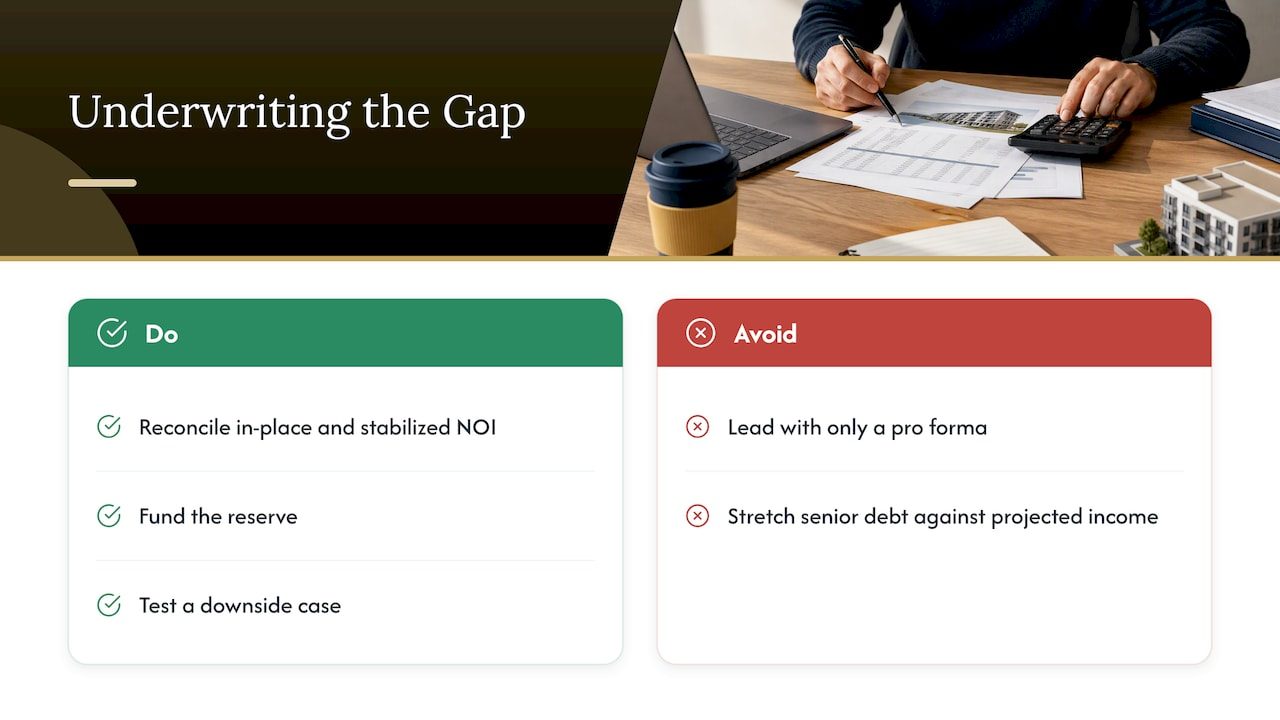
We see the same pattern across sponsor submissions: the stabilized number is rarely the problem. The problem is the unexplained distance between it and the in-place number. A sponsor who walks into a lender conversation with a clear reconciliation, a funded reserve and a downside case is usually received very differently from one who leads with a pro forma and a target loan amount.
Our view is that the stabilized NOI is a promise, and the in-place NOI is the evidence. Institutional-grade underwriting means testing the promise against the evidence before a lender does, and adjusting the business plan, the leverage or the capital stack when the two do not meet. Sometimes that means a lower loan amount paired with preferred equity rather than stretching senior debt against projected income. Sometimes it means a different lender type entirely, since banks, debt funds and CMBS conduits weigh in-place versus stabilized income differently. The right structure depends on the asset, the sponsor’s track record and how quickly the plan can be proven.
— Jerry
Getting the gap financed
If you are preparing a value-add acquisition, a lease-up or a refinance where in-place and stabilized NOI are far apart, the structure matters as much as the headline rate. Brookmont Capital Ventures underwrites both figures, packages the roll-forward for lender and investor review, and places the deal with institutional lenders, debt funds and equity partners. You can review the bridge, construction, CMBS and preferred equity options we arrange, or the capital stack advisory and underwriting services we provide before a deal goes to market.
FAQ
Is stabilized NOI the same as pro forma NOI?
They are closely related and often used interchangeably, but not identical. Pro forma NOI is any forward-looking projection, including a first-year budget. Stabilized NOI is the specific pro forma at normalized occupancy, market rents and full expenses. Always confirm which assumptions a lender or seller means.
Do lenders use in-place or stabilized NOI to size a loan?
It depends on the loan type. Bridge and construction lenders generally size on in-place or as-is income and test the plan to stabilization, while permanent lenders size to stabilized income that is supported by signed leases. Many transitional loans blend both through an as-stabilized valuation with holdbacks or future funding.
What occupancy counts as stabilized?
There is no universal threshold. Practitioners often cite roughly 90 to 95 percent economic occupancy with market rents, but individual lenders set their own tests, sometimes requiring a minimum period at that level before releasing permanent financing.
Can in-place NOI be higher than stabilized NOI?
Yes. That happens when current income is inflated by above-market leases, temporarily low expenses or one-time income. Underwriters normalize those items, so stabilized NOI can come in below the in-place figure, and the loan is sized accordingly.
How do I calculate value from NOI?
Divide NOI by the cap rate. Applied to in-place NOI, the result is the as-is value; applied to stabilized NOI, it is the as-stabilized value, which is only reachable if the business plan is executed and funded.
Sources
- Comptroller’s Handbook: Commercial Real Estate Lending, OCC
- Examination Handbook 213, Construction Lending, OCC
- Vacancy & Credit Loss: In-Place vs. Stabilized Underwriting, MMCG Invest
- Stabilized NOI glossary entry, REI Prime