
Tight Breakeven Occupancy: Lender Tests and Financing for Sponsors

Breakeven occupancy is the occupancy percentage at which a property’s income exactly covers operating expenses plus annual debt service, the floor lenders and asset managers watch to avoid negative cash flow. At that threshold, debt service coverage ratio equals 1.0x: every dollar of income is spoken for, with nothing left over. Investors track it because the gap between current occupancy and breakeven, the vacancy cushion, tells you how much turnover or market softness a deal can absorb before it starts losing money.
TL;DR:
- Breakeven occupancy is most useful when kept below roughly 85 percent, depending on asset class and market volatility, to ensure a comfortable safety margin.
- Relying on potential gross income rather than actual collections makes the metric more conservative and easier to compare across deals.
- Under stress scenarios, breakeven occupancy can spike by 4 to over 10 points, highlighting the importance of monitoring market conditions rigorously.
- Improving operational, revenue, and financing strategies can significantly lower breakeven occupancy, especially through refinancing or adding ancillary income streams.
- Regular stress-testing and monitoring are essential, as dropping below a five-point cushion quickly signals the need for action before covenant breaches occur.
Table of Contents
- What Does Breakeven Occupancy Actually Measure?
- How Do You Calculate Breakeven Occupancy?
- How Do Lenders Use Breakeven Occupancy?
- What Happens to Breakeven Occupancy Under Stress?
- What Levers Actually Lower Breakeven Occupancy?
- How Do You Translate Breakeven Into Units and Market Context?
- How Brookmont Capital Ventures Applies This Metric
- Monitoring Breakeven After Closing: A Working Checklist
- When a Tight Breakeven Calls for a Financing Conversation
- Sources
- FAQ
What Does Breakeven Occupancy Actually Measure?
Breakeven occupancy compares three numbers: operating expenses, annual debt service, and potential gross income (PGI). Get any one wrong and the ratio lies to you.
Operating expenses cover property taxes, insurance, maintenance, management fees, and utilities not passed through to tenants. Annual debt service is the total principal and interest owed on the property’s financing for the year, a figure any DSCR loan underwriter will already have modeled for you. PGI is the income the property would generate at 100% occupancy, current contractual rents, no discounts or delinquencies.
That last point matters more than most investors realize. Using economic occupancy, which reflects actual collections, instead of PGI in the denominator understates risk and produces a breakeven number that looks better than reality supports, according to Cove’s breakeven occupancy glossary. PGI keeps the metric conservative and comparable across deals, which is exactly why lenders default to it.
How Do You Calculate Breakeven Occupancy?
The formula is straightforward: Breakeven Occupancy = (Operating Expenses + Annual Debt Service) ÷ Potential Gross Income, as Wall Street Prep’s breakeven occupancy model lays out.
Here’s how to run it:
- Pull trailing twelve-month operating expenses from the rent roll and expense ledger.
- Confirm annual debt service from the loan amortization schedule (principal plus interest, not just interest-only payments).
- Calculate PGI at 100% occupancy using current contractual rents.
- Add operating expenses and debt service, then divide by PGI.
- Convert the percentage to a required unit count using total unit inventory.
A commonly cited worked example, drawn from Cove’s glossary, uses $480,000 in operating expenses and $540,000 in annual debt service against $1.2 million in PGI:
On a 100-unit property, 85% breakeven means 85 units must stay occupied and paying full rent just to cover costs. Round up, not down, when translating percentage to unit count. Occupying 84.6 units doesn’t exist in practice, and rounding down leaves you short.
How Do Lenders Use Breakeven Occupancy?
Lenders read breakeven occupancy as the mirror image of DSCR. When breakeven occupancy hits 100%, DSCR equals exactly 1.0x, the point where income covers debt service with zero margin. The two metrics express the same survivability from different angles: breakeven speaks the leasing team’s language (occupancy percentage), while DSCR speaks the lender’s language (coverage ratio), which is why underwriters use both rather than picking one.
Most lenders prefer to see breakeven occupancy come in below roughly 85%, though the comfort zone shifts depending on asset class, market volatility, and loan structure, per Wall Street Prep’s real estate underwriting guidance.
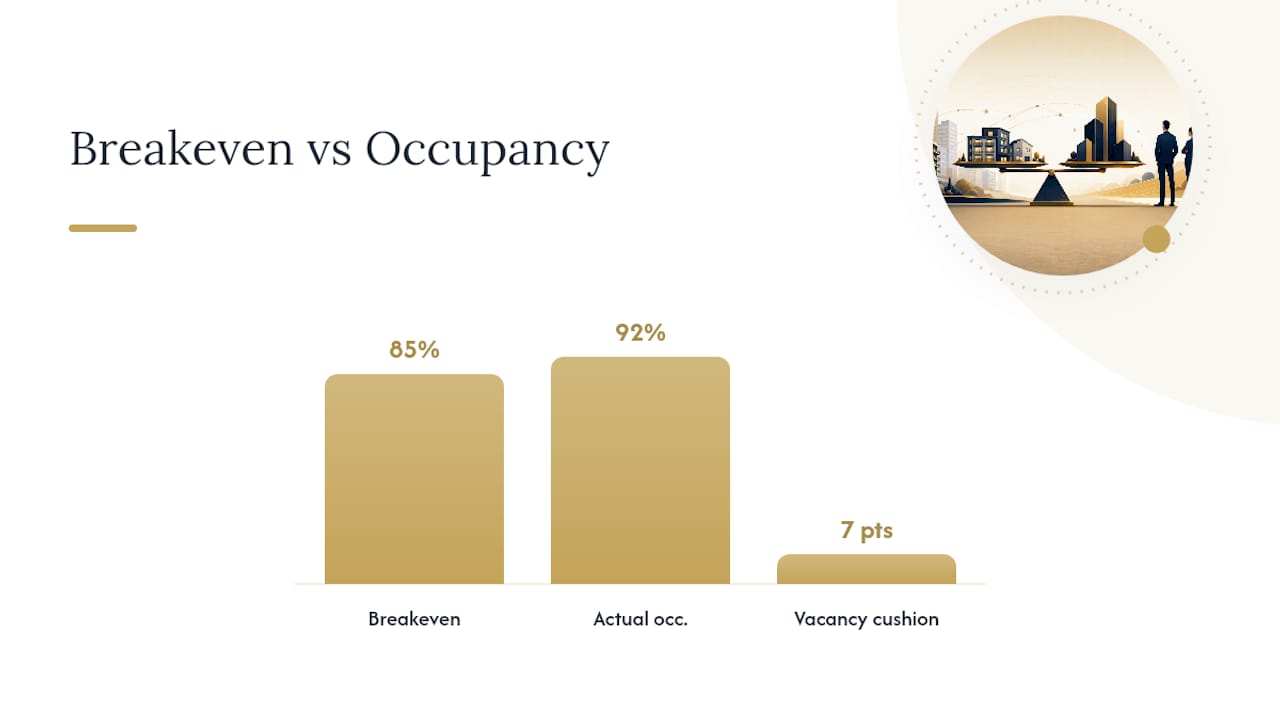
The vacancy cushion is the number that actually predicts trouble. If a property runs at 92% occupancy with an 85% breakeven, the 7-point cushion is what stands between stable cash flow and a capital call.
Lenders stress-test that cushion deliberately:
- A cushion well above a modest threshold generally reads as comfortable to underwriters.
- A cushion moderately close to that threshold invites closer monitoring and tighter covenants.
- A cushion near or below the threshold often triggers a request for reserves or a reevaluation of loan terms.
What Happens to Breakeven Occupancy Under Stress?
A breakeven number calculated once at acquisition tells you almost nothing about how the deal behaves when conditions turn. LoopNet’s multifamily break-even analysis recommends running the formula under three tiers of pressure, flexing rent, operating expenses, and interest rate independently to see which lever moves breakeven the most.
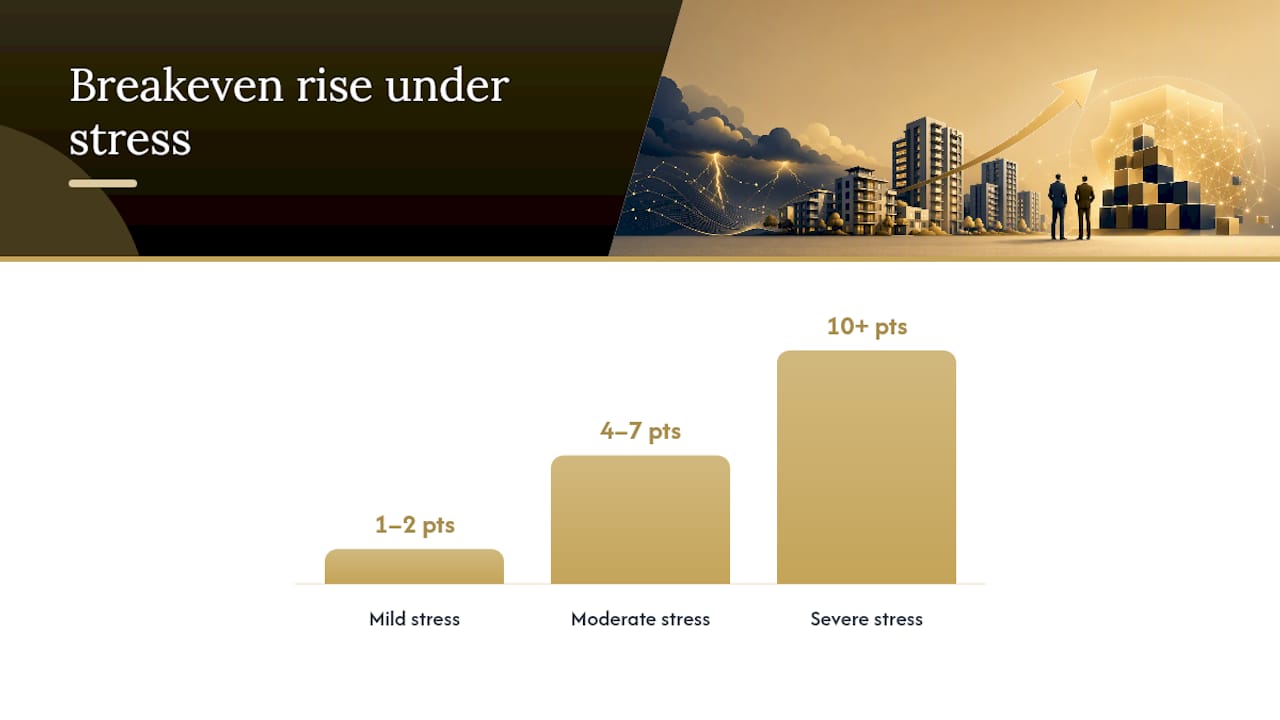
- Mild stress: rents flat, OpEx up 3%, no rate change. Breakeven typically rises 1 to 2 points.
- Moderate stress: rents down 5%, OpEx up 5%, variable-rate debt resets 50 basis points higher. Breakeven can climb 4 to 7 points depending on leverage.
- Severe stress: rents down 10%, OpEx up 8%, rate resets 150 basis points higher. Breakeven can spike 10 points or more on a highly leveraged deal.
Run all three tiers against your current vacancy cushion, not just the base case.
Pro Tip: If the moderate stress scenario pushes your cushion below 5 points, don’t wait for the severe case to play out. Start pricing refinancing or preferred equity options now, while you still have negotiating leverage.
What Levers Actually Lower Breakeven Occupancy?
Three categories of action move the ratio, and they rarely work in isolation.
- Operational: rebid vendor contracts annually, install submetering or energy programs to cut utility exposure, and renegotiate management fees when scale allows it.
- Revenue: add ancillary income (parking, storage, pet fees), capture loss-to-lease on renewals, and push targeted rent increases where the submarket supports them.
- Financing: refinance into better terms, extend amortization to lower annual debt service, swap variable-rate exposure for fixed, or bring in preferred equity to reduce the senior loan balance. LoopNet’s analysis shows a 1-point rate reduction on a $4 million loan amortized over 25 years can save roughly $30,000 in annual debt service, enough to move breakeven occupancy several points on its own.
Pro Tip: Build a short-term reserve line before starting value-add renovations. Construction disruption almost always pushes economic occupancy down temporarily, and a thin cushion during that window is when refinancing options narrow fastest.
How Do You Translate Breakeven Into Units and Market Context?
Percentages are abstract until you convert them into leased space. On a 60-unit property with an 82% breakeven, that’s 49.2 units, rounded up to 50, that must stay rent-paying to break even.
- Compare your breakeven number against current submarket occupancy, not just your own building’s history.
- A property with an 85% breakeven sitting in a submarket averaging 91% occupancy has a real cushion; the same breakeven in a submarket averaging 87% does not.
- Weigh breakeven alongside DSCR and cap rate movement together. A tight breakeven paired with cap rate compression in the exit market compounds risk rather than offsetting it.
Asset managers who integrate breakeven into deal summaries alongside DSCR and loan-to-value, tracking the trajectory through lease-up and stabilization, tend to catch tightening cushions months before a covenant breach shows up on a lender’s radar, a pattern Wall Street Prep’s debt service framework also flags for underwriters reviewing stabilized assets.
How Brookmont Capital Ventures Applies This Metric
Brookmont Capital Ventures builds breakeven occupancy into every deal packet alongside DSCR and capital stack recommendations, not as a standalone number but as one input shaping the financing structure we recommend.
- When breakeven runs tight against submarket occupancy, we evaluate bridge financing to buy stabilization time.
- If the cushion has eroded since acquisition, we model refinancing scenarios to lower annual debt service.
- Where senior debt capacity is maxed out, we assess preferred equity to reduce leverage without diluting control further than necessary.
Distinguishing physical occupancy (units filled) from economic occupancy (rent actually collected) also matters operationally. Tools like SurfaceOps that give property managers compliance-ready condition reporting help asset teams keep the operational side of that distinction tight, since deferred maintenance and turnover friction both widen the gap between the two.
Monitoring Breakeven After Closing: A Working Checklist
I’d rather see a sponsor refresh this number too often than not enough. Pull the rent roll monthly and recheck breakeven against actual PGI. Run the full stress-test tiers quarterly, not just at acquisition. The moment your cushion drops under 5 points, someone on the asset management team, not the leasing agent, not the property manager alone, needs to own the decision on whether to act.
— Jerry
When a Tight Breakeven Calls for a Financing Conversation
Running the math and finding your cushion thinner than you’d like isn’t a dead end. It’s a financing question, and it’s the exact question Brookmont Capital Ventures exists to answer.
We offer advisory services related to bridge loans, refinancing, construction financing, and preferred equity for sponsors facing breakeven occupancy challenges due to changes in financing costs, lease-up delays, or renovation disruption. When refinancing alone is insufficient, advisory services can help develop capital stacks that combine senior debt reduction with preferred equity, aiming to improve financial flexibility without unnecessary loss of control. If your latest stress test left your vacancy cushion under 5 points, that’s the moment to talk to us, not after the covenant notice arrives. Review your financing solutions options with our team and get a capital stack built around your actual number, not a generic template.
Sources
- Breakeven Occupancy Ratio | Formula + Calculator
- Multifamily break-even analysis: vacancy thresholds & risk
- Breakeven occupancy in CRE: definition, formula & examples | Cove glossary
FAQ
How Do I Calculate My Occupancy Percentage?
Divide occupied, rent-paying units by total units for physical occupancy, or divide actual rent collected by potential gross income for economic occupancy; breakeven occupancy itself uses PGI as the denominator, not either of these directly.
How Does Breakeven Occupancy Relate to DSCR?
Both describe the same coverage threshold, one in occupancy percentage, the other in a coverage ratio lenders use directly in underwriting.