
Yield Maintenance vs Defeasance: What CRE Borrowers Should Know

Yield maintenance is a cash penalty. Defeasance is a collateral swap. That single distinction drives almost everything else in this comparison, from which lenders require which method to how much your prepayment will actually cost.
Yield maintenance requires you to pay the lender a lump sum calculated as the present value of the remaining coupon shortfall, discounted at a Treasury-based rate, and the loan is retired outright. Defeasance requires you to buy a portfolio of Treasury or agency securities that replicates your remaining payment schedule, hand it off to a successor borrower entity, and walk away with your property lien released while the loan itself lives on inside the CMBS trust.
- Life company loans and single-asset/single-borrower (SASB) deals often use yield maintenance.
- CMBS conduit loans almost always require defeasance because pooled bondholders need predictable, uninterrupted cash flow.
Pull your loan documents today and check two things: your lockout expiration date and whether your note permits yield maintenance, defeasance, or both. Then model both scenarios before you commit to either exit.
Key Takeaways
Choosing between yield maintenance and defeasance comes down to loan type, current Treasury yields relative to your coupon, and how much calendar flexibility your closing actually allows.
| Point | Details |
|---|---|
| Know your mechanism | Yield maintenance is a cash make-whole penalty; defeasance substitutes Treasury or agency securities and keeps the loan alive. |
| Loan type dictates the default | CMBS conduit loans require defeasance; life company and many SASB loans typically use yield maintenance. |
| Rate direction flips the cost | When Treasury yields exceed your coupon, defeasance can produce negative defeasance, meaning cash back to the borrower. |
| Build in real time | Defeasance runs 30 to 45 days and needs a 45 to 60 day scheduling buffer; yield maintenance can close in days. |
| Model before you decide | Brookmont Capital Ventures builds side-by-side payoff models and coordinates vendors for sponsors weighing either route. |
This article is general information, not a substitute for advice from a qualified financial advisor. Consult a qualified financial professional about your own circumstances before acting on anything here.
Table of Contents
- Yield Maintenance Vs Defeasance: A Side-By-Side Snapshot
- How Yield Maintenance Works: Formula, Inputs, and Example
- How Defeasance Works: Process, Parties, and Deliverables
- Cost Drivers: When Defeasance Gets Cheaper Than Yield Maintenance
- Decision Checklist: Choosing Between Yield Maintenance and Defeasance
- Tax Implications and Accounting Treatment for Borrowers
- Market Trends Shaping the Yield Maintenance vs Defeasance Decision
- Risks and Drawbacks of Each Method
- Real-World Scenarios: How the Numbers Play Out
- Legal and Regulatory Considerations
- Why Timing and Execution Risk Deserve More Attention Than Price
- Sources
- FAQ
Yield Maintenance Vs Defeasance: A Side-By-Side Snapshot
The two mechanisms differ on speed, legal effect, and who tends to use them.
- Speed: Yield maintenance typically closes in days once your servicer issues a payoff quote. Defeasance usually takes 30 to 45 days because it involves securities purchases, legal entity formation, and multi-party sign-off.
- Legal effect: Yield maintenance ends the loan. Defeasance keeps the loan alive inside the trust but substitutes a successor borrower and releases your real property from the lien.
- Typical users: Life insurance companies and many agency loans favor yield maintenance. CMBS conduit deals mandate defeasance almost without exception.
- Cost tilt: When Treasury yields sit below your loan coupon, yield maintenance tends to cost more because the make-whole calculation captures a larger reinvestment gap. When Treasury yields rise above your coupon, defeasance can get cheaper, sometimes dramatically.
Most CMBS conduit loans carry a standard prepayment sequence: a 24-month lockout, followed by a defeasance window lasting roughly 93 months. Then comes a brief open period before maturity. Know exactly where your loan sits in that timeline before you model anything.
How Yield Maintenance Works: Formula, Inputs, and Example
Yield maintenance is built on one core idea: the lender should end up in the same economic position whether you pay off early or keep paying through maturity. The formula calculates the present value of your remaining scheduled coupon payments, minus what the lender could earn reinvesting your payoff at a current Treasury rate.
- Pull the comparable Treasury yield. Most yield maintenance clauses reference a Treasury with a maturity matching your loan’s remaining term, sourced from the Federal Reserve’s H.15 selected interest rates release.
- Add the make-whole spread. Loan documents typically layer on 25 to 50 basis points above the base Treasury rate to account for reinvestment risk and lender margin.
- Discount the shortfall. The gap between your loan coupon and the adjusted Treasury rate gets discounted back to today’s dollars across your remaining term.
Statistic Callout: On a $10 million loan with a 6% coupon and eight years remaining, dropping the comparable Treasury yield from 4.5% to 3.5% can add hundreds of thousands of dollars to the penalty, because every basis point of spread compounds across the remaining term. Small Treasury moves create outsized swings in your payoff number.
Yield maintenance typically closes fast because there’s no collateral substitution, just a payoff wire and a servicer processing fee layered on top of the calculated penalty.
How Defeasance Works: Process, Parties, and Deliverables
Defeasance replaces your real estate collateral with a portfolio of government securities engineered to match your loan’s exact remaining payment schedule, dollar for dollar, month for month.

The mechanics unfold in a specific sequence. You (or your defeasance consultant) purchase a basket of Treasury or agency securities, structured so their scheduled interest and principal payments line up with your loan’s amortization and any balloon payment. A newly formed successor borrower, usually a single-purpose entity, takes on the loan obligation and the securities. Your original property lien releases, and you’re free to sell, refinance, or hold the asset unencumbered by that debt.
Executing this cleanly requires coordinating several parties at once:
- A defeasance consultant who structures the securities portfolio and manages the transaction
- A securities broker who executes the Treasury or agency purchases
- A CPA who issues a comfort letter confirming the cash flows match
- Legal counsel who drafts the successor borrower documents and lien releases
- The master servicer and trustee, who must approve the substitution on behalf of CMBS bondholders
The full process typically runs 30 to 45 days from engagement to closing, and professional fees on institutional-size deals commonly land in the low five-figure range, separate from the cost of the securities themselves.
Pro Tip: Ask your defeasance consultant early whether your loan documents permit agency securities (Fannie Mae, Freddie Mac, Ginnie Mae) instead of Treasuries. Agency yields often run higher, which can shrink the size of the required portfolio and lower your total cost.
Cost Drivers: When Defeasance Gets Cheaper Than Yield Maintenance
The single biggest variable in either calculation is the relationship between your loan coupon and prevailing Treasury yields, and it can flip the entire cost equation depending on where rates sit when you prepay.
When Treasury yields sit meaningfully below your coupon, both methods get expensive because the lender is losing a wide reinvestment spread. But when Treasury yields climb above your coupon, something unusual happens: the securities you need to buy for defeasance can actually cost less than your outstanding loan balance, a phenomenon known as negative defeasance. In that scenario, you can pay off the loan and walk away with cash in hand. Rate windows in the 2024 through 2026 period have periodically produced exactly this setup on older, lower-coupon vintages.
Statistic Callout: Professional fees alone on a defeasance for a large institutional loan commonly run in the low five-figure band, covering the consultant, CPA comfort letter, and legal work, before you even count the securities purchase.
- Consultant and structuring fee
- Securities broker commission
- CPA comfort letter fee
- Legal fees for successor borrower documentation
- Rating agency and trustee review fees where applicable
Model both routes using current Fed H.15 data before you assume either one wins on cost.
Decision Checklist: Choosing Between Yield Maintenance and Defeasance
Run this sequence before committing to either exit strategy.
- Confirm what your loan actually permits. Check your note for lockout expiration, permitted prepayment methods, and any negotiated defeasance collateral flexibility.
- Pull current Treasury yields from Fed H.15 and get preliminary consultant fee quotes for both scenarios.
- Model both penalties side by side, including all professional fees, not just the headline prepayment number.
- Weigh timeline against certainty of closing. If you’re closing a sale in two weeks, yield maintenance’s speed may outweigh a marginally better defeasance number.
- Decide based on loan size and rate environment. Larger loans often justify defeasance’s complexity when Treasury yields favor it; smaller or time-pressed deals often favor yield maintenance’s speed.
Pro Tip: Start defeasance scheduling 45 to 60 days ahead of your target closing. Coordinating a consultant, broker, CPA, and trustee on a compressed timeline is the single most common cause of failed or delayed closings.
Execution Steps and Timeline for Each Route
Yield maintenance moves fast: request a payoff quote from your servicer, wire the funds, and receive your lien release, often within days.
Defeasance runs longer and involves more moving parts: engage a consultant, structure and purchase the securities, obtain CPA comfort, secure master servicer and trustee approval, and close through the successor borrower entity. Expect 30 to 45 days start to finish.
The most common scheduling pitfall is treating defeasance like a same-week transaction. If you’re tying it to a property sale, build in the 45 to 60 day buffer or risk pushing your closing date.
Brookmont’s Perspective on Modeling This Decision
Brookmont Capital Ventures approaches yield maintenance and defeasance decisions the same way it approaches any capital stack question: model the numbers first, negotiate the flexibility second.
- We build side-by-side payoff models using current Treasury data before recommending a route
- We push to expand permitted collateral (agency securities where allowed) during original loan negotiation, not after
- We coordinate consultant, servicer, and counsel timelines to protect your closing date
- When Treasury yields favor negative defeasance, we flag it early rather than let a borrower default to the familiar yield maintenance path
Reach out if you want a modeled comparison run against your actual loan terms.
Tax Implications and Accounting Treatment for Borrowers
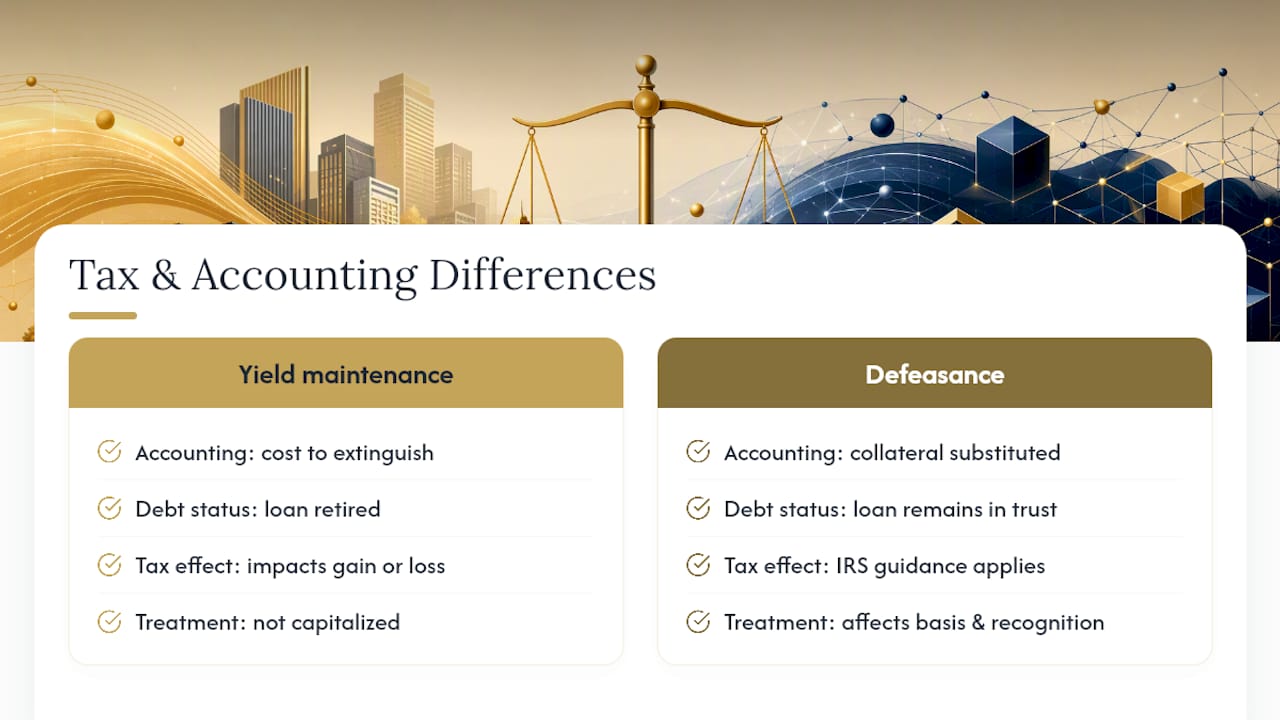
Yield maintenance payments and defeasance costs get treated differently on your books, and the distinction matters more than most borrowers expect.
A yield maintenance penalty is generally treated as a cost of extinguishing debt, which typically affects your gain or loss calculation on the transaction rather than getting capitalized. Because the loan is retired outright, the accounting is comparatively straightforward: you’re closing out a liability and recognizing whatever prepayment cost hits your income statement or gets netted against sale proceeds.
Defeasance is more complicated because the loan doesn’t disappear. You’re not extinguishing debt in the traditional sense; you’re substituting collateral and a successor obligor while the original loan remains outstanding inside the trust. The IRS provides specific guidance on defeasance of debt that distinguishes legal defeasance from in-substance defeasance, and the treatment affects how you recognize any gain or loss and how the transaction interacts with your basis in the property.
Because these distinctions carry real consequences for how a sale or refinancing gets reported, loop your tax counsel or CPA into the workflow before you sign a defeasance engagement letter, not after the securities are purchased. Large institutional transactions routinely include a dedicated tax review precisely because the successor borrower structure raises questions a standard loan payoff never does. This isn’t a step to handle after the fact. Get your accountant’s read on the specific structure your lender requires before you commit fees to a consultant.
Market Trends Shaping the Yield Maintenance vs Defeasance Decision
Interest rate volatility over the past several years has made the choice between these two mechanisms far more consequential than it was in a flatter rate environment.
When Treasury yields sit well below loan coupons, as they did for years following the 2008 financial crisis, defeasance and yield maintenance produce fairly similar, predictably expensive outcomes. The rate cycle since 2022 changed that dynamic. As Treasury yields climbed and, at times, moved above coupons locked in during the low-rate lending years of 2020 and 2021, borrowers holding those older loans started encountering negative defeasance scenarios that simply didn’t exist a few years earlier.
This has pushed more sponsors to run both calculations before assuming yield maintenance is the default cheaper option, particularly on loans originated in 2020 through 2022 at coupons that now sit below current Treasury yields. It has also increased demand for defeasance consultants and driven more borrowers to negotiate expanded permitted-collateral language, including agency securities, into new loan documents at origination rather than discovering those limits at exit.
The practical upshot for sponsors refinancing or selling in 2026: don’t assume last cycle’s rules of thumb still apply. A loan that would have clearly favored yield maintenance in 2019 may now sit in defeasance’s favor, or vice versa, depending entirely on where your specific coupon sits relative to today’s Treasury curve.
Risks and Drawbacks of Each Method
Yield maintenance carries interest rate risk in one direction: if Treasury yields have fallen since origination, your penalty balloons, sometimes to a number that dwarfs the outstanding principal reduction you were hoping to achieve. There’s also less flexibility once you’ve triggered the payoff calculation; it’s a fixed number based on a fixed formula, with little room to negotiate.
Defeasance’s primary risk is operational, not financial. Coordinating a consultant, broker, CPA, master servicer, and trustee on a 30 to 45 day timeline creates real scheduling exposure. Practitioners consistently point to execution complexity, not price, as the main cause of failed or delayed transactions, particularly when a defeasance is tied to a hard sale closing date. Miss your window and you risk a broken deal or an expensive bridge to cover the gap.
From the lender’s side, both methods exist to protect the same interest: preserving the yield or cash flow stream investors were promised. Yield maintenance does this by making the borrower pay for the lost reinvestment spread directly. Defeasance does it by keeping the original payment stream intact through substitute collateral, which is precisely why CMBS trusts, structured around pooled investor cash flows, insist on it rather than accepting a cash payoff. Borrowers sometimes assume defeasance is inherently more lender-friendly; in practice, it simply reflects what a securitized structure requires to keep functioning.
Real-World Scenarios: How the Numbers Play Out
Consider a life company loan with a $15 million balance, a 5.75% coupon, and six years remaining, prepaid when comparable Treasury yields sit at 4%. The yield maintenance formula captures roughly a 1.75-point spread across the remaining term, producing a penalty that can run into the high six figures once discounted to a good rental yield for an investment property present value. The borrower here has no defeasance option; the life company loan documents specify yield maintenance only, and the payoff closes within a week of the servicer’s quote.
Now consider a CMBS conduit loan of similar size and remaining term, but with a 4.25% coupon originated in 2021, prepaid when Treasury yields have since risen to 4.75%. Because the comparable Treasury yield now exceeds the loan coupon, the securities portfolio needed to replicate the remaining payments can cost less than the outstanding balance, a negative defeasance outcome. The borrower engages a consultant, the process runs about six weeks, and the transaction closes with the borrower receiving residual cash rather than writing a penalty check.
These aren’t hypothetical extremes. They illustrate why the same borrower, holding two different loans originated in different rate environments, can face two completely opposite outcomes depending purely on where the loan sits on the coupon-versus-Treasury spectrum at exit. Neither loan type is inherently better; the outcome depends entirely on timing and structure, which is exactly why modeling both scenarios before assuming an answer matters.
Legal and Regulatory Considerations
Both mechanisms are governed primarily by the language in your original loan documents, not by a uniform federal standard, so the specific note and security instrument control what you’re actually allowed to do.
CMBS conduit loans are further constrained by pooling and servicing agreements that dictate what the master servicer and trustee must approve before releasing the lien, which is why defeasance in that context always runs through servicer and trustee sign-off rather than a simple borrower-lender negotiation. Life company and agency loans typically give the lender more direct control, since there’s no pooled investor base whose interests a servicer must protect.
The defeasance process also intersects with federal tax guidance on debt extinguishment, which is why counsel and CPA sign-off are standard requirements rather than optional extras. Rating agencies may also review larger defeasance transactions within CMBS structures, particularly when permitted collateral expands beyond straight Treasuries to include agency securities.
If your loan documents are silent or ambiguous on permitted collateral types or the specific make-whole formula, get counsel to review the exact language before you engage a consultant or request a servicer quote. Ambiguity here tends to surface expensive surprises late in the process, not early.
Why Timing and Execution Risk Deserve More Attention Than Price
Most comparisons of these two mechanisms fixate on which one is cheaper, and that’s the wrong starting question for a lot of sponsors.
Price matters, but it’s a number you can model with reasonable precision once you know your Treasury benchmark and coupon. What’s harder to model, and what conventional advice tends to underweight, is calendar risk. A defeasance that runs long because a CPA comfort letter gets delayed or a trustee sits on an approval doesn’t just cost money in extended interim carry. It can blow up a sale closing entirely, and that downside rarely shows up in the yield maintenance versus defeasance comparisons most borrowers read before they’re in the middle of a live deal.
The judgment this analysis actually supports is straightforward: run both calculations, but weight your final decision toward whichever route your transaction timeline can actually absorb. A borrower closing a sale in three weeks should not choose defeasance purely because it models a few basis points cheaper, only to blow the closing date when a trustee approval slips. Sponsors who treat the 45 to 60 day defeasance runway as a hard floor, not a suggestion, avoid the single most common failure mode in this entire process. That discipline matters more than shaving marginal cost off the payoff number.
How Brookmont Capital Ventures Supports Your Prepayment Strategy
Brookmont Capital Ventures models yield maintenance and defeasance side by side against your actual loan terms and current Treasury yields, so you’re deciding based on real numbers rather than a rule of thumb from your last deal.
When you engage Brookmont, expect a modeled cost comparison for both prepayment routes, coordination with the defeasance consultants, brokers, and counsel your transaction requires, and scheduling support built around your actual closing date, not a generic timeline. That coordination piece is where most borrowers lose time and money: juggling a consultant, master servicer, and trustee approval on your own, without someone actively managing the calendar, is how a 45 day process turns into 60. Brookmont handles that coordination as part of a broader capital stack advisory engagement, whether you’re prepaying ahead of a sale, refinancing into a new structure, or restructuring debt across a portfolio.
If you’re weighing a prepayment decision on an upcoming sale or refinance, request a modeled comparison through Brookmont’s financing solutions page and get both numbers in front of you before you commit to either route.
Sources
- Yield maintenance definition — Investopedia
- Prepayment analysis: defeasance vs yield maintenance — Apers
- CMBS defeasance process, costs, and requirements — LegalClarity
FAQ
What is the difference between defeasance and yield maintenance?
Yield maintenance is a cash penalty paid to the lender based on the present value of lost interest; defeasance replaces your property collateral with Treasury or agency securities while the loan stays outstanding inside a trust.
What is yield maintenance on a loan?
It’s a prepayment penalty, common on life company and agency loans, calculated as the present value of your remaining coupon payments discounted at a Treasury-based rate plus a small spread, typically 25 to 50 basis points.
What is the difference between spread maintenance and yield maintenance?
Spread maintenance and yield maintenance are closely related prepayment penalty structures; both discount the lost coupon at a benchmark rate, though the specific spread and index used can vary by lender and loan document, so the exact formula always depends on your note’s language.
What is defeasance in a loan?
Defeasance is the process of substituting a portfolio of government securities for your real estate collateral, releasing your property lien while a successor borrower assumes the loan obligation inside the CMBS trust, a process that typically takes 30 to 45 days.
Which option should I model first if I’m not sure which my loan requires?
Check your loan documents first; if you have a CMBS conduit loan, defeasance is almost always mandatory, while life company and many agency loans default to yield maintenance, so Brookmont Capital Ventures typically starts by confirming the governing loan type before running numbers.
Recommended
- The 2026 CRE Refinancing Wall: What Investors With $500K-5M Projects Need to Know Now
- Commercial Loan Extension: What CRE Borrowers Need to Know | Brookmont Capital Ventures
- How Lenders Evaluate Exit Strategy for Bridge Loans | Brookmont Capital Ventures
- How to Underwrite a CRE Deal When Interest Rates Stay Higher for Longer | Brookmont Capital Ventures