
Commercial Loan Extension: What CRE Borrowers Need to Know

A commercial loan extension is a formal amendment to the original promissory note that moves the maturity date forward, giving the borrower additional time to repay without triggering a full refinance or new underwriting cycle. When a loan matures and the borrower cannot yet pay off the balance, the options are narrower than many sponsors expect.
The most common paths at maturity:
- Short-term extension or amendment — adds months to the maturity date, usually a few months to a couple of years, with limited changes to other terms
- Refinance — replaces the existing loan with a new note, full underwriting, and typically new origination fees
- Bridge loan — short-term replacement financing, often used when the existing lender declines an extension
- Forbearance — temporary suspension or reduction of payment obligations, distinct from moving the maturity date
- Payoff — full repayment from asset sale, equity raise, or other liquidity event
An extension makes sense when the borrower faces a temporary, solvable problem with a credible exit strategy: a construction delay with a signed subcontractor schedule, a lease-up shortfall with a signed letter of intent, or a short-term liquidity gap ahead of a defined refinancing event. It is not a remedy for long-term insolvency or a pattern of missed payments.
Table of Contents
- What does a commercial loan extension actually change in your contract?
- When do lenders actually approve a commercial loan extension?
- What are your options when a commercial loan matures?
- Extension vs. forbearance vs. modification: what is the legal difference?
- How do you request a commercial loan extension, step by step?
- What does a commercial loan extension cost, and how does it affect your credit?
- What lenders evaluate and how to negotiate a better outcome
- What are your options if the lender denies the extension?
- Key Takeaways
- The case for preparing before you need to ask
- Brookmontcapital can structure your extension or find a faster alternative
- Useful sources
What does a commercial loan extension actually change in your contract?
A commercial loan extension is documented as either an amendment to the original promissory note or, in more substantive cases, a replacement note that supersedes the original. The distinction matters. An amendment leaves most existing terms intact and changes only what is explicitly stated, typically the maturity date, any rate adjustment, and a reaffirmation of guarantees. A replacement note, by contrast, legally supersedes the original agreement and resets the entire contract, which is functionally closer to a refinance.
What typically remains unchanged in a standard amendment: existing covenants, default triggers, security interests, and intercreditor agreements all survive unless the amendment explicitly modifies them. This is where borrowers frequently underestimate their exposure. A reaffirmation clause is not optional language — its absence creates genuine ambiguity about whether prior defaults were waived or whether the lender’s security interest remains fully enforceable.
One critical point that surprises many sponsors: guarantors are not automatically bound by a loan extension. Personal guarantees tied to the original note must be expressly reaffirmed or re-signed in the extension document. Without written consent from each original guarantor, the lender may lose the ability to enforce the guarantee after a post-extension default.
Contract language to expect in a well-drafted extension amendment:
- Revised maturity date (the core change)
- Any interest rate adjustment or spread reset
- Reaffirmation of all existing security interests and collateral
- Guarantor consent and reaffirmation signatures
- Confirmation that no prior defaults are waived unless explicitly stated
| What Changes | What Usually Stays the Same |
|---|---|
| Maturity (payoff) date | Amortization schedule and payment amounts |
| Interest rate (if renegotiated) | Covenants and financial tests |
| Extension fee obligation | Default triggers and cure periods |
| Guarantor reaffirmation requirement | Security interests and lien priority |
When do lenders actually approve a commercial loan extension?
Lenders grant extensions when the underlying asset and borrower present a credible path to repayment, not as a courtesy. The most common qualifying situations in commercial real estate involve construction delays with documented timelines, lease-up schedule slippage on a stabilized asset, short-term liquidity gaps ahead of a known refinancing event, or temporary tenant vacancy with a signed lease pending commencement.

The lender’s rationale is straightforward: preserving an earning asset on the books is almost always preferable to a distressed workout, a foreclosure process, or a discounted note sale. That calculus shifts, however, when the borrower’s situation signals deterioration rather than a temporary setback. Lenders treat extension requests with underwriting rigor similar to new loan approvals, routing them through credit committees with updated financial analysis.
Two scenarios that typically qualify:
Construction delay with documented schedule. A developer is 60 days from a 12-month loan maturity, and a subcontractor delay has pushed the certificate of occupancy back by four months. The borrower presents an updated construction schedule signed by the general contractor, a revised draw schedule, and a term sheet from a permanent lender. The lender sees a defined endpoint and a credible exit.
Stabilized asset with temporary vacancy. A retail center is 78% occupied after an anchor tenant vacated. The borrower has a signed letter of intent from a replacement tenant with a projected lease commencement in 90 days. The asset’s debt service coverage ratio is temporarily below covenant, but the signed LOI and historical performance support the extension.
Red flags that make approval unlikely: a pattern of missed or late payments, ongoing insolvency with no identifiable exit, deteriorating collateral values without a remediation plan, or a borrower who cannot demonstrate current liquidity. Lenders require borrowers to be current or only minimally delinquent — deeply delinquent accounts rarely qualify.
What are your options when a commercial loan matures?
Not every situation calls for a straight extension. Understanding the full range of business loan extension options helps you choose the structure that fits your timeline, cost tolerance, and exit plan.
Short-term extension (amendment). The most common form: a written amendment adds 6–24 months to the maturity date, usually with an extension fee and sometimes a rate adjustment. Best suited for borrowers with a clear, near-term exit and a lender relationship in good standing.
Extendible loans. Some commercial loans are originated with pre-negotiated extension options built into the original documents. These typically allow the borrower to exercise one or two extension periods (often 6–12 months each) by meeting defined conditions: no existing default, payment of an extension fee, and sometimes delivery of updated financials or an appraisal. The advantage is speed and certainty — no credit committee re-underwriting if conditions are met.
Bridge financing. A bridge loan is a separate, short-term replacement loan from a new lender, not an amendment to the existing note. It carries higher pricing than a conventional extension but can close faster and does not require the existing lender’s cooperation. Bridge underwriting focuses on the asset’s current value and the borrower’s exit plan rather than historical cash flow. For developers facing a construction delay or lease-up gap, bridge financing is often the most practical alternative when the existing lender declines.
Forbearance and deferment. These are temporary relief mechanisms, not maturity extensions. A forbearance agreement suspends or reduces payment obligations for a defined period without moving the maturity date. Deferment relocates missed payments to the end of the amortization schedule. Both are typically used when the borrower is in or near default and needs breathing room to stabilize.
Decision cues: if you need 6–18 months of runway with a defined exit, a standard extension or extendible option is the most cost-effective path. If the existing lender is uncooperative or the timeline is uncertain, bridge financing gives you independence. If you are in payment distress, forbearance buys time but does not solve the maturity problem.
Extension vs. forbearance vs. modification: what is the legal difference?
These three terms are used interchangeably in casual conversation, but they carry distinct legal and financial consequences.
A loan extension amends the maturity date. Interest continues to accrue on the outstanding principal balance throughout the extended term. Deferred payments are typically added to the end of the amortization schedule, not forgiven. The borrower’s payment obligations remain active; only the deadline moves.
A forbearance agreement temporarily changes payment obligations or suspends the lender’s right to enforce remedies. It does not move the maturity date. When the forbearance period ends, the full balance — including any accrued interest — remains due. Forbearance is a short-term truce, not a structural fix.
A loan modification changes one or more substantive terms of the loan: the interest rate, the amortization schedule, the principal balance, or the covenant structure. When a modification introduces new principal, new underwriting, and a new note, it effectively becomes a refinance with the legal effect of superseding the original agreement. A simple amendment that adjusts only the maturity date is not a modification in this sense.
Refinancing replaces the loan entirely with a new note, new underwriting, new origination fees, and often a new lender. It is the most expensive path in the short term but may be the right choice when the borrower’s situation has changed materially or when the existing loan’s terms are no longer competitive.
Pro Tip: If you need temporary runway with a clear exit in sight, a short-term extension is almost always cheaper than refinancing. If you need permanent relief — a lower rate, reduced principal, or restructured covenants — a modification or refinance is the appropriate tool. Never use a forbearance agreement as a substitute for addressing the underlying maturity problem.
How do you request a commercial loan extension, step by step?
Timing is the single most controllable variable in the extension process. Start the conversation with your lender 60–90 days before maturity on most commercial real estate deals. Waiting until 30 days out compresses the lender’s internal timeline and signals poor planning, both of which reduce your negotiating position.

Primary contacts to involve: your loan officer or relationship manager, in-house or outside counsel, and each guarantor on the original note. All guarantors must be prepared to reaffirm their obligations in writing.
Documentation checklist:
- Current financial statements (trailing 12 months, year-to-date)
- Rent roll and executed leases (or signed LOIs if leases are pending)
- Updated operating projections and pro forma cash flow
- Appraisal or current valuation evidence (broker opinion of value at minimum)
- Evidence of exit plan: signed lease, sales contract, refinancing term sheet, or LOI
- Guarantor financial statements and liquidity evidence
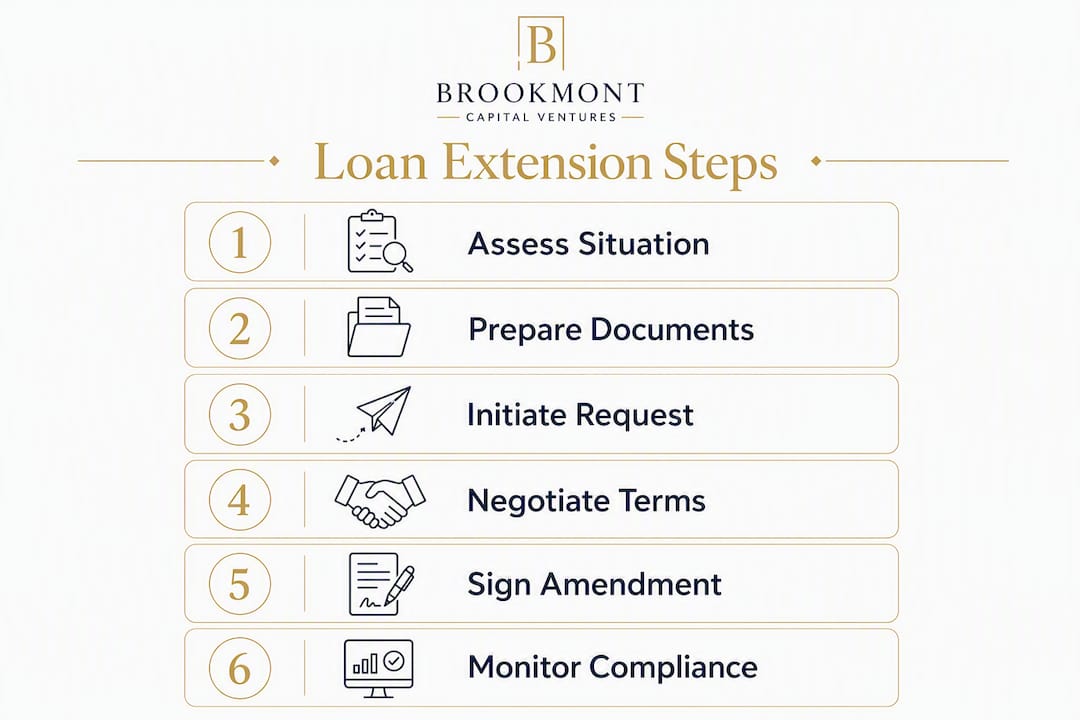
Step-by-step process:
- Prepare the request package (financials, rent roll, exit evidence, projections)
- Submit a formal written request to your relationship manager with a cover memo explaining the situation and proposed terms
- Lender routes the request through internal underwriting review
- Credit committee decision (approval, conditional approval, or denial)
- Execute the amendment, collect guarantor signatures, pay the extension fee, and close
Lenders route extension requests through credit committees the same way they process new loan approvals. Budget 3–6 weeks for this process at a minimum bank lender; some institutional lenders move faster.
Sample request email outline:
- Opening: identify the loan (loan number, property address, current maturity date)
- Situation summary: brief, factual description of why an extension is needed
- Exit strategy: specific, documented path to repayment (signed lease, sale contract, refinancing timeline)
- Proposed terms: requested extension period, willingness to pay an extension fee, any proposed covenant adjustments
- Attachments: financial package, rent roll, exit evidence
- Closing: request a call to discuss and confirm next steps
Understanding how commercial real estate financing works at the institutional level helps you frame this request in language underwriters respond to.
What does a commercial loan extension cost, and how does it affect your credit?
Extension fees on commercial loans typically fall in the range of 0.25%–0.50% of outstanding principal for straightforward amendments. On a $1,000,000 loan, that translates to $2,500–$5,000 paid at signing or capitalized into the balance. More substantive amendments — those that include rate resets, covenant changes, or new collateral requirements — can carry consideration fees of 0.5%–2.0%.
Interest continues to accrue throughout the extension period at the note rate (or the new rate if renegotiated). Whether unpaid interest is capitalized into the principal balance depends on the specific agreement. Capitalization increases the effective balance and compounds future interest costs, so it is worth negotiating explicitly.
| Cost Element | Typical Range | Notes |
|---|---|---|
| Extension fee | 0.25%–0.50% of principal | Paid at signing or capitalized |
| Amendment/consideration fee | 0.5%–2.0% of principal | For substantive term changes |
| Interest accrual | Continues at note rate | Unpaid interest may be capitalized |
| Appraisal/third-party costs | Varies | Often required by lender |
On the credit and market side, a single well-documented extension on a performing loan rarely damages a borrower’s institutional reputation. A pattern of repeated extensions, however, raises pricing on future debt, signals weak underwriting discipline to new lenders, and can limit refinancing options when the borrower eventually needs to access the capital markets. Confirming whether interest accrues and whether unpaid interest is added to principal are the two questions every borrower should ask before signing any extension agreement.
Pro Tip: Ask the lender explicitly whether the extension fee is paid upfront or capitalized, and whether any unpaid interest will be added to principal. Both answers change the real cost of the extension and should be modeled in your pro forma before you sign.
What lenders evaluate and how to negotiate a better outcome
Lenders underwriting an extension request focus on four priorities: current payment history, stabilized or improving collateral value, a credible and documented exit strategy, and sponsor liquidity and track record. A borrower who can demonstrate strength on all four is in a negotiating position. A borrower who is weak on two or more is asking for a favor.
Institutional-grade documentation lenders expect:
- Audited or reviewed financial statements (CPA-prepared, trailing 12 months)
- Current rent roll with lease expiration dates and tenant credit quality
- Updated appraisal or third-party broker opinion of value
- Capital expenditure plan if the asset requires near-term investment
- Guarantor personal financial statements and liquidity evidence
- A written exit strategy memo with specific milestones and dates
Negotiation tactics that improve approval odds:
- Stage the story: present the extension as a defined bridge to a specific event, not an open-ended request for more time
- Offer consideration: propose a fee or a yield step-up (rate increase) to compensate the lender for the extended risk
- Propose targeted covenant adjustments rather than blanket waivers — lenders respond better to precision than to broad relief requests
- Use a third-party valuation to support collateral value if the lender’s internal assessment is conservative
- If the existing lender is hesitant, a short-term bridge proposal from a third-party lender can create competitive pressure
Understanding what different types of commercial lenders prioritize in their underwriting helps you tailor the request to the specific institution.
Scenario contrast: A lease-up project with a signed lease from a creditworthy tenant and a 60-day commencement date is a straightforward approval — the exit is documented and the timeline is short. A development project with continued construction delays, no signed leases, and a sponsor requesting a 12-month extension without a defined milestone is a workout candidate, not an extension candidate. Position your request accordingly.
Pro Tip: Structure the extension with a clear, short exit tied to a defined milestone: a signed lease, a refinancing commitment letter, or an executed sale contract. Lenders approve extensions when they can see the end of the story. Vague timelines produce denials.
What are your options if the lender denies the extension?
A denial is not the end of the road, but it does compress your timeline and require immediate action. The most practical short-term alternatives:
Bridge financing. A bridge loan from a debt fund or private lender can replace the maturing loan and buy 12–24 months of runway. Bridge underwriting is asset-value-driven rather than cash-flow-driven, which makes it accessible when the existing lender’s credit committee is unwilling to extend. Pricing is higher, but the independence is worth it when the alternative is a forced sale.
Equity injection. Bringing in a preferred equity partner or mezzanine lender to reduce the outstanding principal can make the remaining balance refinanceable or payable. This dilutes the sponsor’s return but preserves the asset.
Asset sale or short sale. If the balloon payment cannot be covered and no replacement financing is available, a controlled sale at market value is preferable to a foreclosure. A short sale — selling for less than the outstanding balance with lender consent — is a last resort but avoids the credit and legal consequences of foreclosure.
Refinancing. If the asset’s fundamentals are sound, a fresh commercial real estate refinancing with a new lender may be the cleanest path. Expect full underwriting, a new appraisal, and origination fees. For borrowers with commercial loan qualification questions, understanding eligibility criteria before approaching new lenders saves time.
Operational actions while pursuing replacement financing: prioritize tenant collections to demonstrate cash flow, accelerate any pending lease negotiations to produce signed documents, and reduce discretionary capital expenditures to preserve liquidity.
When the timeline is short and the options are complex, engaging a capital markets advisor to expedite lender matching and package the deal at an institutional standard is often the fastest path to a solution.
Key Takeaways
A commercial loan extension is a targeted tool for temporary, solvable problems — not a substitute for addressing fundamental credit or asset issues.
| Point | Details |
|---|---|
| Extension vs. refinance | An extension amends only the maturity date; a refinance replaces the entire note with new underwriting and fees. |
| Start early | Initiate the extension request 60–90 days before maturity to preserve negotiating leverage and lender goodwill. |
| Fee ranges | Extension fees typically run a small fraction of outstanding principal for standard amendments; substantive changes can reach higher percentages. |
| Lender priorities | Payment history, collateral value, a documented exit strategy, and sponsor liquidity are the four factors underwriters weigh most heavily. |
| Brookmontcapital’s role | Brookmontcapital structures extension requests, sources bridge alternatives, and packages institutional-grade deal documentation for sponsors who need a faster, stronger outcome. |
The case for preparing before you need to ask
There is a version of this conversation that goes well and a version that does not, and the difference is almost entirely about preparation. Borrowers who arrive at a lender’s credit committee with audited financials, a current rent roll, a signed lease or LOI, and a written exit memo get extensions. Borrowers who arrive with a verbal explanation of why they need more time do not.
The conventional wisdom in commercial real estate is that lenders want to work with you. That is true, but only up to a point. What lenders actually want is to preserve a performing asset on their books with minimal administrative burden. Your job in an extension negotiation is to make that outcome easy for them to approve. Every document you provide, every milestone you define, and every fee you offer is reducing the lender’s perceived risk. The borrowers who treat an extension request like a new loan application — with the same rigor and institutional packaging — consistently outperform those who treat it as a conversation.
One thing most guides understate: the guarantor reaffirmation issue is a genuine trap. Sponsors who have brought in new equity partners or restructured their ownership since the original closing often discover that one or more original guarantors are no longer willing to reaffirm. That single issue can kill an otherwise approvable extension request. Identify your guarantors and confirm their willingness to sign before you submit the package, not after the lender asks.
For sponsors who want a developer’s negotiation playbook grounded in current market conditions, the preparation framework is the same whether you are negotiating original terms or an amendment.
Brookmontcapital can structure your extension or find a faster alternative
When a commercial loan maturity is approaching and the path forward is unclear, the difference between a clean extension and a distressed workout often comes down to how the request is packaged and who is presenting it. Brookmontcapital works with real estate developers, investors, and sponsors nationwide to structure extension requests at an institutional standard, source bridge financing when the existing lender declines, and advise on capital stack solutions that preserve the asset and the sponsor’s position.

Specific services relevant to borrowers facing maturity:
- Extension structuring and lender negotiation: Brookmontcapital prepares the full request package, models the exit strategy, and presents the case to the credit committee in the format institutional lenders expect.
- Bridge loan sourcing: When an extension is not available, Brookmontcapital connects sponsors with debt funds and private lenders for short-term replacement financing through its bridge loan platform.
- Capital stack advisory: For more complex situations involving preferred equity, mezzanine debt, or a full recapitalization, Brookmontcapital’s advisory services cover the full capital stack.
If your loan is maturing in the next 90 days, contact Brookmontcapital now to assess your options and prepare a lender-ready package before the clock runs out.
Useful sources
The following resources were used in preparing this article and are recommended for borrowers who want deeper legal and technical detail.
- Commercial Loan Extension Options: Structure and Mechanics — LegalClarity: covers amendment vs. replacement note mechanics, covenant survival, and reaffirmation requirements.
- How to Extend a Promissory Note: Key Terms and Drafting — LegalClarity: explains drafting considerations, fee structures, and guarantor consent requirements.
- Loan Extension: How It Works and How to Request One — LegalClarity: borrower-facing overview of interest accrual, capitalization, and when extensions are appropriate.
- 4 Options for Maturing Loans — Pinnacle Financial Partners: practical overview of borrower choices at maturity, including eligibility criteria.
- Modification, Renewal, Extension of a Loan — Maas Law Firm: legal distinctions between modification, renewal, extension, and refinancing.
- What Is a Loan Extension? — Capital One: consumer-facing explanation of the two critical questions borrowers must ask about interest accrual and capitalization.
- What Is a Term Extension and How Does It Work — Standard Bank: clarifies overlapping terminology (extension, deferment, forbearance) and the importance of confirming contract terms.
- Loan Repayment Options — Platinum Capital Advisors: regional guide on repayment structures and timing considerations for borrowers evaluating alternatives.
This article is general information, not legal or financial advice. Confirm current terms, rates, and requirements with your lender, legal counsel, or a qualified financial professional before making decisions about your specific loan situation.
Recommended
- How to Get Your CRE Deal Funded in 2026: What Lenders Actually Want to See | Brookmont Capital
- Construction Loan Requirements for Developers | Brookmont Capital Ventures
- Bridge Loan Benefits for Developers: 9 Key Advantages | Brookmont Capital Ventures
- Construction Lender Underwriting Criteria: 2026 Guide | Brookmont Capital Ventures