

A sale-leaseback converts real estate you own into upfront cash while you keep operating from the property under a lease. The outcome is liquidity without disruption: you redeploy capital tied up in walls and land toward growth, debt reduction, or working capital. One caveat matters from the start: under ASC 842, whether this counts as a true sale or gets reclassified as financing depends on contract terms you negotiate before closing.
TL;DR:
- Under ASC 842, below market repurchase rights, finance lease terms, or off market pricing can prevent sale accounting and create a financing liability.
- For a modest capital need, compare a cash out refinance first; it preserves ownership and may offer more flexibility than a full sale.
- Lease economics include triple net costs for taxes, insurance, and maintenance, plus rent escalators; longer terms may raise proceeds but commit you to occupancy obligations.
- Buyers offer better pricing when occupancy plans match the lease term, credit is strong, and the property attracts institutional demand; specialized assets may draw fewer bidders.
Table of Contents
- How a sale-leaseback transaction works
- Benefits for owner-occupiers
- Is a sale-leaseback right for your business?
- Accounting and tax implications under ASC 842
- Typical deal economics and term components
- What buyers and lenders underwrite before closing
- Alternatives to a sale-leaseback worth comparing
- When a sale-leaseback needs advisory support
- How we structure and place sale-leaseback financing
- FAQ
- Sources
How a sale-leaseback transaction works
A sale-leaseback involves two roles: you, the seller-lessee, and a buyer-lessor, typically an institutional investor, a real estate investment trust, or a private capital buyer seeking stable, long-term rental income secured by your occupancy. The transaction closes in one coordinated event. Sale proceeds transfer to you, and the lease commences simultaneously, so there is no gap in occupancy and no operational interruption.
The lease that governs your continued use carries its own negotiated architecture:
- Term length is negotiated to reflect the buyer’s need for predictable, long-duration income.
- Rent structure is commonly triple net, meaning you continue paying taxes, insurance, and maintenance, similar to ownership responsibilities.
- Escalation clauses increase rent annually or periodically, often tied to a fixed percentage or an index.
- Renewal options give you the ability to extend occupancy beyond the initial term, which matters if the property remains essential to your operations.
How the sale price is allocated against fair value shapes more than the lease rate. When the sale price exceeds fair market value, the excess is typically treated as additional financing rather than pure sale proceeds, a distinction accounting rules enforce closely, which we cover in the accounting section below.
Benefits for owner-occupiers
The core appeal of a sale-leaseback is that it separates the capital trapped in real estate from the operation that depends on the space. You convert an illiquid asset into cash without relocating, retraining staff, or interrupting customer relationships.
- Immediate liquidity for expansion, equipment purchases, acquisitions, or paying down higher-cost debt.
- Operational continuity, since you remain in the same facility under a lease rather than searching for new space.
- Capital structure flexibility, allowing you to redeploy equity that was otherwise illiquid and locked into a single asset.
- Potential balance-sheet presentation benefits, though these depend entirely on whether the transaction qualifies for sale accounting under ASC 842 rather than financing treatment.
Sale-leasebacks tend to outperform other capital options when the property represents a disproportionate share of your balance sheet relative to its contribution to revenue generation, and when your credit profile supports favorable lease terms more readily than it would support a comparable loan.
Pro Tip: If you only need a modest amount of capital relative to the property’s value, a cash-out refinance may preserve more long-term flexibility than a full sale-leaseback.
Is a sale-leaseback right for your business?
Before initiating a sale-leaseback, weigh these factors against your specific situation and timeline.
- Assess how essential the property is to your operations and how long you expect to occupy it, since a leaseback only makes sense if your holding horizon matches or exceeds the lease term being offered.
- Evaluate your credit profile, because lessee creditworthiness directly affects the rent rate and term length a buyer will offer. Stronger credit generally compresses the cap rate the buyer applies and improves your economics.
- Consider the asset’s marketability, since institutional buyers favor properties in sizes and locations with established investor demand. A specialized or small-market asset may draw fewer bidders and less favorable pricing.
- Define how you intend to use the proceeds and compare that use against alternative funding sources, including a cash-out refinance, a term loan, or SBA 504 financing, before committing to a sale.
A sale-leaseback that scores well on all four points tends to execute faster and price more favorably than one where any single factor is weak.
Accounting and tax implications under ASC 842
The accounting treatment of a sale-leaseback is not a formality: it determines whether the transaction removes the asset from your books or leaves it there with a new liability attached. Under ASC 842, a sale-leaseback only qualifies for sale accounting if the transfer meets the control requirements borrowed from ASC 606. If the buyer-lessor does not obtain control of the asset, the sale is not recognized, and the transaction is accounted for as a financing arrangement instead.
Detailed ASC 842 guidance addresses the mechanics of this split, including how excess sale price and lease incentives get allocated between lease payments and additional financing.
In failed sales, the seller-lessee keeps the asset on the books, continues depreciation, and recognizes the proceeds as a financial liability, according to 2024-2026 accounting guidance and SEC filings.
This is not a hypothetical risk. One SEC filing shows a company that entered a 20-year sale-leaseback and accounted for it entirely as a financing transaction: the lease was classified as a finance lease, the carrying value of the financing liability was disclosed with its principal and interest split, and no gain or loss was recognized under GAAP. A related filing from the same company illustrates a recurring pitfall: a non-fair-value repurchase option or finance-lease characteristics in the contract language can defeat sale accounting entirely, leaving the intended balance-sheet cleanup unrealized.
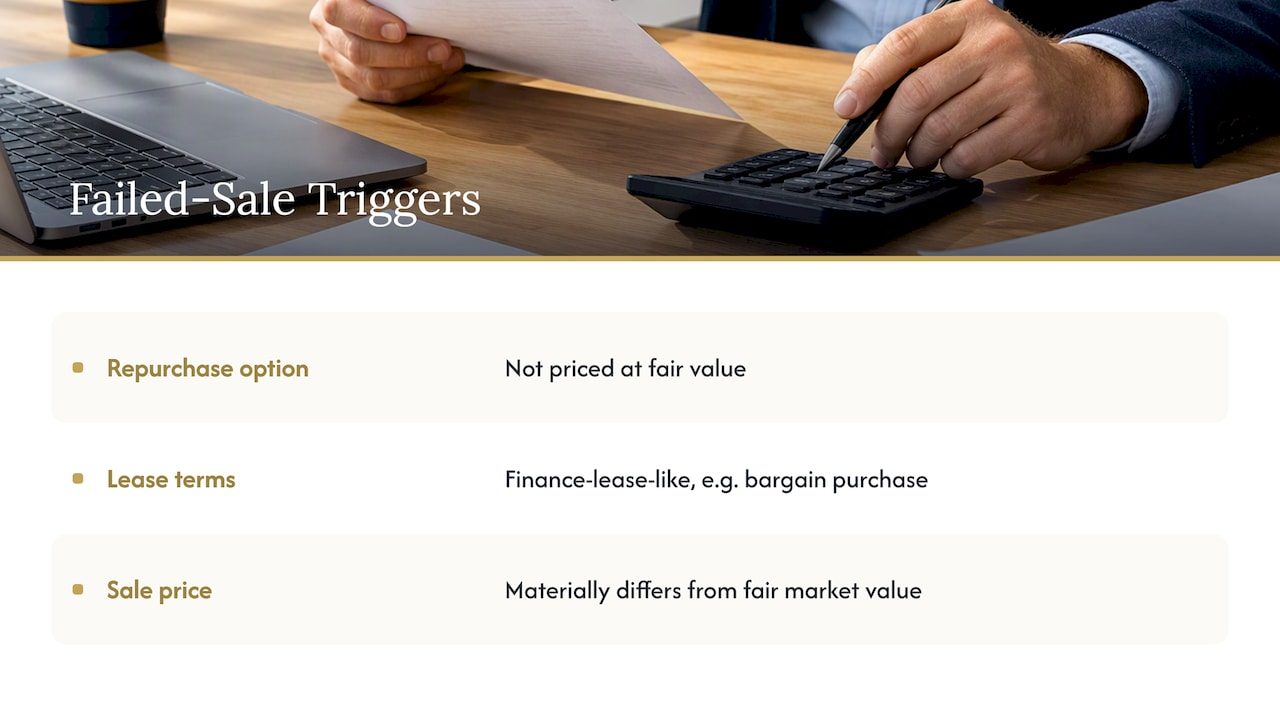
Common triggers for failed-sale treatment include repurchase options that are not priced at fair value, lease terms that mirror finance-lease criteria such as a bargain purchase option, and sale prices that deviate materially from fair market value.
Typical deal economics and term components
Pricing in a sale-leaseback starts with fair market value, and any amount above it is generally treated as additional financing layered on top of the lease rather than pure sale proceeds. Understanding this distinction before you negotiate protects you from unexpected liability recognition later.
- Lease terms vary, with longer terms generally supporting higher sale proceeds because the buyer gains more years of rental income.
- Annual escalators are a standard feature, incrementally raising rent to protect the buyer’s return against inflation and holding costs.
- Implied borrowing cost can be estimated by comparing the present value of lease payments over the term against the net proceeds received, which functions similarly to calculating the interest rate on a loan.
- Residual value and your credit quality both influence how aggressively a buyer prices the deal, since a stronger credit profile and a more marketable asset reduce the buyer’s perceived risk.
Owners who treat the lease rate as equivalent to a loan’s interest rate, without adjusting for the embedded real estate risk the buyer assumes, often misjudge whether the sale-leaseback is truly cheaper than conventional debt.
What buyers and lenders underwrite before closing
Buyers and institutional lenders move faster, and price more favorably, when you arrive with organized documentation rather than assembling it mid-negotiation.
- Financial statements and cash-flow metrics, including debt service coverage ratio where the transaction involves a financing component rather than a pure sale.
- Property documentation, including title, survey, environmental reports, and current condition assessments.
- Operational evidence, such as business plans, projected space needs, and documentation showing the property is essential to ongoing operations.
- Clean, well-organized packaging, since how your financials and property data are presented to lenders directly affects both execution speed and the terms you receive.
Pro Tip: Assemble your rent roll, trailing financials, and property condition reports before approaching buyers, since incomplete packaging is one of the most common reasons deals stall mid-diligence.
Our underwriting checklist for sponsors walks through how to prepare financials that hold up under institutional scrutiny.
Alternatives to a sale-leaseback worth comparing
A sale-leaseback is not the only route to unlocking capital, and it is worth weighing against other structures before committing.
- A cash-out refinance preserves ownership and may suit you if you need less capital than a full sale would generate.
- SBA 504 financing fits owner-occupiers purchasing or improving commercial property with longer amortization and lower down payments.
- Partial sale, joint venture redevelopment, or synthetic lease structures suit owners seeking to monetize part of an asset’s value without a full exit.
- Working with an advisor for placement tends to outperform a direct lender approach when the transaction involves portfolio complexity or multiple capital sources.
When a sale-leaseback needs advisory support
Complexity escalates quickly with portfolio-wide sale-leasebacks, large proceeds, or transactions involving multiple properties and lenders simultaneously. Before engaging an advisor, ask about their lender network, their packaging approach, their expected timeline, and how their fee structure works. Our team at Brookmont Capital Ventures brings institutional-grade underwriting and national lender relationships to capital stack structuring for exactly these situations.
— Jerry
How we structure and place sale-leaseback financing
We help owners evaluate whether a sale-leaseback, a refinance, or another capital structure fits their situation, then handle the heavy lifting of placement. Our capital stack advisory, underwriting and feasibility, and deal packaging services prepare your transaction for institutional buyers and lenders nationwide.
- We start with an initial financial and property review to determine structuring options.
- We run targeted outreach to our network of institutional lenders, buyers, and equity partners.
- We negotiate term sheets and support you through closing.
If you are weighing a sale-leaseback against a bridge loan, DSCR loan, or another financing path, reach out and we will map out which structure fits your property and your timeline.
This article is general information, not a substitute for advice from a qualified financial advisor. Consult a qualified financial professional about your own circumstances before acting on anything here.
FAQ
What are the disadvantages of a sale-leaseback?
The primary tradeoff is losing ownership and any future appreciation in the property’s value, since you become a tenant subject to the lease terms you negotiate. If the transaction fails to qualify for sale accounting under ASC 842, the asset and a new financing liability both remain on your books, which can undercut the balance-sheet benefit you were seeking.
Is a sale-leaseback a good idea?
A sale-leaseback tends to work well for owners whose real estate ties up capital disproportionate to its operational value and who plan to occupy the property long term under the new lease. It works less well for owners who expect to relocate soon or whose property has limited marketability to institutional buyers.
Can a sale-leaseback cause debt?
Yes, when the transaction does not meet the control-transfer criteria in ASC 842, the proceeds are recorded as a financing liability rather than sale proceeds, which functions economically like debt with principal and interest components. This “failed sale” outcome has appeared in SEC-filed examples where companies disclosed the arrangement as a finance lease with no gain or loss recognized.
What causes a failed sale-leaseback?
A failed sale-leaseback most often stems from a repurchase option priced below fair market value, lease terms that meet finance-lease criteria such as a bargain purchase option, or a sale price that departs materially from the property’s fair value. A related SEC filing illustrates how these contract features can shift an intended sale into financing treatment.