
30–40 Year Rule: Ground Lease Financing for Developers and Lenders
Ground lease financing splits a property into two collateral positions: a leased fee interest owned by the landowner and a leasehold interest owned by the sponsor, who finances improvements separately from the land. The structure frees up capital and often lowers blended cost of capital, but lenders will only extend a leasehold mortgage against a lease that meets specific protections spelled out in rating-agency criteria. Get the lease terms wrong, and no amount of pro forma optimism will make the deal financeable.
TL;DR:
- Leasehold mortgages require specific protections such as recorded memorandums, title insurance, and estoppel certificates to be insurable and financeable.
- Lenders prefer leases with remaining terms significantly longer than the loan, typically at least 30 to 40 years, to mitigate term erosion risks.
- Ground lease financing is most suitable for long-term, stabilized assets with creditworthy tenants, avoiding appraisal-based rent resets and unrecorded lease terms.
- Securing protections before lease execution, including notice, cure, and non-disturbance rights, reduces costs and increases the likelihood of loan approval.
- Modern ground leases often include purchase options or extensions to mitigate the risk of value loss as the lease approaches expiration.
Table of Contents
- Ground Lease Financing Basics: Structure and Common Uses
- How Leasehold Mortgages Work: Mechanics and Recording
- Lender Underwriting Checklist for Ground Lease Financing
- Risks and Mitigations in Leasehold Financing
- When Ground Lease Financing Pays Off
- Preparing for Ground Lease Financing: What Sponsors Should Have Ready
- When Ground Lease Financing Makes Sense: An Editor’s Take
- Structure Your Ground Lease Financing With Brookmont Capital Ventures
- Sources
- FAQ
Ground Lease Financing Basics: Structure and Common Uses
The leased fee is the landlord’s ownership interest in the land, entitled to ground rent for the lease term. The leasehold is the tenant’s right to use and improve that land, typically for 50 to 99 years. Sponsors finance the leasehold interest with a leasehold mortgage, while the land itself may carry separate leased-fee financing or sit unencumbered on the landowner’s balance sheet.
Developers and investors turn to this structure in several recurring situations:
- Recapitalization of an existing asset where the sponsor wants to extract land value without selling the whole property
- Sale-leaseback transactions that convert owned land into cash while retaining operational control
- Land monetization for institutional landowners who want steady income without development risk
- Build-to-suit deals where a tenant or developer needs long-term site control but not fee ownership
- 1031 exchange strategies where bifurcation helps sponsors defer tax on a disposition
Term length matters more than most sponsors expect. A lease with many years remaining refinances more easily; shorter remaining terms start to concern long-tenor lenders, since the leasehold interest shrinks in value as the reversion date approaches.
How Leasehold Mortgages Work: Mechanics and Recording
A leasehold mortgage secures the tenant’s leasehold interest and any improvements built on the land. The fee interest stays with the landlord, meaning the lender’s collateral is fundamentally different from a fee-simple mortgage. If the borrower defaults, the lender cannot foreclose on the land itself. It can only step into the tenant’s shoes under the existing lease, or assign that leasehold position to a third party if the lease permits assignment.
That single distinction drives almost every protection a lender demands before closing. According to practice guidance on leasehold mortgage financing, lenders typically require:
- A recorded memorandum of lease, putting the lease terms on public record and protecting the lender’s priority against future claims
- Title insurance insuring the leasehold interest, confirming the tenant’s right to occupy and the lender’s right to foreclose on that right
- Estoppel certificates from the landlord, confirming the lease is in force, rent is current, and no defaults exist
- Notice and cure mechanics, giving the lender advance warning of tenant default and time to cure before the landlord can terminate
Skipping any one of these items doesn’t just slow closing. It can make the leasehold position uninsurable, which kills the deal outright. Sponsors preparing for a leasehold mortgage should read our breakdown of the protections lenders insist on before they start lease negotiations, not after.
Lender Underwriting Checklist for Ground Lease Financing
Rating agencies developed the Model Ground Lease Criteria to give lenders and CMBS underwriters a consistent way to evaluate whether a ground lease is financeable. The framework breaks into three buckets, and sponsors who address all three before drafting the lease save themselves months of renegotiation later.
Transactional Criteria governs the economic terms embedded in the lease itself:
- Lease term must exceed the loan term by a meaningful cushion, not just match it
- Rent escalations should be fixed steps, fixed percentages, or CPI-indexed with an explicit cap, commonly capped near 3.5% compounded annually
- No revenue-sharing or appraisal-based rent resets, since both introduce unpredictability that rating agencies penalize
- Ground rent must be non-contingent, meaning it doesn’t fluctuate with property performance
Closing Criteria covers the documentation package lenders expect at the table: the recorded memorandum, estoppel certificates, title insurance for the leasehold, and written lender consents. Underwriters also check that rent schedules and insurance documents match the estoppels exactly, since mismatched paperwork is a common reason files get kicked back before closing.
Minimum Protections are the substantive rights lenders need baked into the lease: notice and cure periods, a prohibition on the landlord amending or terminating the lease without mortgagee consent, lender control over insurance and condemnation proceeds, subordination and non-disturbance mechanics, and clear treatment of the lease in the tenant’s bankruptcy.
Pro Tip: Negotiate rent escalation language before the lease is executed, not during the financing process. Trying to retrofit a fixed-percentage cap onto an appraisal-based escalation clause after the fact usually means reopening negotiations with a landlord who has no incentive to give you better terms.
Meeting these criteria matters even outside securitized transactions. Rating-agency benchmarks have become a practical proxy for institutional acceptance generally, so a lease built to satisfy CMBS standards tends to clear underwriting faster with balance-sheet lenders and debt funds too.
Risks and Mitigations in Leasehold Financing
The biggest structural risk in ground lease financing is term erosion. As the lease approaches expiration, the leasehold interest loses value regardless of how well the improvements perform, and lenders apply hard remaining-term thresholds depending on loan tenor: a 10-year loan usually needs at least 30 to 40 years of remaining lease term as a cushion.
Other risks require negotiated mitigations rather than simple math:
- Landlord and fee-lender conflicts are managed through intercreditor agreements and subordination, non-disturbance, and recognition (SNDA) arrangements that coordinate remedies between the fee lender and the leasehold lender.
- Casualty and condemnation situations require lender approval rights over insurance settlements and a defined restoration and disbursement procedure, so proceeds don’t disappear into a rebuild that never happens. A landlord’s building insurance coverage needs to align with these disbursement terms from day one.
- Bankruptcy exposure is addressed through assignment and assumption rights that let the leasehold lender step in and preserve its collateral if the tenant enters bankruptcy proceedings.
Pro Tip: Push for these protections while the lease is still a draft. Retrofitting them into an executed lease means asking a landlord for concessions with no leverage to get them, which is far more expensive than negotiating them upfront.
When Ground Lease Financing Pays Off
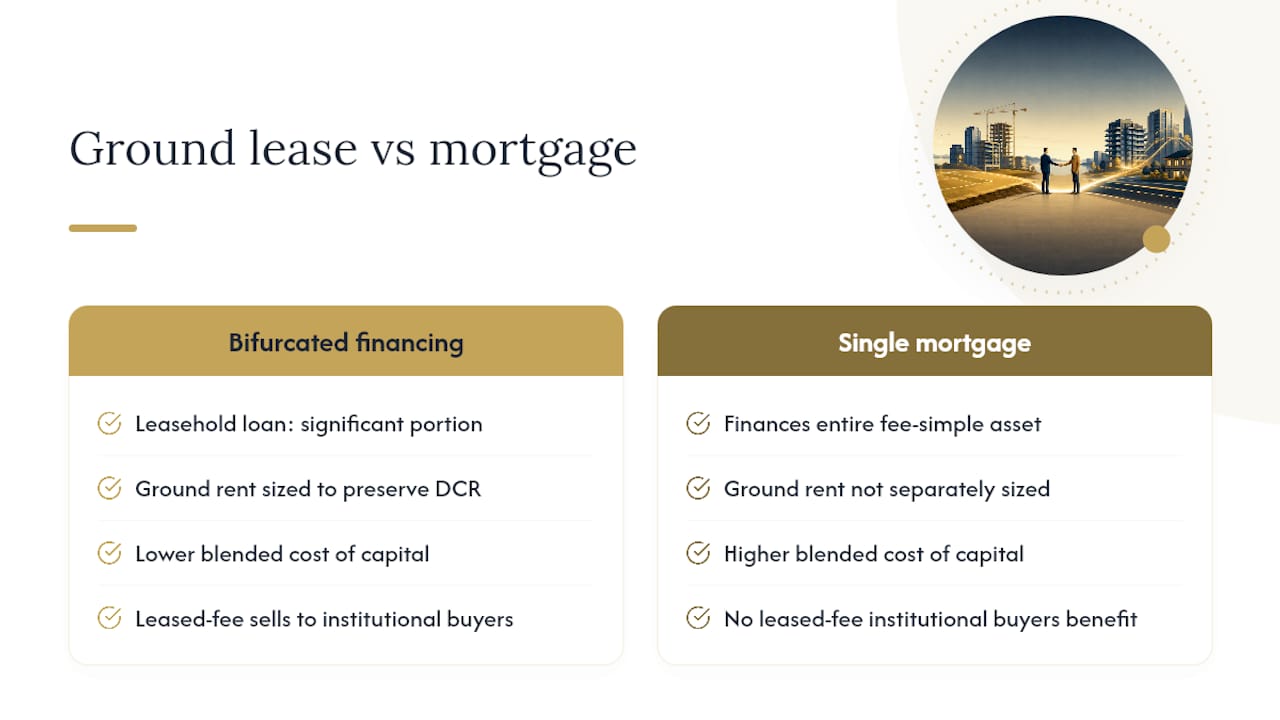
Bifurcated financing programs commonly size the leasehold loan at a significant portion of fee-simple cost, targeting ground rent levels calibrated to leave the sponsor a workable debt service coverage ratio consistent with market practices, according to program benchmarks from Mesirow. That structure often compresses the sponsor’s blended cost of capital compared to financing the entire fee-simple asset with a single mortgage, since the leased-fee interest can attract institutional fixed-income buyers at yields well below what a leveraged operating loan commands.
The tradeoff sits at the back end of the lease term. Improvements revert to the landowner at expiration unless the lease includes purchase options or evergreen extensions, and modern ground leases increasingly build these in precisely to avoid a cliff-edge loss of leasehold value as expiry nears.
Preparing for Ground Lease Financing: What Sponsors Should Have Ready
Sponsors approaching lenders with a ground lease deal need three things assembled before outreach: a lease that already reflects Minimum Protections language, a document package matching the Closing Criteria, and a clear narrative on remaining term relative to requested loan tenor. An experienced capital markets advisory firm can help sponsors align lease drafting with institutional buyer and rating-agency expectations from the start, rather than discovering gaps during underwriting. This advisory role may extend to negotiating intercreditor terms between fee and leasehold lenders and packaging the transaction for CMBS or direct institutional buyers, drawing on relationships across debt and equity sources that most sponsors can’t access solo. Our negotiation playbook for developers covers the clause-level detail sponsors should walk into lease talks with.
When Ground Lease Financing Makes Sense: An Editor’s Take
Ground lease financing works best for stabilized retail, industrial, and net-lease assets with long remaining terms and creditworthy tenants, where the sponsor wants liquidity without giving up operating control. The three mistakes I see most: accepting appraisal-based rent resets, skipping the recorded memorandum until refinancing forces the issue, and assuming a friendly landlord today means no dispute over consent rights tomorrow. Get the lease protections right at signing, and financeability takes care of itself.
— Jerry
Structure Your Ground Lease Financing With Brookmont Capital Ventures
Unlike a lease drafted without lender input, Brookmont Capital Ventures builds financeability into the transaction from the first term sheet, so sponsors aren’t scrambling to fix Minimum Protections language after a lender has already passed.
Our advisory team structures the capital stack around bifurcated deals, places leasehold mortgages with institutional lenders and debt funds, and packages transactions for CMBS acceptance when securitization is the right exit. We also integrate construction financing where a build-to-suit component sits alongside the ground lease, so sponsors aren’t juggling separate advisors for each piece of the capital stack. If you’re structuring a ground lease transaction or evaluating whether your existing lease will actually finance, visit our capital stack advisory services page or explore our full range of commercial real estate financing solutions to start a conversation before you sign anything.
Sources
- Model ground lease criteria (American Bar Association) — Model Ground Lease Criteria for CMBS
- Building on borrowed ground: ins and outs of leasehold mortgage financing — Lexology
- Ground Lease Financing — Mesirow
FAQ
What Are the Disadvantages of a Ground Lease?
The main disadvantages are term erosion as expiry approaches, reversion of improvements to the landlord unless the lease includes purchase or extension options, and financing constraints if the lease lacks the notice, cure, and non-termination protections lenders require.
Is a 10-Year Ground Lease Considered Long-Term?
No. A 10-year ground lease is short by industry standards, since typical ground leases run 50 to 99 years, and lenders generally need 30 to 40 years of remaining term as a cushion against a 10-year loan.
Why Would Anyone Want a Ground Lease?
Ground leases let sponsors control and develop a site without the upfront cost of buying the land outright, while landowners collect steady rent income and retain long-term ownership. For sponsors, bifurcating land from improvements can also lower the blended cost of capital compared to financing the whole fee-simple asset.
Who Pays Taxes on a Ground Lease?
Property tax responsibility is set by the lease itself, but most ground leases assign it to the tenant as an operating expense alongside ground rent, similar to how insurance and maintenance costs are typically allocated in a net lease.