

Gap financing covers the difference between what your senior lender will advance and what the project actually costs, and the main options are mezzanine debt, preferred equity, subordinate gap loans, common equity from a joint venture partner, and, for qualifying projects, public gap programs. Which one fits depends on your senior lender’s intercreditor requirements, your takeout strategy and how much of the stack you are willing to give up in cost, control or upside. This guide walks through each option, how lenders evaluate the request, and how to choose before you approach the market.
TL;DR
- Gap capital is any layer that sits between the senior loan and your sponsor equity: mezzanine debt, preferred equity, a subordinate gap loan, or a public program where the project qualifies.
- The structure matters as much as the price, because it determines what your senior lender will consent to and how much control you retain if the project underperforms.
- Gap providers underwrite your exit as closely as the asset, so a vague takeout strategy raises cost or ends the conversation.
- Bank standards for construction and land development loans remain restrictive enough that many sponsors now plan for a junior layer from the first draft of the capital stack.
- Price the full stack, including reserves and intercreditor consent, before you sign any term sheet.
Table of Contents
- What gap financing is, and why it is more common now
- The main gap financing options compared
- Bridge loan or gap loan: the difference
- How gap lenders evaluate your request
- How to choose among the options
- Our perspective: price the structure, not just the rate
- Where Brookmont can help
- Mistakes that raise the cost of gap capital
- FAQ
- Sources
What gap financing is, and why it is more common now
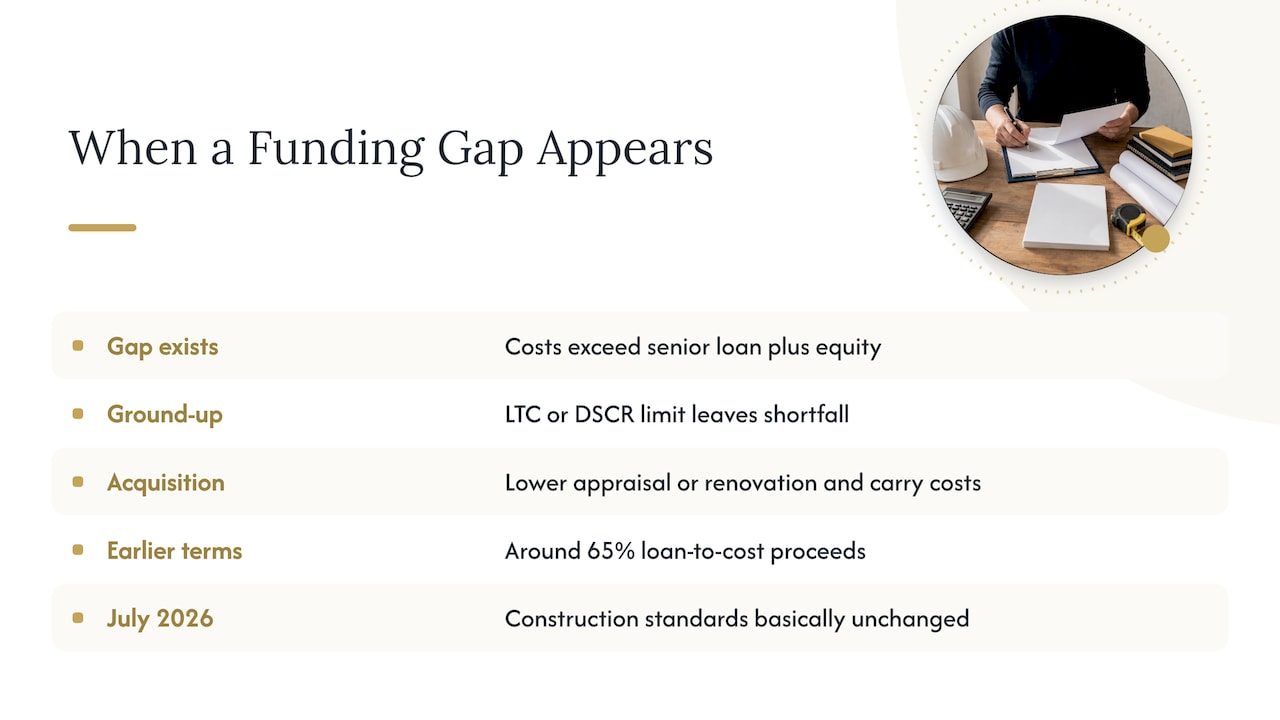
A gap exists whenever total project costs exceed the sum of the senior loan and the equity you have committed. On a ground-up development it often appears because the lender sizes to a loan-to-cost or debt service coverage ratio limit that leaves a shortfall. On an acquisition or repositioning it appears when the senior lender sizes to a lower appraised value than your pro forma assumes, or when you need to fund renovation and carry costs that the first mortgage will not cover.
The pressure on the senior layer is documented. The Pension Real Estate Association has described a market recalibration that produced fewer, smaller and more expensive construction loans, noting that typical nonrecourse construction terms had previously offered around 65% loan-to-cost proceeds. The Federal Reserve’s July 2026 Senior Loan Officer Opinion Survey shows banks reporting basically unchanged standards for construction and land development loans, which means the earlier tightening has not been reversed. When the senior lender advances less, the sponsor either brings more equity or finds a junior layer, and the second path is where the options below come in.
A note on terminology. Readers also search for this as last mile capital, meaning the final slice of funding needed to close a capital stack. It is the same problem described from the sponsor’s side: the last dollars of the budget are the hardest and most expensive to source.
The main gap financing options compared
The table summarizes how the common options differ. Pricing is deliberately not quoted, because it moves with the senior lender, the asset class, leverage and the sponsor’s track record, and it should be confirmed against live quotes for your deal.
| Option | Where it sits | Typical security | Key trade-off |
|---|---|---|---|
| Mezzanine debt | Behind the senior loan | Pledge of the equity interests in the property-owning entity | Often needs an intercreditor agreement and can complicate the senior lender’s position |
| Preferred equity | Behind all debt, ahead of common equity | Equity position with negotiated rights and remedies | Usually costs more than debt and can carry control rights on default |
| Subordinate gap loan | Second position or structured as a junior note | Second lien or equivalent | Less common, depends on senior lender consent |
| Joint venture common equity | Alongside sponsor equity | Ownership share | Gives up the most upside, but adds no debt service |
| Public or quasi-public gap programs | Varies | Varies by program | Restricted to projects meeting program goals, with slower timelines |
Mezzanine debt
Mezzanine financing is a loan that is typically secured not by the real estate itself but by a pledge of the borrower’s equity ownership in the property-owning entity. That distinction lets the mezzanine lender foreclose on the equity interests, often faster than a real property foreclosure, and it is why the senior lender will want a negotiated intercreditor agreement spelling out cure rights, transfer rights and standstill terms.
For a sponsor the advantages are leverage and the fact that mezzanine debt does not dilute ownership while it is performing. The costs are a coupon that is higher than senior debt, debt service that competes with the senior loan for cash flow, and the structural risk that a default can transfer control of the entity. Model the combined debt service coverage ratio of both layers, not the senior loan alone, because the interest reserve and the operating budget both have to carry the blended burden.
Preferred equity
Preferred equity is usually documented as an investment in the ownership entity, with a priority return and a defined set of remedies if the project misses milestones. Because it is generally treated as equity rather than additional debt, it can avoid some of the collateral pledge and intercreditor requirements that come with mezzanine loans. PREA’s analysis points to a shift toward preferred equity on many construction projects partly because it is friendlier to the senior lender’s regulatory treatment, including HVCRE capital rules, and because it leaves the senior lender more room to work directly with the sponsor.
The cost for the sponsor sits in the details of the operating agreement. Review the preferred return and whether it accrues or is paid current, the redemption date and any minimum multiple, the events that flip control, and whether the investor can force a sale. These are the same lines we examine in our guide to term sheet terms to nail with equity partners, and they matter most when the project runs late.
Subordinate gap loans and debt-fund structures
Some lenders will make a junior loan secured by a second lien, or structure a single loan with an A/B or A/B/C note split so that the senior and junior pieces are held by different investors. Private credit has expanded this space: it describes lending outside conventional bank and agency channels, including debt fund and other alternative lender strategies. The appeal is speed and flexibility on leverage. The limitations are consent requirements from the first mortgage holder and a pricing premium for the subordinate risk. Many bank senior loans prohibit secondary liens outright, so confirm this in your senior loan documents before spending time on a junior lender.
Joint venture common equity
Bringing in a joint venture partner to fund the gap with common equity adds no debt service and no covenant package, which is valuable when cash flow during lease-up is thin. The cost is the promote and the share of residual proceeds. Whether this is cheaper than preferred equity depends on how well the project performs, and a waterfall model will show the answer. Before negotiating, run the numbers on a structure that includes a catch-up, as we describe in our walkthrough of the GP catch-up and waterfall formula.
Public and quasi-public gap programs
Cities, states and housing agencies run gap programs for projects that deliver public benefits such as affordable units, job creation or revitalization. The City of Los Angeles, for example, operates a Gap Financing Loan Program aimed at real estate projects that support economic development. The District of Columbia’s housing department has also sought lender partners for a site acquisition bridge loan program serving affordable housing developers. Eligibility, award sizes and terms are set by each program and change, so read the current guidelines for your jurisdiction and do not assume a program from one city exists in another. For qualifying redevelopment projects, federal incentives can also fill part of the stack: see our overview of 20% federal historic credit financing.
Bridge loan or gap loan: the difference
The two terms get mixed up because both are short-term and both solve a timing or sizing problem. A bridge loan typically replaces or precedes the primary financing: it carries the property until a refinance, a sale or construction takeout. A gap loan fills a shortfall inside an existing structure, sitting behind or beside the senior debt. In practice the same lender may call a bridge facility a gap solution when it funds the delta between a conservative senior loan and the cost basis. When a lender quotes you a number, ask where the loan sits in the stack and who holds the first lien, because those two answers tell you which product you are actually being offered.
How gap lenders evaluate your request
The reader’s question is often who will lend when nobody else will. The honest answer is that gap providers will lend where they understand the risk and can see how they get repaid. That is a different test from the one your senior lender applies.
The takeout strategy comes first
Gap capital is highly deal-specific rather than a commodity, and the difference between a financed deal and a rejected one often comes down to a clear takeout. Lenders providing this capital underwrite the sponsor’s ability to reach stabilization and then refinance or sell. A vague exit tends to raise the cost of capital or lead to a decline. Be specific: the stabilized net operating income you expect, the cap rate you assume for a sale and a sensitivity range around it, the permanent loan sizing at a realistic debt service coverage ratio, and the timeline with a contingency for delays. If your plan relies on a refinance, it helps to understand how takeout lenders look at it; this explainer on how fix-and-flip lenders weigh hard money against conventional financing shows the same logic of repaying short-term capital from a defined exit.
Reserves and the interest carry
Banks scrutinize the interest reserve closely. The OCC’s examination handbook on construction lending lays out the risk factors lenders are trained to manage, and a reserve that runs dry through delays or cost overruns is a warning sign for any lender, senior or junior. If you cannot replenish it, expect a restructuring conversation that may involve additional recourse or more expensive debt. When you model a gap layer, add its carry to the interest reserve and stress the schedule by several months. Our piece on absorption underwriting shows how to find the month your reserves run out before a lender does.
Sponsor strength and the package
A junior lender reads the sponsor as closely as the property: the track record on comparable projects, liquidity, and the quality of the budget and schedule. A package that arrives with a clean pro forma, a sourced budget, a rent roll or absorption analysis and a clear capital stack gets a faster and more precise response. We cover what a strong submission contains in packaging that wins middle market financing and the underwriting steps in our six-step underwriting checklist.
How to choose among the options
Work through the decision in order, because each step narrows the field for the next.
- Read the senior loan terms first. Check whether the senior lender permits mezzanine debt, a second lien or preferred equity, and what intercreditor terms it requires. A junior option that the senior lender will not consent to is not an option.
- Size the gap honestly. Use a budget with contingency, a realistic interest reserve and the lender’s own sizing constraints, not your pro forma’s best case. A gap that grows after closing is expensive to fill.
- Compare on all-in cost, not coupon. Include origination fees, exit fees, minimum multiples, legal costs for intercreditor negotiation and the cost of the extra reserve each layer requires.
- Test the control provisions. Ask what happens at a missed milestone. Mezzanine lenders can take the equity; preferred equity investors may take control rights or force a sale. Decide what you can live with.
- Match the term to the business plan. If stabilization takes 30 months, a 24-month layer with weak extension rights creates a refinancing cliff.
- Model rate exposure. If the gap layer floats, an index choice can swing your payment, as we discuss in SOFR versus Prime.
A worked illustration
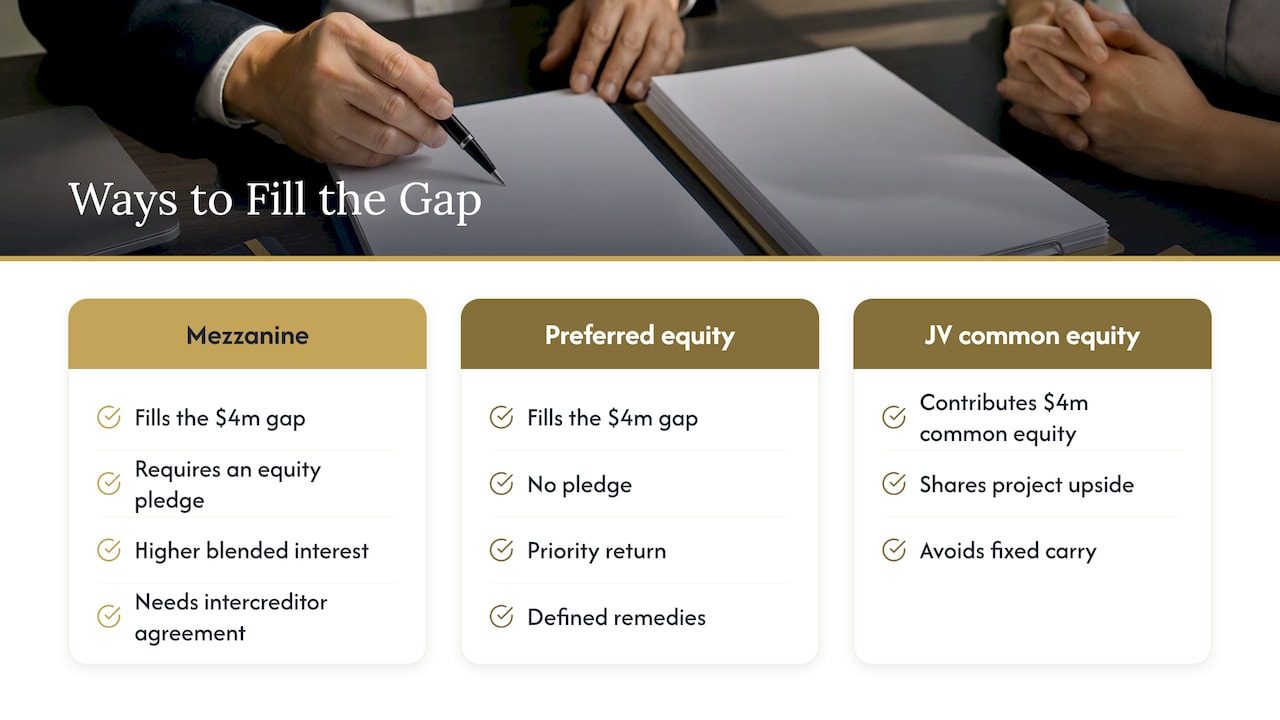
Consider a hypothetical ground-up project with a total cost of $20 million. A senior lender sizes at 60% of cost, or $12 million, and the sponsor has $4 million of equity committed. That leaves a $4 million gap. If the senior lender permits a pledge of the entity’s equity, mezzanine debt could cover it, at the price of higher blended interest and an intercreditor agreement. If the senior lender resists additional debt, preferred equity of $4 million might fill the same hole with no pledge, but with a priority return and defined remedies. If the sponsor expects strong lease-up and wants to avoid fixed carry, a joint venture partner contributing the $4 million as common equity takes a share of the upside instead. The figures are illustrative only and are not a quote, but the exercise shows why the same gap can have three different answers depending on the senior lender and the sponsor’s priorities.
Our perspective: price the structure, not just the rate
We see sponsors compare gap quotes on the headline rate and nothing else, and that is where the damage starts. In our experience the more useful comparison is how each layer behaves when the project is late or over budget, because that is when the senior lender, the junior provider and the sponsor all discover what the documents really say. A slightly cheaper mezzanine loan that triggers a consent requirement and delays a draw can cost more than a preferred equity investment with a higher stated return.
Our approach at Brookmont is to build the full capital stack with institutional-grade underwriting before going to market, so the senior lender’s constraints are known and the junior layer is designed around them. We then place the package with lenders and equity partners who actually write that type of capital, and negotiate the term sheet from the sponsor’s side. The most common mistake we try to prevent is treating gap financing as a late-stage patch. Raised early, it is a design choice; raised after a senior commitment, it is a negotiation with little leverage.
— Jerry
Where Brookmont can help
If you are sizing a gap on a development, acquisition or repositioning, our capital stack advisory, underwriting and deal packaging services are built for this stage, and our financing solutions cover bridge loans, construction loans and preferred equity placed with institutional lenders and equity partners. Bring the budget, the senior term sheet if you have one and your business plan, and we will tell you which structure we would pursue and why.
Mistakes that raise the cost of gap capital
- Raising the gap after the senior loan is committed. The senior documents may restrict junior liens or require consent, and you lose leverage in the negotiation.
- Ignoring HVCRE implications. The regulatory treatment of the senior loan can shape which junior structure the bank prefers.
- Underestimating the reserve. A thin interest reserve is both a risk and a signal, and gap lenders will look for it.
- Presenting an aspirational exit. Use conservative cap rates and a realistic timeline, and show a fallback path if the refinance market is not what you expect.
- Shopping a weak package widely. Repeated declines travel through a small market. Fix the package, then approach the right lenders.
- Skipping the waterfall. Equity gap solutions change the distribution of returns, so model them before agreeing to terms.
FAQ
How does gap financing work?
A gap provider advances capital that fills the difference between the senior loan and total project cost, and is repaid from the refinance, sale or cash flow after stabilization. It sits behind the senior lender in priority, which is why it costs more than the first mortgage. The terms depend on how the layer is structured, as debt, a loan secured by equity interests, or preferred equity.
What is the difference between a bridge loan and a gap loan?
A bridge loan carries a property between one financing event and another, such as acquisition to refinance, and usually is the primary loan. A gap loan fills a shortfall within a capital stack that already has senior debt. The labels overlap in practice, so always confirm the lien position and the repayment source.
Is preferred equity better than mezzanine debt?
Neither is better in every case. Preferred equity is generally treated as equity and can avoid some of the intercreditor and collateral pledge requirements tied to mezzanine loans, which senior lenders often prefer. Mezzanine debt may cost less and avoids ceding ownership rights while it is performing, so the right choice depends on your senior lender and your business plan.
Who will lend when banks will not?
Debt funds, other private credit lenders, preferred equity investors and joint venture partners fill the space when banks pull back, and some public programs fund qualifying projects. Each underwrites the sponsor and the exit strategy closely. A complete package and a credible takeout plan are what move a request from declined to considered.
Sources
- The Capital Stack for Multifamily Development, Pension Real Estate Association
- Private Credit in CRE, CRE Terminal
- July 2026 Senior Loan Officer Opinion Survey on Bank Lending Practices, Federal Reserve
- Examination Handbook 213, Construction Lending, OCC
- Gap Financing Loan Program, City of Los Angeles Community Investment Department
- Site Acquisition Finance Initiative Bridge Loan Program RFP, DC Department of Housing and Community Development