How to Qualify for Construction Financing in 2026

You can qualify for institutional construction financing in 2026 if your sponsor track record, capital stack, and pro forma clear tighter lender thresholds than most developers expect. Bank term sheets issued in early 2026 signal a minimum stabilized DSCR of at least 1.25x, with maximum loan-to-cost usually around two-thirds, and mandatory stress testing on pro formas. Brookmont Capital Ventures works with sponsors across commercial, multifamily, and mixed-use projects to structure deals that clear these thresholds. Programs like Fannie Mae Multifamily and Freddie Mac Multifamily remain relevant for permanent takeout planning, but the construction phase itself demands a different level of underwriting discipline. If your deal passes the five checks below, you are likely fundable. If it fails two or more, keep reading before you shop it to lenders.
- Sponsor track record: two or more comparable completed projects
- Stabilized DSCR at or above 1.25x under a stress-rate scenario
- Loan-to-cost at or below 65–70% for the senior tranche
- Yield-on-cost exceeding the projected exit cap rate by at least 150 basis points
- Fully entitled project with a licensed GC under a fixed-price or GMP contract
Table of Contents
- What do lenders actually look for in sponsor, project, and team?
- How does the capital stack work for institutional construction deals?
- What numbers do lenders actually underwrite in 2026?
- What goes into a lender-ready construction financing package?
- How does the approval process run from term sheet to first draw?
- What causes construction financing to be declined and how do you fix it?
- Key Takeaways
- What Brookmont Capital Ventures sees clearing in 2026
- Brookmontcapital structures your path to construction financing approval
- Useful sources and Brookmontcapital resources
What do lenders actually look for in sponsor, project, and team?
Institutional lenders in 2026 evaluate three parallel tracks simultaneously: the sponsor, the project, and the delivery team. A strong project with a weak sponsor rarely closes. A strong sponsor with a weak GC increasingly does not close either.
Sponsor and borrower criteria
- Demonstrated track record on comparable projects (asset class, size, and complexity matter)
- Liquidity: generally a modest portion of the loan amount in post-close liquid reserves
- Net worth at or above the loan amount, often required for full recourse guaranty
- Sponsor co-investment at a moderate proportion of total project cost signals alignment and reduces lender risk
- Clean credit history and no unresolved litigation on prior construction projects
Project criteria
Entitlements are non-negotiable. Lenders will not underwrite discretionary approval risk. Pre-leasing or signed letters of intent from credit tenants materially improve leverage and pricing, particularly for retail and office components. Regulatory exposure must be modeled explicitly: local rules like NYC Local Law 97 add compliance capital expenditure and potential annual penalties that lenders now deduct directly from projected NOI in their stress tests.
Team and delivery

Lenders now evaluate the GC with nearly the same rigor as the sponsor, examining backlog health, safety performance, dispute history, and subcontractor lock-in. A GMP or fixed-price contract is the baseline expectation. Performance bonds and builder’s risk insurance are underwriting inputs, not administrative afterthoughts.
Pro Tip: Request your GC’s current backlog schedule and subcontractor commitment letters before you approach lenders. A GC running at 90% capacity with uncommitted subs is a red flag that will surface in diligence regardless.
How does the capital stack work for institutional construction deals?
Senior debt typically covers 65–70% of total project cost for most commercial and multifamily projects, with the range tending lower for speculative projects. Mezzanine debt or preferred equity fills a moderate portion, and sponsor plus LP equity covers the remainder. The practical design challenge is hitting a target yield-on-cost spread while keeping blended cost of capital manageable as senior rates stay elevated.
| Layer | Typical Range (% of LTC) | Notes |
|---|---|---|
| Senior construction debt | 65–70% | Banks trending lower for speculative projects; HUD/agency programs may allow higher |
| Mezzanine debt | 5–15% | Subordinate to senior; higher cost, more flexible on control |
| Preferred equity | 5–15% | Sits above common equity; no debt on title, different lender consent dynamics |
| Sponsor + LP equity | 20–30% | Residual after senior and sub-debt; lenders verify source and commitment |
Mezzanine debt and preferred equity solve the same gap problem but differ in structure. Mezzanine sits as a loan secured by a pledge of the borrower’s equity interest, which means the senior lender’s intercreditor agreement governs what is permitted. Preferred equity has no lien on the property itself, which can simplify senior lender consent but typically carries a higher cost of capital. The choice depends on the senior lender’s intercreditor appetite and the sponsor’s tolerance for control provisions.
SBA 504 can reach approximately 90% combined financing for owner-occupied projects, materially reducing equity requirements, but job-creation rules and eligibility constraints limit its applicability. HUD construction-to-perm programs offer long-term fixed-rate takeout but introduce 12–18 month processing timelines that affect deal scheduling. When senior rates rise and shrink the supportable loan amount, sponsors typically respond by adding equity, layering in preferred capital, or deferring scope to preserve deal economics.
What numbers do lenders actually underwrite in 2026?
The binding constraint on most 2026 construction deals is DSCR at stabilization, not LTC. A project can sit at 65% LTC and still fail underwriting if the stabilized NOI does not support 1.25x debt service at the lender’s stress rate.
Key metrics and thresholds
- LTC: 65–70% for senior debt on most commercial and multifamily projects
- Stabilized DSCR: 1.25x minimum, tested at a stress rate typically 50–100 bps above the note rate
- Yield-on-cost: must exceed the projected exit cap rate by 150–250 basis points to demonstrate adequate development margin
- Debt yield: growing in importance for debt funds; typically 8–10%+ at stabilization
- Contingency reserve: 5–10% of hard costs for conventional projects; lenders scrutinize adequacy
- Interest reserve: sized to cover the full construction period plus a buffer; exhaustion risk is a common lender concern
Typical development yield targets by asset class
2026 market benchmarks show industrial at 7–9%, multifamily at 5.5–7%, healthcare at 6–8%, and cold storage or data center at 8–11%.
Quick DSCR illustration
Assume a multifamily project with stabilized NOI of $1,400,000 and annual debt service of $1,050,000 on a $13,000,000 senior loan at a 7.5% interest rate. DSCR = $1,400,000 / $1,050,000 = 1.33x, which clears the 1.25x threshold. Now stress the rate to 8.25%: debt service rises to approximately $1,155,000, and DSCR drops to 1.21x, which fails. That gap is where lenders push back, and where sponsors either reduce the loan request or improve NOI assumptions.
Pro Tip: Run your pro forma at the lender’s stress rate before the first call. Sponsors who present a pre-stressed DSCR analysis signal underwriting sophistication and shorten the diligence timeline.
What goes into a lender-ready construction financing package?
A complete package submitted at the outset closes faster. Lenders who receive a cost-certification plan and third-party monitoring protocol with the initial submission move to term sheet more quickly than those who chase documents through diligence.
Core deal documents
- Sources and uses statement with equity commitment evidence
- Detailed construction budget with hard costs, soft costs, and contingency line items
- Schedule of values aligned to the GC contract
- Construction schedule with milestone dates and critical path
- GC AIA contract or GMP agreement with executed exhibits
- Evidence of entitlements, zoning approvals, and permits in hand or on a defined timeline
Sponsor financial documents
- Personal financial statements for all guarantors
- Two to three years of tax returns (personal and entity)
- LP operating agreement and equity commitment letters
- Prior project delivery examples with cost-to-budget and schedule-to-plan comparisons
Third-party and technical reports
- ALTA/Title survey and title commitment
- Phase I Environmental Site Assessment (Phase II if warranted)
- Geotechnical report
- Market study supporting absorption and rent assumptions
- Energy compliance or LL97 plan where applicable
- Cost-certification plan and third-party construction monitoring protocol
A lending package that arrives without a cost-certification plan or third-party monitoring protocol signals to lenders that the sponsor has not managed institutional construction debt before. That perception alone can add weeks to diligence or trigger a pricing premium.
For a detailed construction loan document checklist, Brookmontcapital’s developer resource covers the full lender expectation set.
How does the approval process run from term sheet to first draw?
The construction financing approval process typically runs 60–120 days from initial lender engagement to closing, with draw cycles beginning 30 days after closing.
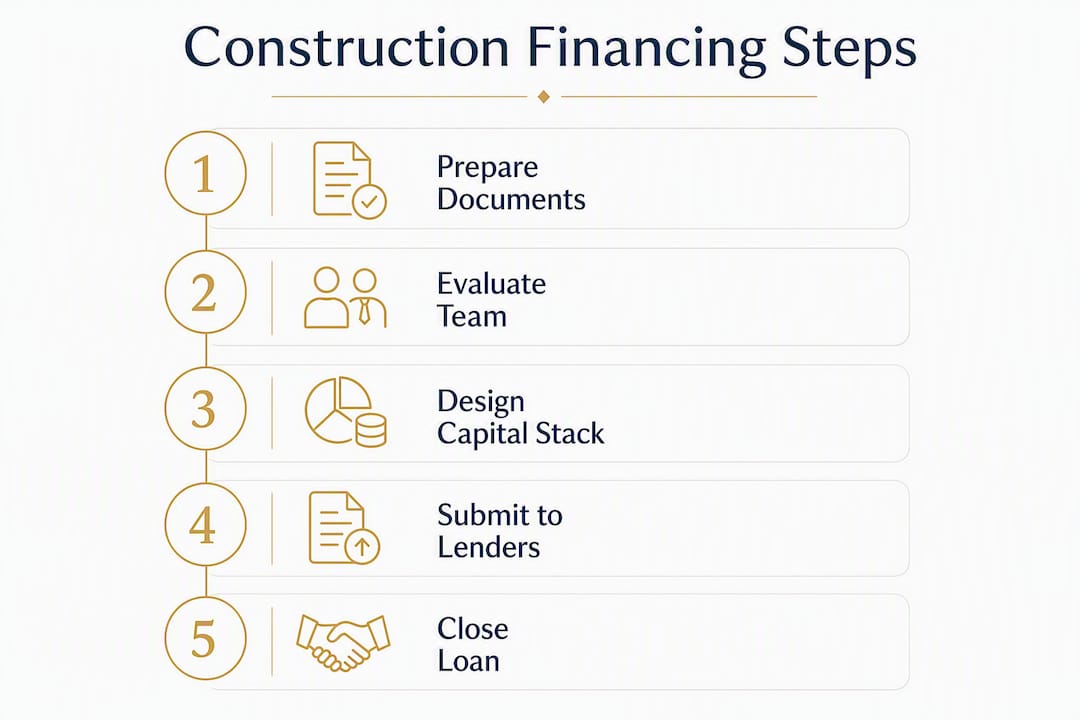
- Lender pitches (weeks 1–3): Submit the package to three to five targeted lenders simultaneously. Expect initial feedback within 10–15 business days.
- Term sheet (weeks 3–6): Negotiate rate, LTC, recourse, draw mechanics, and reserve requirements. Do not accept a term sheet without reviewing the draw fee structure and interest reserve sizing.
- Diligence window (weeks 6–10): Lender orders appraisal, environmental review, and third-party cost review. Conditions precedent typically include finalized GC contract, insurance certificates, and evidence of equity.
- Commitment letter (weeks 10–12): Issued after diligence clears. Commitment fees are typically non-refundable.
- Closing (weeks 12–16): Title, legal, and funding mechanics. SBA 504 and HUD closings add 4–8 weeks to this timeline.
- Monthly draw cycle: Draws are requested against the schedule of values, inspected by a third-party monitor, and funded within 5–10 business days of inspector sign-off. Interest accrues only on drawn balances.
Lenders flag optimistic construction schedules and underbudgeted contingencies as the two most common red flags during diligence. A schedule that assumes no weather delays, no permit lag, and no subcontractor substitution will be marked up by the lender’s cost reviewer.
Pro Tip: Negotiate the draw inspection fee and funding lag at the term sheet stage. A 15-business-day funding lag on a $2,000,000 monthly draw creates meaningful interest carry exposure that compounds over a 24-month construction period.
What causes construction financing to be declined and how do you fix it?
Most declines trace to five failure points, each with a defined fix path.
The most common reason a fundable project fails to close is not the deal itself. It is the packaging. Lenders decline deals they cannot underwrite quickly, and they cannot underwrite quickly when the sponsor has not done the pre-work.
- Insufficient equity: Sponsor equity below 20–25% of total cost. Fix: bring in a preferred equity partner to fill the gap without diluting common equity control beyond acceptable levels. See Brookmontcapital’s preferred equity vs. mezzanine comparison for structuring trade-offs.
- Weak GC or missing GMP: Lender cannot underwrite delivery risk. Fix: re-procure with a GMP contract and performance bond, or replace the GC with a lender-approved contractor.
- Missing entitlements: Discretionary approval risk is unacceptable to most institutional lenders. Fix: do not shop the deal until entitlements are in hand or on a defined, low-risk timeline.
- Aggressive pro forma: NOI assumptions that do not survive a stress-rate DSCR test. Fix: reduce the loan request, increase equity, or improve NOI through pre-leasing.
- Undersized contingency: A 3% contingency on a complex project signals inexperience. Fix: resize to 7–10% of hard costs and document the basis with a quantity surveyor or cost estimator report.
When two or more of these failure points appear simultaneously, the fastest path forward is a capital markets advisor who can re-underwrite the deal, identify the minimum fixes required for lender acceptance, and match the restructured package to the right lender profile rather than re-shopping a flawed submission.
Pro Tip: Use a construction loan interest rate calculator to model interest carry sensitivity before finalizing your contingency and reserve sizing. A 50 bps rate move on a 24-month draw schedule materially affects total project cost.
Key Takeaways
Qualifying for institutional construction financing in 2026 requires a sponsor track record, a capital stack at 65–70% LTC or below, a stabilized DSCR of 1.25x or higher under stress, and a fully packaged submission before you approach lenders.
| Point | Details |
|---|---|
| DSCR is the binding constraint | Lenders require 1.25x stabilized DSCR tested at a stress rate; LTC alone does not determine approval. |
| Capital stack design matters | Senior debt at 65–70% LTC, with mezzanine or preferred equity filling 5–15% when banks pull back. |
| GC strength is underwritten | Lenders evaluate GC backlog, bonding, and subcontractor commitments as core underwriting inputs. |
| Package completeness accelerates closing | A cost-certification plan and third-party monitoring protocol submitted upfront shortens diligence by weeks. |
| Brookmontcapital structures qualifying deals | Brookmontcapital’s capital stack advisory helps sponsors identify and fix qualification gaps before lender submission. |
What Brookmont Capital Ventures sees clearing in 2026
The deals closing in 2026 share one trait that has nothing to do with market conditions: the sponsor did the pre-underwriting work before approaching lenders. They stress-tested their DSCR at a rate 75 basis points above their target note rate. They had a GMP contract in place, not a letter of intent from a GC. They sized their contingency at 8%, not 3%, and they could show a lender exactly where every dollar of equity was coming from on day one of diligence.
What Brookmontcapital observes is that the gap between a fundable deal and a declined deal is rarely the project itself. It is almost always the preparation. Sponsors who arrive with a complete package, a defensible pro forma, and a clear capital stack get to term sheet in three weeks. Sponsors who arrive with a concept and a spreadsheet spend three months in diligence and often lose the deal anyway.
The practical implication: pre-underwrite your deal against 2026 lender thresholds before you submit anywhere. If it does not clear 1.25x DSCR at stress, fix the stack first.
Brookmontcapital structures your path to construction financing approval
Sponsors who engage Brookmontcapital before submitting to lenders close faster and on better terms because the deal arrives pre-structured for the right lender profile.
Brookmontcapital’s advisory process covers capital stack design, lender matching across banks, debt funds, and agency programs, institutional-grade deal packaging, and draw administration support. For sponsors who need to fill an equity gap, Brookmontcapital sources preferred equity solutions that preserve sponsor control while satisfying lender co-invest requirements. The engagement runs on an advisory and placement fee basis, with no pricing specifics disclosed until a scope is defined.
If your project is within 60–90 days of a lender submission, the right next step is a pre-underwriting review. Contact Brookmontcapital through the construction financing solutions page to request a deal assessment and lender-fit analysis.
Useful sources and Brookmontcapital resources
Industry programs and market data
- Fannie Mae Multifamily — agency permanent takeout program guidelines and underwriting standards
- Freddie Mac Multifamily — agency program terms and lender network for multifamily permanent financing
- 2026 construction loan interest rate ranges — third-party overview of rate drivers and pricing benchmarks
Brookmontcapital advisory resources
- Construction lender underwriting criteria, 2026
- Capital stack types for sponsors
- How to structure your stack when banks pull back
- Spec construction financing: what builders must know
Sponsors who treat lender qualification as a packaging problem, not a market problem, consistently outperform those who wait for conditions to improve. The thresholds are known. The fixes are defined. The only variable is whether you execute the preparation before or after your first decline.
This article provides general information about commercial real estate construction financing and does not constitute legal, financial, or investment advice. Confirm current program terms, underwriting thresholds, and eligibility requirements with your lender, legal counsel, or a qualified financial advisor before making financing decisions.
Recommended
- Construction Lender Underwriting Criteria: 2026 Guide | Brookmont Capital Ventures
- Spec Construction Financing: What Builders Must Know in 2026 | Brookmont Capital Ventures
- Common Construction Financing Mistakes to Avoid in 2026 | Brookmont Capital Ventures
- Reduce Construction Financing Costs: 2026 Builder’s Guide | Brookmont Capital Ventures