How to Prepare a Loan Package for Institutional Lenders

Preparing a loan package for institutional lenders means delivering a comprehensive, reconciled, and professionally organized set of documents that demonstrate stable cash flow, borrower creditworthiness, and a clear investment thesis before the underwriter asks a single question. Lenders do not negotiate on incomplete submissions; they move to the next deal. Get the package right the first time, and you control the timeline.
Table of Contents
- What Institutional Lenders Expect in Your Loan Package
- How to Assemble a Strong Loan Package Step by Step
- What Institutional Lenders Are Actually Underwriting in 2026
- How Brookmontcapital Helps You Secure Institutional Financing
- Best Practices for Your Loan Package Submission
- Brookmontcapital: Expert Advisory for Institutional Loan Packages
- Key Takeaways
What Institutional Lenders Expect in Your Loan Package
Lenders require extensive documentation to assess risk accurately, and the list is more consistent across institutions than most sponsors expect. Build your package around these core components:
- Executive summary (1–2 pages): loan request, property overview, capital stack, business plan, exit strategy, and sponsor credentials. A lender should understand the full deal before opening a single attachment.
- Sources and uses statement: every dollar accounted for, from equity contributions to closing costs and reserves.
- Purchase and sale agreement or payoff statement for refinances, including all amendments.
- Current rent roll: tenant names, suite numbers, square footage, lease start and end dates, base rent, and any concessions.
- Trailing 12-month operating statements and prior year-end financials; both are required together.
- Commercial leases for anchor and major tenants.
- Property photos and capital expenditure history.
- Personal and business tax returns for 2–3 years, plus personal financial statements for all guarantors dated within 90 days.
- Schedule of real estate owned (REO): every property in the sponsor’s portfolio with current value, mortgage balance, and net cash flow.
- Entity formation documents: articles of organization, operating agreement, and an organizational chart for complex structures.
- Business plan and pro forma projections for value-add or transitional assets, including a stabilization timeline.
- Debt schedule: all existing mortgages, equipment loans, lines of credit, and personal obligations.
- Credit reports and liquidity reserve verification confirming post-closing reserves.
How to Assemble a Strong Loan Package Step by Step
The sequence matters as much as the content. A well-organized submission compresses underwriting timelines; a disorganized one generates round-trip requests that can add weeks to your closing.
Step 1: Review lender-specific underwriting criteria first. Before gathering a single document, confirm the lender’s minimum DSCR, maximum LTV, and property type appetite. Submitting to a lender whose floor you cannot clear wastes everyone’s time. Understanding types of commercial lenders and their distinct underwriting approaches helps you target the right capital source from the start.
Step 2: Reconcile all financial data. Pull trailing 12-month income and expense statements, then cross-reference every line against the rent roll and leases. Inconsistencies between the operating statement and the rent roll are among the first things underwriters flag.
Step 3: Write the executive summary last, not first. Once you have reconciled financials and a clear business plan, the executive summary writes itself accurately. Draft it last so the numbers and narrative align.
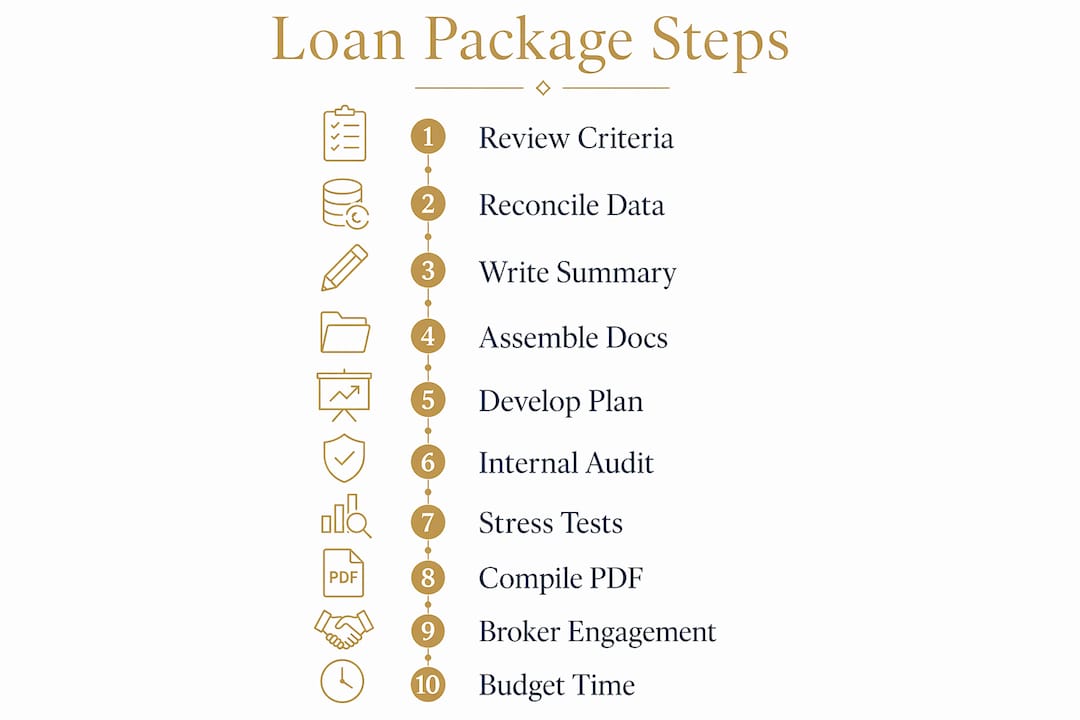
Step 4: Assemble personal and entity financial documents. Confirm all personal financial statements are dated within 90 days. Collect 2–3 years of personal and business tax returns for every guarantor and the borrowing entity.

Step 5: Develop the business plan and pro forma for transitional assets. For value-add or repositioning deals, include a detailed capital expenditure budget, a lease-up timeline, and year-by-year pro forma projections through exit. Use market rents from real comparables, not aspirational estimates.
Step 6: Run an internal audit before submission. Missing documents stall loan approvals and force multiple lender follow-ups. Check every checklist item: rent rolls, leases, appraisals, environmental reports, entity docs, and guarantor financials.
Step 7: Include sensitivity analyses and stress tests. Model downside vacancy scenarios, interest rate increases, and cap rate shifts. A package that anticipates lender questions through stress testing reduces the underwriter’s verification burden and builds deal confidence.
Step 8: Compile into a single, labeled PDF. Organize with bookmarks and consistent formatting. Submit one coherent package, not 15 separate attachments.
Step 9: Engage a mortgage broker or loan officer early. Experienced intermediaries provide lender-specific feedback before submission, improving your match rate and reducing back-and-forth. Brookmontcapital’s advisory team performs this function as part of its capital markets process.
Step 10: Budget time and costs realistically. Appraisals, Phase I environmental reports, and legal entity documents each carry their own lead times and fees. Plan for a preparation window of several weeks before your target submission date, and factor third-party report costs into your sources and uses.
What Institutional Lenders Are Actually Underwriting in 2026
Institutional lenders today apply conservative underwriting assumptions, and the current market climate rewards deals with documented, stable cash flow over speculative upside. Understanding their priorities directly shapes how you build your package.
DSCR thresholds are firm, not flexible. Most commercial lenders require a minimum DSCR between 1.20x and 1.30x, and falling short under the lender’s own assumptions typically results in outright rejection rather than negotiation. If your deal clears at 1.18x under the lender’s conservative vacancy and expense load, expect a decline. Model your DSCR using a DSCR calculator with market-based inputs before you submit. For a deeper look at how lenders stress-test coverage ratios, Brookmontcapital’s guide on DSCR loans for investment property covers the mechanics in detail.
Lenders underwrite actual income, not projections. Trailing 12-month net operating income based on real operating statements carries far more weight than pro forma assumptions. Lenders pull their own market data and immediately notice when your numbers diverge from comparable properties.
Borrower creditworthiness and liquidity are risk buffers. Liquid reserves covering 6 to 18 months of debt service post-closing improve lender confidence and can support more favorable terms. Document reserves explicitly; do not assume the lender will find them in bank statements.
Pro Tip: Address every known risk flag proactively in the executive summary. Below-market rents, a lease expiring within 12 months, or a single-tenant concentration should each come with a one-paragraph mitigation plan. Lenders who find surprises buried in the financials lose confidence; lenders who see risks acknowledged upfront gain it.
First-time commercial buyers face stricter scrutiny and need to demonstrate capacity to manage both the property and the debt obligation. Co-borrowing with an experienced sponsor or providing an exceptionally detailed business plan are the two most effective paths forward for sponsors without a deep track record.
Loan covenants define your operating flexibility post-closing. The OCC’s Comptroller’s Handbook requires that CRE loan documentation include covenants covering minimum DSCR maintenance, LTV limits, restrictions on junior liens, and reporting obligations. Understand these terms before you sign; covenant violations can trigger default provisions even when debt service is current.
How Brookmontcapital Helps You Secure Institutional Financing
Brookmontcapital brings capital markets advisory depth to every stage of the loan package process, from initial document organization through lender submission and term sheet negotiation.
- Capital stack structuring: bridge loans, construction financing, CMBS loans, DSCR loans, and preferred equity, each matched to the deal’s risk profile and exit timeline.
- Document organization and financial reconciliation: identifying inconsistencies across rent rolls, operating statements, and pro formas before they reach a lender’s desk.
- Lender network access: institutional lenders, banks, debt funds, and equity partners across the country, with knowledge of each lender’s current appetite and underwriting parameters.
- Business plan and sensitivity analysis preparation: building the analytical framework that demonstrates deal resilience under conservative assumptions.
- Lender matchmaking and submission management: targeting the right capital sources and presenting the package in the format each lender prefers.
Best Practices for Your Loan Package Submission
The difference between a package that moves quickly and one that stalls usually comes down to preparation discipline, not deal quality. Apply these practices before every submission:
- Start preparation at least four to six weeks before your target submission date to allow time for third-party reports and document gathering.
- Reconcile all financial figures across the rent roll, operating statements, and pro forma so every number tells the same story.
- Address known risks in the executive summary with specific mitigation plans rather than hoping the lender overlooks them.
- Update personal financial statements to within 90 days and verify that liquidity reserves are clearly documented.
- Confirm entity documents are current, including good standing certificates and organizational charts.
- Partner with experienced advisors like Brookmontcapital for lender matchmaking, document review, and underwriting guidance.
- Compile the full package into a single, professionally formatted PDF with bookmarks and consistent headers.
- Use stress-tested financial assumptions in your pro forma; conservative inputs build lender confidence.
- Maintain open communication with the lending officer throughout review to clarify questions and prevent unnecessary delays.
Brookmontcapital: Expert Advisory for Institutional Loan Packages
Assembling a loan package that meets institutional standards requires more than a checklist. It requires knowing which lenders are active in your asset class, what their current underwriting floors look like, and how to present your deal so it clears the first review without a single follow-up request.
Brookmontcapital works with real estate developers and syndicators across the country to structure capital stacks, organize loan documentation, and connect sponsors with the right institutional capital sources. Whether your deal involves a bridge loan, a CMBS execution, or a preferred equity layer, the team brings the lender relationships and advisory depth to get your package in front of the right decision-makers. Explore Brookmontcapital’s full range of commercial real estate financing solutions or reach out directly to discuss your deal and get a clear picture of where your package stands before you submit.
Key Takeaways
A complete, reconciled, and professionally organized loan package is the single most reliable way to accelerate institutional lender approval and secure competitive terms.
| Point | Details |
|---|---|
| DSCR thresholds are firm | Most institutional lenders require a minimum DSCR between 1.20x and 1.30x; falling short typically means rejection, not negotiation. |
| Executive summary is critical | A concise 1–2 page summary must communicate the full deal before the lender opens any other document. |
| Document completeness prevents delays | Missing documents force lender follow-ups that add significant time to the approval process. |
| Liquidity reserves matter | Documenting 6 to 18 months of post-closing debt service reserves strengthens borrower credibility and loan terms. |
| Brookmontcapital accelerates the process | Brookmontcapital structures capital stacks, reconciles financials, and connects sponsors with institutional lenders to improve approval outcomes. |
Recommended
- How to Get Your CRE Deal Funded in 2026: What Lenders Actually Want to See | Brookmont Capital
- How Syndicators Source Institutional Debt in 2026 | Brookmont Capital Ventures
- Hard Money vs Institutional Construction Loans: 2026 Guide | Brookmont Capital Ventures
- Commercial vs. Residential Real Estate Loans: Key Differences | Brookmont Capital Ventures